“All beings do not see mountains and waters in the same way. Some beings see water as a jeweled ornament, but they do not regard jeweled ornaments as water. What in the human realm corresponds to their water? We only see their jeweled ornaments as water. Some beings see water as wondrous blossoms, but they do not use blossoms as water. Hungry ghosts see water as raging fire or pus and blood. Dragons see water as a palace or a pavilion. Some beings see water as the seven treasures or a wish-granting jewel. Some beings see water as a forest or a wall. Some see it as the Dharma nature of pure liberation, the true human body, or as the form of body and essence of mind. Human beings see water as water. Water is seen as dead or alive depending on causes and conditions. Thus the views of all beings are not the same. You should question this matter now. Are there many ways to see one thing, or is it a mistake to see many forms as one thing? You should pursue this beyond the limit of pursuit.” – Zen Master Dogen, The Mountains and Rivers Sutra.

María Lionza and I arrived in Missouri in early December, with little but my GPS to go on. I’d been told the Ozark Mountains were breathtaking, and was eager to explore them. After all, my entire 18-month journey had begun with an urge to go to the mountains. And these were the mountains, weren’t they? From Google maps, it was rather hard to tell. Put “Sierra Nevada Mountains” or “Rocky Mountains” into Google, and it pulls up vast expanses of green, with prominent peaks and valleys; individual mountains identified by name. Put “Ozark Mountains” into Google, and the indicator plops itself down, unconvincingly, into a flat, beige area near Arkansas. Sure, there are splashes of green throughout southern Missouri and northern Arkansas that seem to indicate some kind of forest. There’s an enormous reservoir, Lake of the Ozarks, in the state’s central region. But I simply couldn’t pinpoint any mountains.
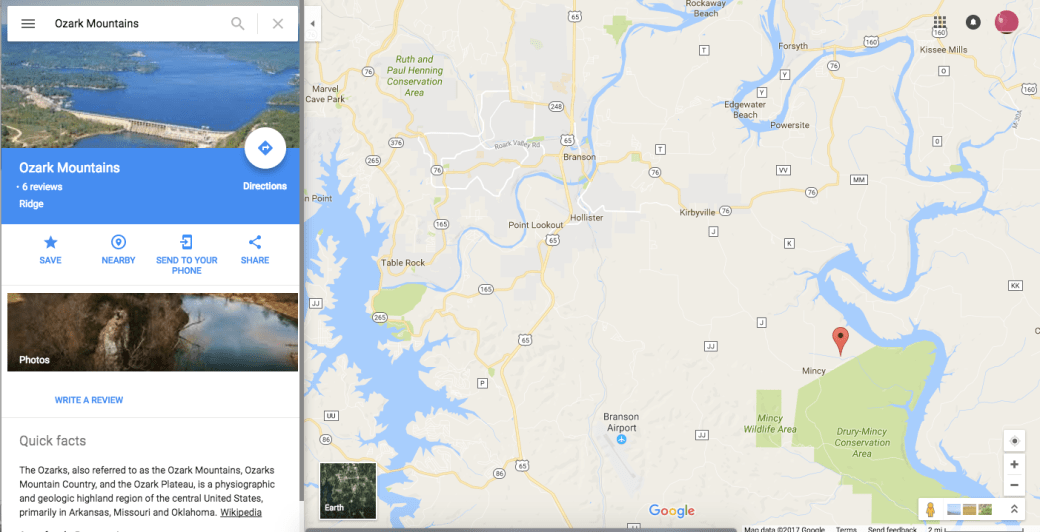
Nothing much there that seems to look like mountains.
If I thought my arrival would dispel this mystery, I was wrong. As I drove down into Missouri’s southwestern corner, the land around me remained flat but for brief, rolling hills. Cows mooed out across lonely fields; the earth was dusty and dry; grey trees clutched to the last of their crinkled brown leaves. And upon my arrival in Branson – a Bible Belt-inspired Las Vegas, Disneyland and Broadway musical mecca combined – I grew increasingly disoriented. Perhaps it was the inquisitive rooster and fork-stabbed bloody meatballs that urged me into restaurants, the celebrity-studded Mt. Rushmore with its plaster cast veneer, or the King Kong raging above the Hollywood Wax Museum, but I could never seem to figure out exactly where I was – or where I should be going.


Come hang out here! You know you want to.


When I finally set out to explore the Ozarks, they remained elusive. The most obvious location, Dogwood Canyon – overly accessible with its motorized tram, paved walkways and manicured lawns – was beautiful, but hardly felt wild. And when I followed my GPS to a hiking trail I’d identified online, it took me to the middle of a dirt road where I ground to a halt in a patch of dust, surrounded by dreary trees. There was no trail in sight. Defeated, I turned back to Route 76, with its flashing lights, imposing billboards and Titanic-sized, roadside entertainment.

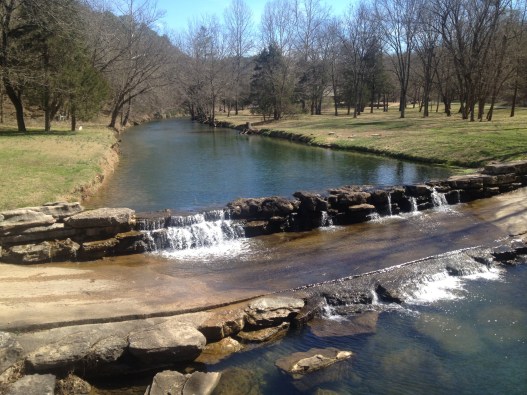
Streams and waterfalls in Dogwood Canyon.
In search of answers, I visited the Branson History Museum, where I viewed an hour-long film on the area’s history and culture. Many people had moved to Ozark country, the film explained, on the strength of a novel – “The Shepherd of the Hills,” written by Harold Bell Wright and published in 1907. The tale has since inspired a televised version as well as four movies – including a 1941 adaptation starring John Wayne. In terms of sales, the museum claimed, the book is second only to the Bible (a claim I was unable to verify).
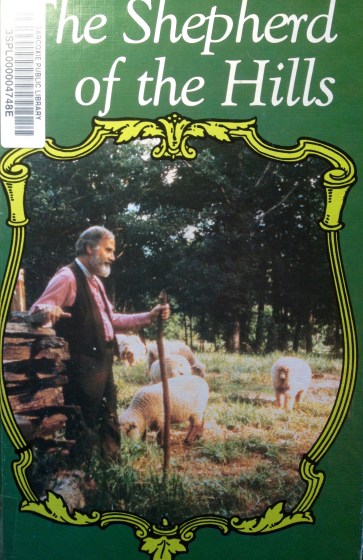
We left Branson several days later for our new home, two hours north – an ancient cottage outside the small town of Sarcoxie, built in the early 1800s. And once we’d settled in – María Lionza lounging comfortably in our shared “Lavender Room”– I ventured forth to the Sarcoxie Library, to find a copy.

The Sarcoxie library, which sometimes doubled as my office.

María Líonza and I reading in our Lavender Room.
“The Shepherd of the Hills” is a story that revolves around a mysterious, cultured stranger with a secret who leaves the far-off and nebulous “city” for the peace and beauty of the Ozarks, and quickly endears himself to the local mountaineers. The characters – including a strapping young man and his beautiful love interest, a whimsical young boy named Pete, and a sturdy, elderly couple – are said to have been based on the author’s own encounters with the region’s early mountain dwellers. Many of them – Pete in particular – encounter ghosts, and other unseen forces, on a regular basis. “A lot of people in the Ozarks still hold onto these superstitions,” the librarians told me. “They still believe in these things.”
Did these “things” include the mountains, I wondered? Because I still didn’t see them. Was I – like Mugatu – taking crazy pills? I’d been in Missouri a month when I finally worked up the courage to ask. As we drove into Springfield for ballroom dance class one evening, I took a deep breath and turned to my landlady – a sweet, retired schoolteacher named Candy. “OK,” I said. “Everyone’s always talking about the Ozark mountains. People call this Ozark country. But I simply don’t see any mountains. Where ARE they?”
Candy laughed at me. “Oh, they’re not really mountains,” she said, as though explaining things to one of her schoolchildren. “They’re more like hills.” I gazed out, confused, at the flat land all around me. What hills? “People say we shouldn’t call this Ozark country,” Candy added, referring to the area we were traversing between Sarcoxie and Springfield. “It’s not, really. But everybody does. It’s kind of a joke.”
Clearly, the joke was on me. The “Ozark Mountains,” I finally managed to ascertain, were, according to Wikipedia, “actually a high and deeply dissected plateau” covering most of southern Missouri, as well as parts of Arkansas and Oklahoma. They were also considered “by far the most extensive and mountainous region between the Appalachians and the Rocky Mountains.” Their highest point could well be the rolling hills I had navigated near Branson. So, as it turned out, the Ozark Mountains weren’t really mountains at all. Or were they?
I set out to explore them one warm winter day, as bold patches of yellow daffodils pierced through the grey landscape. The Hercules Glades Wilderness, northeast of Branson, is a 12,000+ acre area full of cedars, waterfalls, bald rugged hilltops and prairie-like grasslands. It’s Missouri’s oldest designated wilderness, and is said to be exemplary of the Ozarks’ unique ecosystem.

Spring flowers blooming in Dogwood Canyon.
As I navigated dirt trails covered in dead leaves, stood inspired before limestone cliffs and dry creek beds, and listened to wild winds in thick trees, I began to see the hills in a different light. They rose and fell like the earth’s steady breath – constant, present, reliable. Perhaps their grounded nature, their earthy presence – not their appearance – was what made them mountains. There I’d been, looking for the familiar characteristics of the West –green forests; jagged outcroppings of rock; snowy peaks that asserted themselves high above me. And as a result, I’d failed to notice what lay directly underfoot.
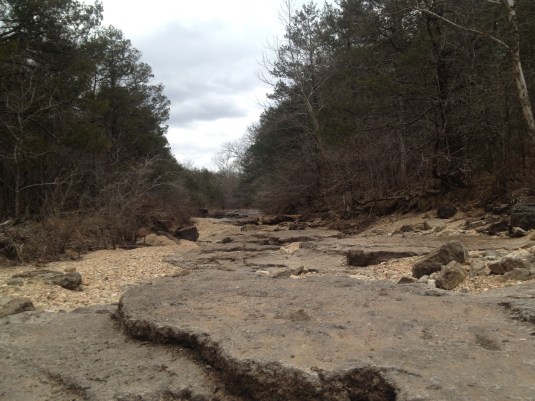
A dry creek bed in the Hercules Glades Wilderness.

A dead tree in the Hercules Glades Wilderness.
When I came upon a small, painted rock in a wide-open glade, urging me to “Be still,” I sat for a time, gazing out toward the distant hills. And I recalled Harold Bell Wright’s whimsical, misunderstood character – the young outdoor adventurer and enthusiast named Pete, a “wandering spirit of the woods and hills” who was more at home among the trees than beneath a roof.
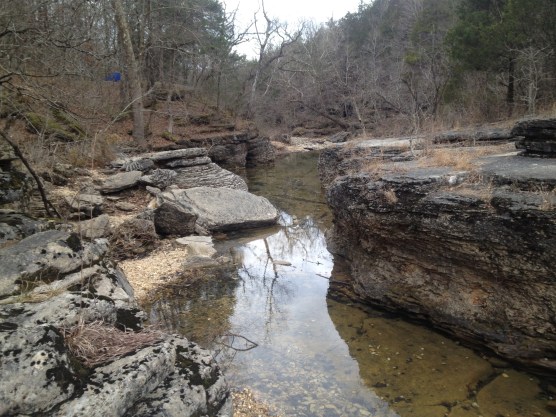
The Hercules Glades Wilderness.
“Here and there among men,” Wright wrote of Pete, “there are those who pause in the hurried rush to listen to the call of a life that is more real. How often have we seen them … jostled and ridiculed by their fellows, pushed aside and forgotten, as incompetent or unworthy. He who sees and hears too much is cursed for a dreamer, a fanatic, or a fool, by the mad mob, who, having eyes, see not, ears and hear not, and refuse to understand.
“We build temples and churches, but will not worship in them; we hire spiritual advisers, but refuse to heed them; we buy bibles, but will not read them; believing in God, we do not fear Him; acknowledging Christ, we neither follow nor obey Him. Only when we can no longer strive in the battle for earthly honors or material wealth, do we turn to the unseen but more enduring things of life; and, with ears deafened by the din of selfish war and cruel violence, and eyes blinded by the glare of passing pomp and folly, we strive to hear and see the things we have so long refused to consider.
“Pete knew a world unseen by us, and we, therefore, fancied ourselves wiser than he. The wind in the pines, the rustle of the leaves, the murmur of the brook, the growl of the thunder, and the voices of the night were all understood and answered by him. The flowers, the trees, the rocks, the hills, the clouds were to him, not lifeless things, but living friends, who laughed and wept with him as he was gay or sorrowful.”

Rock in the Hercules Glades Wilderness.
Pete, it seemed, had seen things differently from many of us. And, as the librarians in Sarcoxie had assured me, there were many who continued to do so today. Were the Ozarks mountains, or weren’t they? Were there many ways to see one thing, or was it a mistake to see many forms as one thing? The answer, it seemed, lay in the small, red stone; that admonition, placed there by some far-seeing stranger – some whimsical character, some elusive Pete – urging us to finally, for once, “be still.”


So good! And to think, I thought I needed to take a trip to find the mystery…. it’s right under these tired old feet. Happy trails, my friend!
LikeLike