I arrived at the Zen Mountain Monastery in Mt. Tremper, NY in late October, as the last of fall’s brightly colored leaves drifted from bare branches to the ground. After a whirlwind trip across the country – visiting a vet clinic in Watford City, North Dakota; farming vegetables in Hermosa, South Dakota; building wheelchair ramps and bunk beds on the Pine Ridge Indian Reservation; visiting the pipeline protest at Standing Rock; camping in parks and on roadsides in the northernmost parts of the northernmost U.S. states – I had deposited María Lionza at a “Cat Lodge” in upstate New York so that I could spend a month in residence there.


María Lionza living it up in her private suite.
The imposing grey building – built by a Catholic priest and Norwegian craftspeople in the 1930s – today provides a home and meeting place for a handful of monastics, some yearlong residents, and numerous weekend and weekly retreatants. Our group of eight, short-term “monthers” had joined them in a rigorous training program to experience traditional Zen practice and learn how to incorporate it into our daily lives.
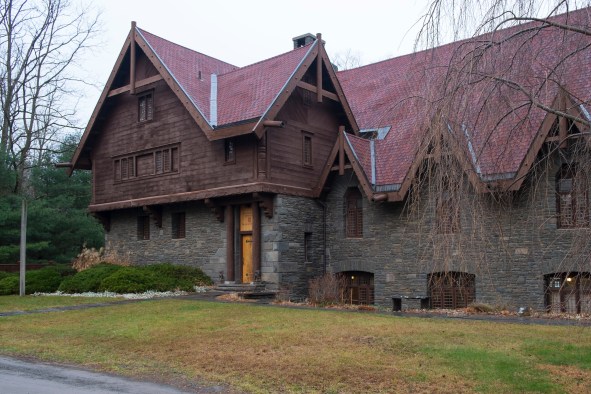
The Zen Mountain Monastery in Mt. Tremper, NY. Photo by Loo Lin – see more of her work here.
We were quickly absorbed into the monastery’s routine – a tight schedule that had us up early every morning, and seated in the zendo, wearing long, grey-blue monks’ robes, well before 5 a.m. We spent several hours a day meditating; the rest of our time was consumed by work practice, body practice, art practice, or preparing, eating (and cleaning up after) delicious, home-cooked vegetarian meals. By lights-out at 9:30 p.m., we were more than ready to collapse onto the wooden bunk beds in our hillside cabins, absorbing as much rest as possible before our alarms sounded again, a few hours later, ushering in yet another day.
I entered the monastery with the election looming, and when I told a friend, she laughed. “You’re getting Zen about it,” she said. “When people bring up the election, I’m going to tell them I have a friend who is literally getting Zen about it.” While I laughed along with her, I wondered: What, exactly, does that mean? Would I have immediate access to the results? Would we be sequestered away in silence, and come stumbling out of a dark grey meditation hall one morning to find the world an unrecognizable place? Would we discuss what the results meant – for us, for the country, for the world – or simply try to meditate it all away?
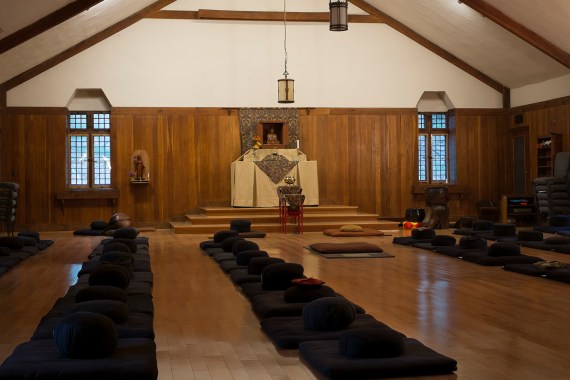
The zendo at Zen Mountain Monastery. Photo by Loo Lin – see more of her work here.
Regardless, I wasn’t too worried. While I’d long ago lost faith in politics, I was hopeful that Clinton would win. I’d read a scattering of news articles, followed a few polls, and submitted my mail-in ballot with weeks to spare. The results were assured, I told myself – despite what I’d seen during my drive through the rural communities of northern Minnesota, Michigan and Illinois: the Trump/Pence signs that sat planted in yards, hung boldly from billboards, and rose up along backcountry roads. Whatever America’s problems, whatever Clinton’s failures, whatever the issues at hand, I hoped – I believed – that a man who espoused such hatred could never hold our country’s highest office.
Many of the monastics seemed to share my optimism, and announced that they would be setting up a television in the community building for those who wanted to watch the results. Far from the isolated, offline environment I had imagined, the Zen Mountain Monastery – first founded as a Zen Arts Center in 1980 – provided an unusual mixture of silence, stillness, and connection to the outside world. I was impressed by the organization’s ability to balance a rigorous training schedule – one that adhered closely to ceremony, ritual and punctuality – with the inclusion of art and Chi Gong, as well as weekly time off to go hiking, attend to personal business, or even travel. I was impressed with the leadership’s and practitioners’ concentrated efforts to address racism, sexism and other issues – within themselves, within their community, and beyond the monastery’s walls – and inspired by the strong, grounded presence of the female monks.

Everything at the monastery was balanced and carefully cared for, as evidenced by this rock garden. Photo by Loo Lin – see more of her work here.
The weekend prior to the election, the other female residents and I had the opportunity to attend a women’s sesshin (meditation intensive). The gathering of some 70 female practitioners took place with the full support the men – who abdicated the building, cooked our meals, and otherwise assisted us – and was an incredibly powerful experience. Hojin Osho, who led the retreat, rearranged the zendo in the shape of a womb, and as we chanted a poem by one of her heroes – the badass 19th century Buddhist nun Ōtagaki Rengetsu – I found myself in tears.
The women at Zen Mountain Monastery chanting “Field of Wild Grasses.”
The opportunity to experience such a feminine gathering within a male-dominated tradition was not only profound and impactful, but also seemed indicative of the way our society at large was breaking down barriers to become more inclusive and connected; more willing to celebrate differences; more attuned to the benefits of diversity and balance.
So on the fateful night of Tuesday, November 8, I chose to go to bed, fairly confident of the results I would encounter in the morning. It was a shock, then, to wake up, break silence to check my phone, and find that Donald Trump – according to all reliable predictions – would be our next president. That morning’s meditation in the zendo was somber, solemn and emotionally charged. Afterward, when we had traipsed over to the community building for Chi Gong, I fought back tears as we went through the movements, wondering if I should escape to the bathroom for a good cry. I was heartbroken that we, as a populace, had chosen to embrace a leader who embodied such hatred, division and cruelty, and felt that an immense amount of suffering would result – not only for my fellow humans, but for the world in general.
After breakfast, after the announcement of the day’s work assignments, Hojin Osho stated: “A lot of us are feeling quite shell-shocked right now. So let’s just acknowledge that.” Later, in the afternoon, we met to chant the Karaniya Metta Sutta, and in the evening, we gathered in a circle, by candlelight; creating a safe space for people to share their feelings. And while we continued to sit, for hours – including a week-long intensive – on end, to encounter those places inside ourselves that were equally confused and divided, there was also much discussion of how to move in this new world, in Trump’s new America. Tables were set up to write letters to senators and other political representatives, defending civil liberties. One student, undergoing an elaborate ceremony to become a senior, gave a talk in which he suggested that there were times, in our current political climate, to stand up and not back down. “Yes, yes,” he said, referring to a koan he had been discussing, “can sometimes be a resounding ‘No!’”
I’d shared my own thoughts with one of the monks that morning, as we’d cleared pathways and weeded the garden. “I don’t think that we can begin to understand the implications of what we’ve done,” I told him. “All bets are off; anything can happen.”
“Absolutely,” he’d agreed. “And,” he added, “there are a lot of people out there whom we’ve failed to take care of.”
His words struck me. They rang in my ears as I left the monastery in late November. They echoed in my heart as I drove down through Pennsylvania, Virginia, Kentucky, Indiana – camping in cold forests populated by gun-toting men in camouflage, hunting deer and bear; men who treated me with nothing but courtesy and respect. I passed signs for Trump/Pence in all shapes and sizes; navigated through rusty red territories; sidled my way into rural convenience stores, aware that I was likely the only liberal there.

A campaign sign in rural Virginia.
And as I settled down into Missouri, my home for the next few months, I wondered about my new neighbors, my roommates – those who had voted, overwhelmingly, for Trump. How had we gotten here? Why had we, as a people, chosen this path, of all paths? What could I learn from such choices? What could I do differently? This, it seemed, was getting Zen about it – not only sitting on a cushion, focusing exclusively on inner revolution at the expense of engaging with the world outside, however interconnected they may be. Rather, it was making an effort to understand; taking responsibility for our own mistakes and delusions; working together; moving forward. And yes, sitting. But when sitting proved not to be enough? Standing up, giving voice, and refusing to back down.
_____
For another take on residency at Zen Mountain Monastery, check out Where is Loo?
 travels with maría lionza
Thank you for that look into your life and mind, and the monastery, at that time. Beautifully written!
LikeLike
Thanks for reading, Justin!
LikeLike
Pingback: Wake UP! | where is loo?