I celebrated my birthday among the slim cedars of McCroskey State Park, with sunlight easing down through bristly branches and enlivening the grass all around me. I turned 38 among trees that were easily double my age – trees that had found a home there, and would remain there for hundreds of years to come. As I sat in my camping chair – a $10 mishmash of plastic and fabric, made in China, María Lionza in my lap – I marveled at the cedars’ relative permanence; their friendly shade and ever-present generosity. I marveled at the bundle of fur curled up on my thighs; at the way this creature of another species, so bound to me, had traveled with me across continents, huddled next to me for warmth in sub-zero temperatures, and entrusted me daily with her life and livelihood.
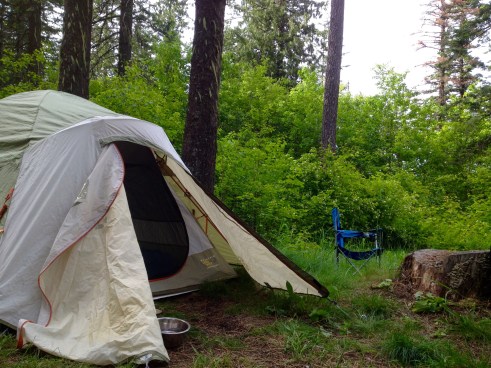
Our camp spot at McCroskey State Park.
McCroskey State Park was created by Virgil T. McCroskey, a local conservationist who amassed 4,400 acres on the slopes of Mineral Mountain – a transitional zone between the prairies and the Rockies filled with cedars, ponderosa pines, deer, black bears and other wildlife. When McCroskey approached the Idaho state legislature about donating the land to create a park in 1955, they declined – fearing it would only drain their resources – unless he maintained it at his own expense for the next 15 years. McCroskey agreed, and kindly kept his promise by living exactly 15 years more, to the ripe old age of 93. The result is a beautiful ridgeline retreat along a modest dirt road; a quiet place for fresh air, reflection and unorthodox birthday celebrations.

María Lionza keeps watch over our campsite – and my purse.
When María Lionza and I reemerged – somewhat reluctantly – a few days later, we found our way north, to Talus Rock Retreat, in Sandpoint. Nestled alongside Lake Pend Oreille in the Idaho Panhandle, Sandpoint is a mixture of beach town – pedestrians in flip flops; kids in bikinis; beach cruisers winding through traffic – and gateway to the wild. The lake is the fifth deepest in the U.S.; its shores are largely unpopulated, and it’s surrounded by national forests and the jagged peaks of nearby Rocky Mountains.
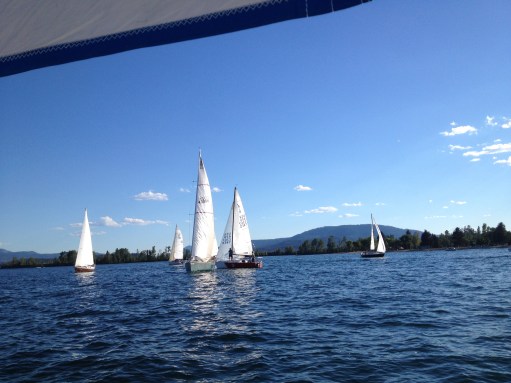
Sailing on Lake Pend Oreille.
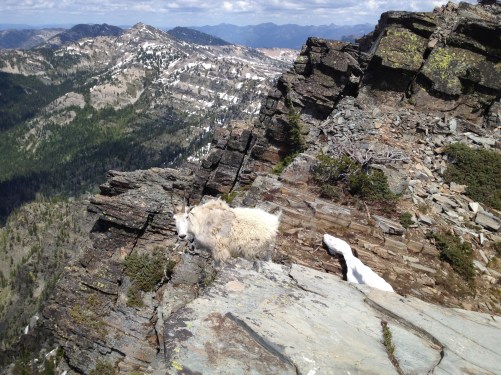
A mountain goat reigns over Scotchman Peak, in the nearby Cabinet Mountains – part of the Rocky Mountain range.
Just up highway 2, tucked away among 30 acres of woodland, Talus Rock Retreat is an eclectic lodging villa. The castle-like inn is furnished with items salvaged from surprising locales – two trees form a love-locked embrace near the fireside, and each self-styled room contains treasures hand-carried from around the world. Owners Bruce and Heather Pederson and their three children had full rein over the place for several months before converting their home into a business; now, they float between rooms or hang out in the garage, fondly known as the “Garage Mahal.” Guests visit to hold weddings, attend yoga retreats, or simply enjoy the luxury of a weekend getaway. The proceeds help to keep the place running, and to support Heather’s work with the International Children’s Network.
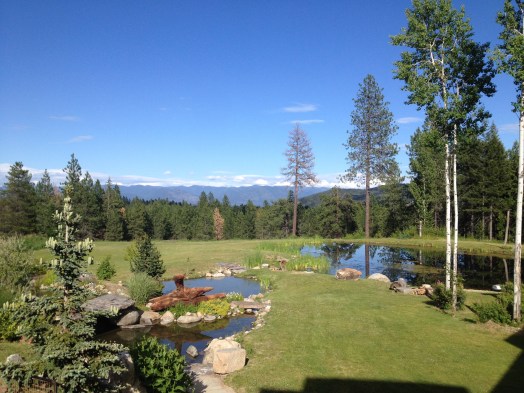
The beautiful grounds at Talus Rock Retreat.
Heather, as the property’s creative visionary (she designed the unique interior herself), had marked out a trail that covered much of its forested area. And soon, after I’d settled María Lionza and I into our small trailer, near the top of the property, Brian – one of the caretakers – and I began working to make her vision a reality. We soon settled into a rhythm – lopping off cedar branches; yanking up trailing blackberries and Oregon grapes by their roots; hauling birch branches off to one side. It was cool and fresh among the trees, and as we labored we sometimes chatted about religion, politics, or less contentious topics; others, we simply fell into silence.
As the days went on, I began to feel that there was something more to what I was doing, the manner in which we were uprooting the vines and branches and furnishing a clean, pine needle-cushioned trail through the woods. It felt as though I was clearing a path not just through the trees, but also through the thickets of my mind, or even that of our collective humanity – the increasingly volatile mix of political opinions and strife splashed all over my Facebook newsfeed; my own confused ideas about what was happening in the world. One night, I had a dream in which talking heads were loudly asserting their opinions all around me as I crept my way forward, uprooting one vine at a time, easing my way toward a place that was balanced and sane; a haven amid the mayhem; a respite from this topsy-turvy world.
One morning as we were working, on our knees in the dirt and our gloved hands grasping at the roots, yanking them from the soil, Brian asked me: “Do you ever think about the role of humans on the earth?”
“What do you mean?” I asked.
“Well, you know how everything in nature has its role – the trees, the plants, the animals – each species has its place in the planet’s ecology and serves a specific purpose. Do you ever think about how humans fit in – what our role might be?”

Human leave a temporary mark before old growth cedars at the Ross Creek Cedars in nearby Montana.
I considered the question. Immediately, I thought of all of the destruction and devastation that we cause; the upheaval and the violence; our tendency to push our own self-righteous agendas on others. I was having a hard time coming up with a way that we, as a species, had benefited the global ecology, or even one another. “I’m not sure,” I said.
“There’s a book called ‘Tending the Wild,’” Brian said. “It’s all about how Native American groups in California worked with nature to help it flourish. There’s this idea that Native groups didn’t do anything to nature, that they left it untouched. But in reality they were stewards of the land – tending the environment around them.” I thought back to McCroskey State Park, and to Virgil, who had devoted the last 15 years of his life to the park. “I think that’s what we’re here to do,” Brian said. “To take care of the planet.”
I looked around at the trail we were forging through the woods. Here we were, uprooting plants, severing tree roots and removing young seedlings. But despite the violence involved, the result would hopefully benefit the forest as well as ourselves. It would not only provide a cool path through leafy trees, a place for quiet reflection, but also create a space for the forest to interact with its human providers. Hopefully, this would encourage better maintenance and care; an improved relationship. “That makes a lot of sense,” I agreed. “I guess the tricky part is to tend nature in a way that serves it, without trying to change it into what we want it to be. After all, we humans have a tendency to do that.”
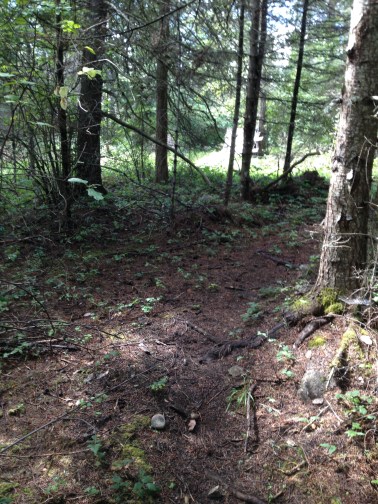
Trail-making at Talus Rock Retreat.
Later, I found the book Brian had mentioned, authored by Kat Anderson, at the Sandpoint library. But it languished on the small shelf in my trailer as I focused on other options: a stack of books on art and creativity, writing and Zen. One of these, “Wild Mind” by Natalie Goldberg – a writer I’d heard read in Taos – spoke to the very phenomenon I’d been considering as we forged our way through the trees. “If it is true that we are all interpenetrated and interconnected,” she wrote, “then wild mind includes mountains, rivers, Cadillacs, humidity, plains, emeralds, poverty, old streets in London, snow, and moon. A river and a tree are not unconscious. They are part of wild mind.”
Often, as we worked, we’d see wildlife – a spotted fawn; a curious doe; a mother moose with two young cubs. And one hot day in late July, near the end of my two months at Talus Rock, an orphaned raccoon found us – just a few weeks old, craving attention and care. We named him Hakuna, and he quickly became a family favorite. I spent my last two days there with Hakuna, and while he was in many ways still wild – attacking and biting me viciously when I tried to take away a sugary plastic wrapper – he was also incredibly affectionate. He would climb up over my shoulders, spread himself around my neck, and cuddle up on my lap to sleep. As I was preparing to leave, Hakuna followed me from my trailer to the car – back and forth, repeatedly, as I packed up my belongings. When I sat for a brief rest, he collapsed next to me, nuzzling up against my leg.

Hakuna – totally wiped out after a busy morning.
Our impact on the plants and animals around us is inevitable. Whether we’re aware of it or not, we’re constantly interrupting their environments – bringing them into our homes; making trails through their territory; relying on their presence for food or inspiration, labor or companionship. We are increasingly interconnected, and my relationship with María Lionza is just one example of that. When it finally came time for us to bid farewell – to Brian and his lovely wife Alex, to Heather and to Bruce, and yes – to Hakuna – we packed ourselves up into the car and headed north for the Canadian border. As we left town, I dropped my stack of books into the return slot at the library – including “Tending the Wild,” still unread.
Several days later, in Penticton, Canada, I searched for the book again at a used bookstore, but couldn’t find it. Instead, I came across Diane Ackerman’s “The Rarest of the Rare: Vanishing Animals, Timeless Worlds.” I’d long enjoyed Ackerman’s writings on the natural world, so I purchased her treatise in its place. Soon, I found myself enthralled by her poetic descriptions of endangered creatures and the unique environments in which they lived: Monk seals in Hawaii; golden lion tamarin monkeys in the Brazilian Amazon; short-tailed albatrosses, sequestered away on Japanese islands. She spoke to her own version of humans’ role in the natural ecosystem, of their responsibility to care for the plants and creatures around them.

“At some point, one asks, ‘Toward what end is my life lived?’” Ackerman wrote. “A great freedom comes from being able to answer that question. A sleeper can be decoyed out of bed by the sheer beauty of dawn on the open seas. Part of my job, as I see it, is to allow that to happen. Sleepers like me need at some point to rise and take their turn on the morning watch, for the sake of the planet, but also for their own sake, for the enrichment of their lives. From the deserts of Namibia to the razor-backed Himalayas, there are wonderful creatures that have roamed the Earth much longer than we, creatures that are not only are worthy of our respect but could teach us about ourselves.”
Her words rang true – not only for the rare, endangered species across the globe, but also for the various plants and animals we encounter regularly – and often automatically – in our own mundane, day-to-day existence. In the way that we tend to our gardens and care for our pets; the way we treat the young raccoon who shows up one day on our doorstep, or the decisions we make regarding the many creatures whose environments we inevitably disturb. (As I later learned, the family found Hakuna a home at a nearby rehabilitation center, where, I was told, he seemed happy among the other “orphans and misfits.”) It holds true in the way we navigate the many challenges that we face – socially, environmentally, politically, globally – as well as in the trails and roads we forge through forests, through our lives, through the thickets of our own conditioned minds. Trails we would do well to maintain, as Virgil T. McCroskey did, in the final years of his life, if for no other reason than to preserve a place of sanity; a home for cedars, pines, deer and bears; a place where the occasional human – and her cat – can find retreat.


Nicely put.Those are some books I’ll put on my list. “Wild Mind” made me recall the book “Mind and Nature: A Necessary Unity” by Gregory Bateson from around 1977. He argued carefully, eloquently and with some scientific rigor for how our minds follow similar processes that evolution does. That may seem obvious, but historically many thinkers have tried to place mind as separate from nature.
LikeLike