When I was 14 years old, I picked up a book at the library that changed me. It had a faded paperback cover, and yellowed pages that explained in gruesome detail – made more vivid by the accompanying line drawings – the horrific conditions on factory farms. How chickens were packed so tightly together they could barely move; how cows were left chained and covered in feces; pigs, stuffed together in sterile pens, suffered from constant anxiety. As an animal lover (and really, who isn’t?), I was appalled, and when we drove home later that afternoon, I turned to my mom and announced: “I’m going to be a vegetarian.”
And I was – for about a year, until the memory of those pages was swept aside by the more urgent desire to visit my aunt’s place, in Ontario, for the summer (I was told that I couldn’t go if I was a vegetarian, and so I was no longer a vegetarian). Somehow, after that, I didn’t give much thought to farm conditions – until years later, in adulthood, when I stopped eating most meat for health reasons, and kept at it because I’d recalled what I’d first learned on those yellowed pages at the library. I didn’t have a problem with killing animals for food – after all, animals everywhere kill one another for food – but I recoiled at the thought of their constant torture; the absolute lack of respect we often demonstrate for the very forms of life that sustain us.
When I arrived at the Becker Family Stock Farm last October, I still didn’t eat much meat. But as I told Sonja Becker in our telephone interview, “I’d probably eat what you’re producing.” Knowing that the animals were living freely and happily and cared for – grazing on fertile land; roaming greedily, healthily, in the open air – I didn’t see why I’d have a problem. And I didn’t. When Hank, the pet pig who’d grown from a bottle-fed runt to a full-sized adult, went to the butcher’s shortly before Christmas, I went to scratch him one last time behind the ears, gave him one of the Christmas cookies I’d just baked and bid him an admittedly sad farewell. Later, when I mentioned that I was eating some of Hank, Sonja asked how it felt to call my food by a name. “Strangely good,” I answered, realizing that it was true. “Much more personal.” Eating a “Hank sandwich,” as I found myself calling it, was unexpectedly heartwarming, knowing that it came from a creature that I’d loved and cared for myself – a creature whose bright personality and eager appetites had been given a place and a time in the world to flourish. As Sonja explained, when people asked her how she could eat an animal she’d named, her response was: “How can you eat one that you haven’t?”
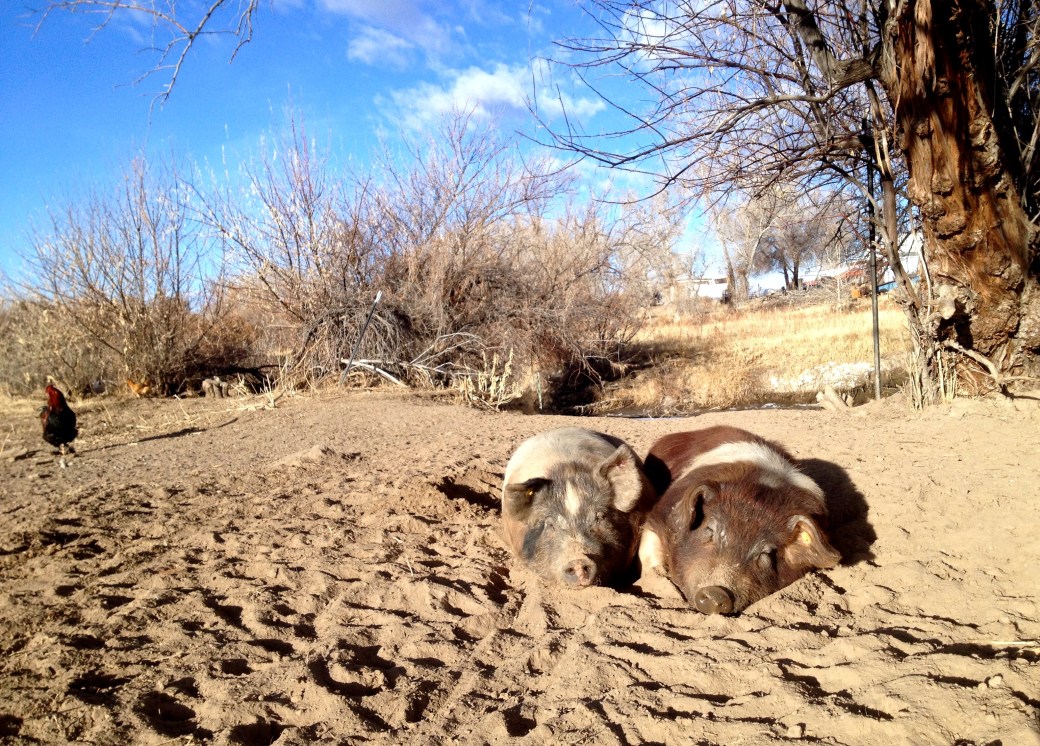
Happy pigs, sunning themselves near the creek.
I’ve always felt that if I was willing to eat something, I should not only try to ensure it had been treated humanely, but I should also be willing to kill it myself. So when Sonja asked if I wanted to sit in on a “kill day” at the local butcher’s, to see how they did it, I said yes. The Wind River Processing company hovers in a low building up on a hill near the edge of town. When I arrived early one morning, wearing rubber boots and a grim expression, Wayne the butcher greeted me and ushered me inside, to where the process was already in full swing. One cow stood in a narrow chute; a man in a floor-length black apron used a bolt gun to the back of its head to knock it out. The cow dropped to the ground, still thrashing but clearly unconscious.
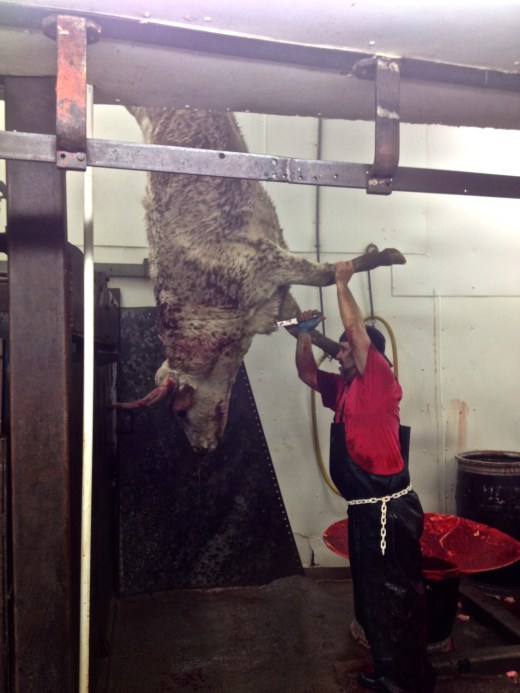
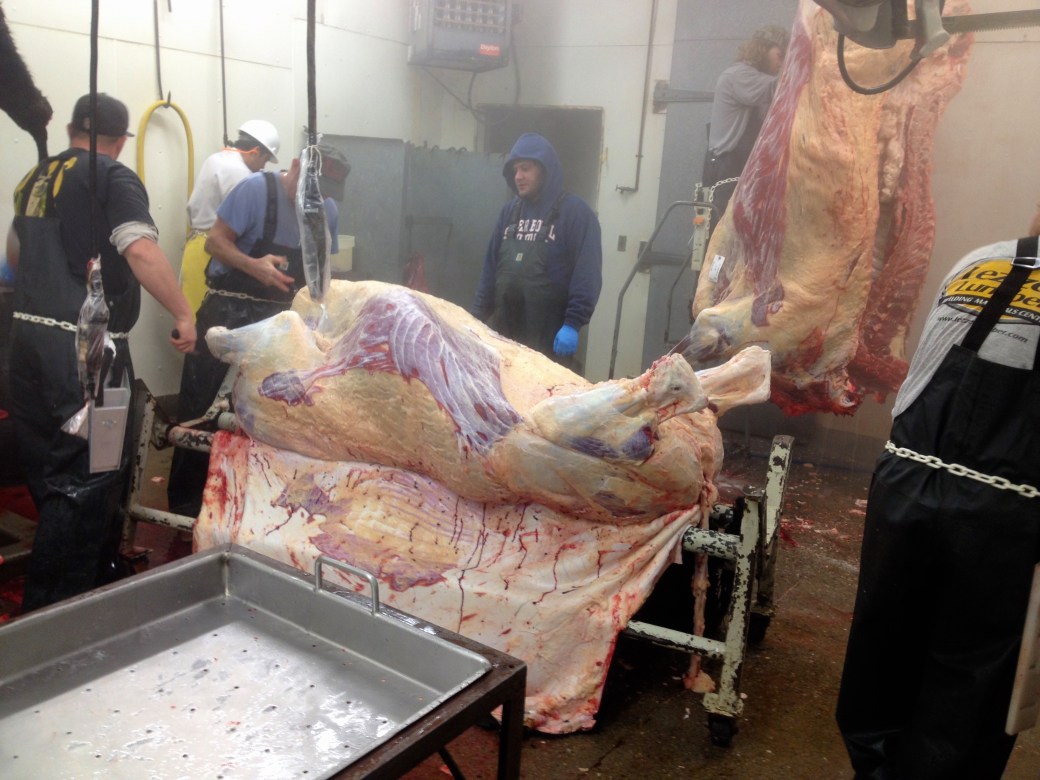
Next, the same man hung it upside down by its feet, and slit its throat, bleeding it out into a large rubber bin and removing the skull. Then, it was laid flat on a table, and several others skinned it and removed its feet before hanging it once more so that it could be gutted. The gutter [my term] removed the hay-filled stomachs in one piece, and dumped them – along with the intestines, and other offal – into a cart that he wheeled away to dispose of elsewhere. He then sliced the cow in half using a saw suspended from the ceiling.
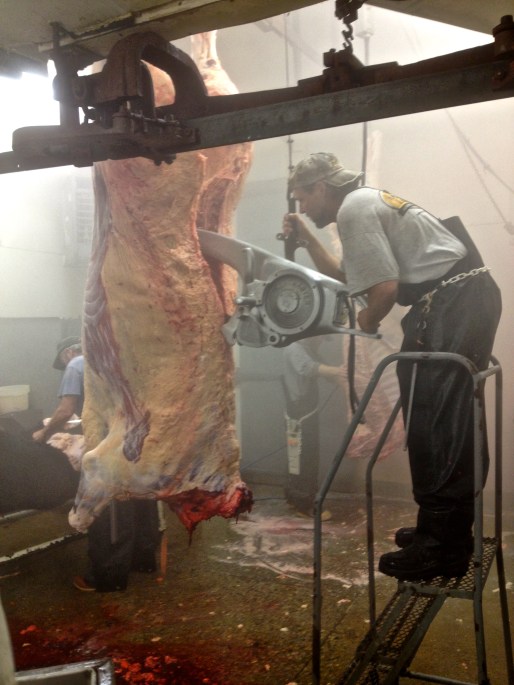
Yet another man washed the two halves down with a hose, removing any remaining skin or other unwanted bits, and then slid the halves, still hanging, into a freezer to chill. Then, the chute’s back door was opened, and another cow ushered in – one that had, just moments before, been sitting on the straw in the barn outside, chewing contentedly on its cud.
Though I watched this process several times, and had participated in similar processes before – we’d butchered the farm’s turkeys ourselves, prior to Thanksgiving – it never failed to amaze me how quickly an active, breathing creature went from a live animal to a hanging slab of meat. The speed and efficiency of the process said much for its humanity; there were only a few short minutes when each cow was left standing in the chute, nervous due to the unfamiliar nature of its surroundings. One of the men would often wave a hand in front of its face – to distract the cow, to calm it, to take its attention elsewhere – and sometimes, in my desire to ease its anxiety, I ended up taking over the job. As a result, I would find myself gazing directly into the animal’s eyes during its final moments of life – a moment of connection, dissolving into nothingness.
It’s been said that farming puts you face-to-face with death, and I’ve found that to be true. The butchering is just one example; a farm animal can be lively and rambunctious one day, and the next, it can go downhill before you realize what’s happening. Most often, most tragically, it’s the babies – there’s a reason many animals have litters, and it’s because not all of them tend to make it. When a chicken hatched nine eggs out in November, only half of her little fluffballs survived into adolescence. When I brought Thelma – a tiny malnourished piglet – into the house in an effort to mother her back to health, she perked up for a day or two and then plummeted, passing away shortly after. Her sister, meanwhile, simply disappeared one day – all we could surmise was that she’d been trampled, and then buried in the pile of dirt that her mother had been using as a nest. Sometimes, gruesome tactics are necessary to save a life – when one lamb dies, and another needs a mother, farmers will employ a procedure known as “jacketing” to save the orphaned lamb. They take the dead lamb, cut off its skin, and put the bloodied shell over the live one so that the adoptive mother will accept it. This may sound like something from a horror film, but it does the job – and saves a young lamb’s life.
And that’s the thing on the farm – no life, no matter how small, goes wasted. We’ll drag in road kill – deer, and rabbits – to help feed the dogs. When Danielle, one of the milk cows, died unexpectedly, we cut off her legs for the dogs, and then I used the Bobcat to bury the rest of her in the compost pile. When another cow, Bella, lost her calf, the vet autopsied the body before she, too, went to the dogs, and the chickens pecked at the undigested hay spilling from her belly. Bella mooed loudly for hours, mourning the loss, and I tried to provide some comfort as I milked her each morning – some ground grain, some extra gentleness, a pat on one side. How does one comfort a cow? I wanted to believe that just recognizing what she was feeling had some small effect, but who knows.
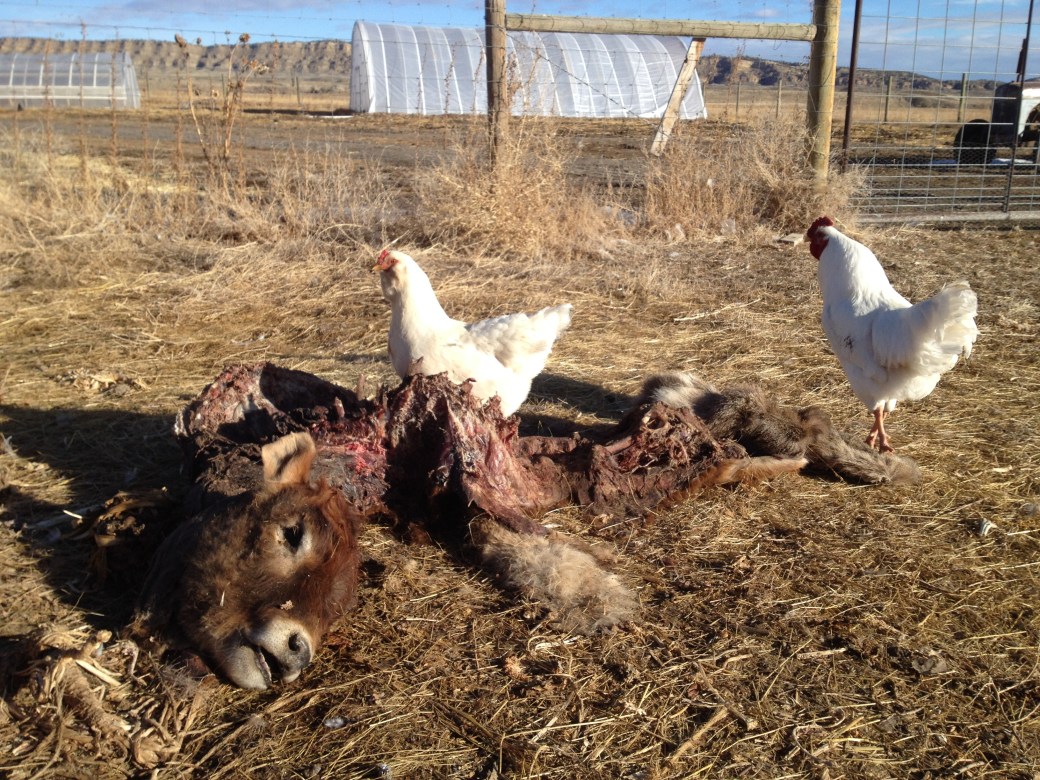
Chickens peck at the remains of Bella’s calf, most of which the dogs have already eaten.
And while it’s heartbreaking, somehow, strangely, there’s a beauty in it as well. In all of it – in the lamb encased in another’s bloody skin; the chicken clutching at its last breath in the straw; Bella’s lonely mooing, and the cow bleeding out at the butcher’s shop. There’s a beauty in it because it’s all part of the same cycle. We may be built and conditioned to only want to view one half of life’s cycle, but the thing about a cycle is that – well, it’s cyclical. It’s not static, it doesn’t stay in one place, and it doesn’t negotiate.
Because you don’t get to have one without the other. You don’t get to have life without death, or joy without sorrow. You don’t get to spend three beautiful days with a tiny piglet without taking the chance that you’re attaching yourself to a life that’s on its last legs anyway. You don’t get to find a newborn lamb an adoptive mother without bloodying yourself up to the elbows in the still-warm body of another tiny lamb. You don’t get to keep your creatures well-fed and happy without carting in the remains of dead plants and animals to sustain them; you don’t get to nourish your own body without participating in the deaths of many others. You don’t get to refrain from giving your own body in return.
And when we can recognize this cycle, as one is forced to do on a farm – embrace it even – we can start to appreciate it, to give each stage the respect that it deserves. To make conscious choices about where our food comes from, to look at how the plants and animals that feed us are treated at all stages of their lives – from their very first breath to their last. To look death in the eye, and realize that it’s only one part of the cycle, and that while it may seem final, it’s not – because inevitably, relentlessly, life will go on.
 travels with maría lionza
Beautiful! Also love those pictures of you on tractors.
LikeLike
Thanks Pei!
LikeLike