“I feel that there are too many realities. What I set down here is true until someone else passes that way and rearranges the world in his own style.” – John Steinbeck, Travels with Charley.
“Everyone in Taos believes in everything,” I told an anthropologist friend of mine as we chatted over Skype. He was showing me his 6-month old son, and his view across the Aegean Sea to Gallipoli. I was showing him the bunkhouse where I was living and the goats I’d just fed. It was 7:00 am in New Mexico; 4:00 pm in Turkey.
“Wait,” my friend said. “Did you just say that everyone in Taos believes in everything? That’s a great first line for an article. Now you just have to find somebody that you can quote saying it.”
“Great idea,” I said. But then, suddenly, I realized that I had a blog. Aha! I could just quote myself.
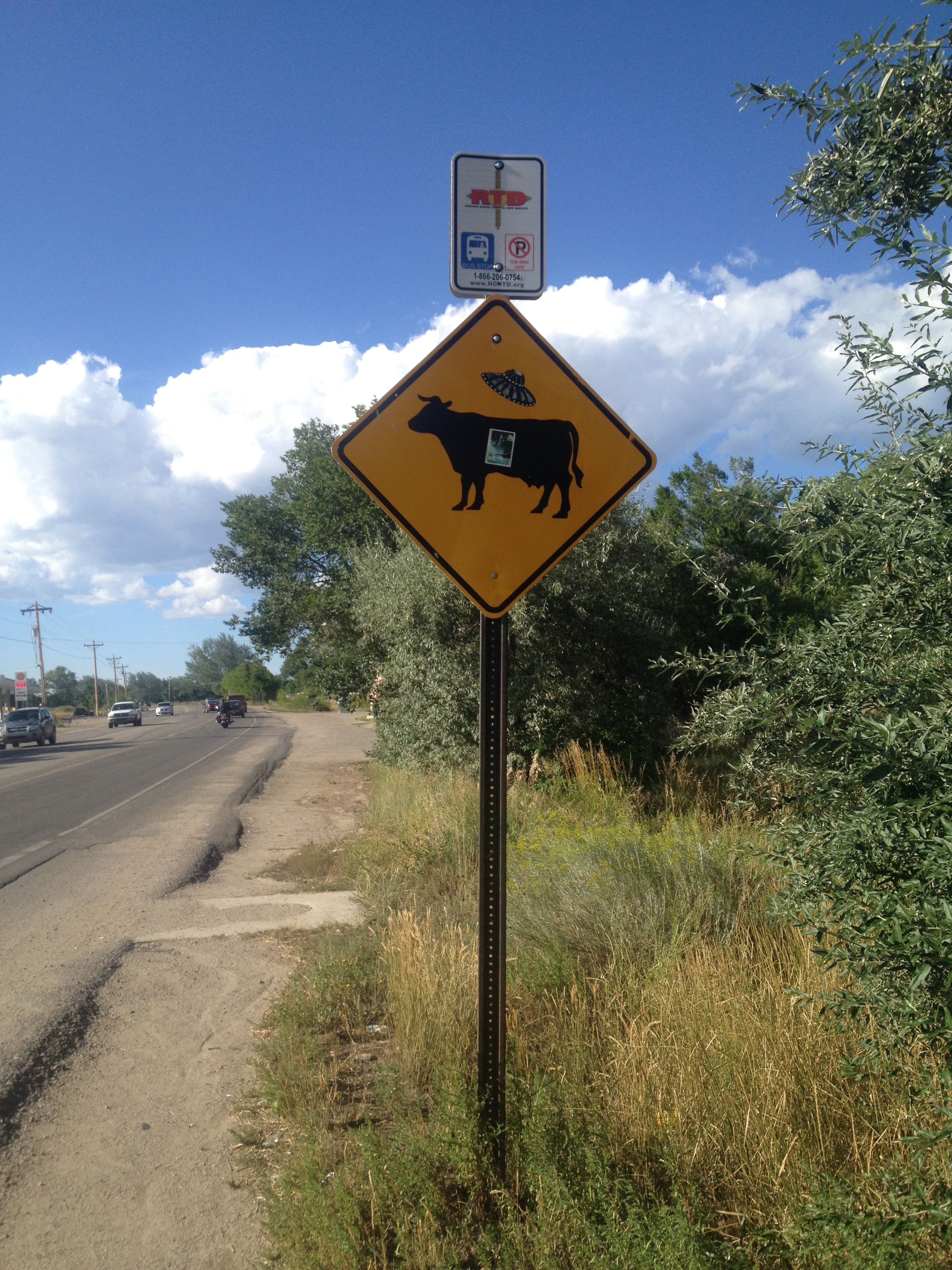
Cow crossing or UFO abduction?
And it’s somewhat true, at least – everybody in Taos kind of does believe in everything. Alien interventions, government conspiracies, Bigfoot, witchcraft – it’s all just par for the course. The roads around Taos are peppered with yellow, diamond-shaped signs with a silhouette of a cow at the center, to indicate that cattle may be crossing. While this may be somewhat normal, most are also plastered with stickers of UFOs hovering above the poor, unsuspecting beasts. Some believe it’s a prank, while others find it further indication that aliens are to blame for unexplained cattle mutilations. Conversations regularly veer into the supernatural and surreal – and never more often than at Eske’s, a local brew pub that boasts a lively bluegrass jam on Wednesdays.
(Plastic Jesus – one of many possible entities in which to place one’s belief.)
My first evening at Eske’s, we shared a table with a man dressed in a cowboy hat and jeans, who asked where I was from. When I told him California, he nodded in confirmation. “I can tell you’re not from here,” he said. “You’re too dressed up.” I looked down at my outfit – a striped shirt-dress from Target, a fleece jacket and oversized flip-flops. I was wearing no makeup, I hadn’t blow-dried my hair in weeks, and my toenail polish had grown out so that only my big toes were partially red. Still, compared to many of the locals – dreadlocked, bearded, and decked out in dusty thrift store finds – I guessed he could be right. He told me about his aerial photography business, and his efforts to fix up his house in Taos. Then, he moved on to the Illuminati.
“I’m not sure that I believe in the Illuminati,” I told him.
“Huh.” He snorted dismissively, one eyebrow raised. “Do your research.”
A couple of weeks later, a similar conversation took place with a man who identified himself as White Dog, a garrulous Pennsylvania native who’d recently moved out to the Mesa – the legendary, rather lawless stretch of cheap desert land west of Taos. White Dog had a scrappy beard, a well-worn hat, and plenty of strong opinions, including somewhat similar anti-government views. “Are you all up to date on the military assault on Bundy’s ranch?” he wanted to know. I told him that I wasn’t, so he filled me in on Cliven Bundy, a Nevada rancher who’s engaged in a long-term standoff with the BLM over the right to graze his cattle on federal land. “I was there, you know,” he said proudly. Then, he told me about moving out to the Mesa. He’d driven out there, map in hand, he said, following signs that read, “Land for Sale.” He’d pulled to a stop somewhere, and one girl came out of her house to ask him what he was doing. “I could see pretty quickly that she was a crackhead,” White Dog said. Nevertheless, he bought the land, and had since been living there, off-grid, largely avoiding his neighbors.
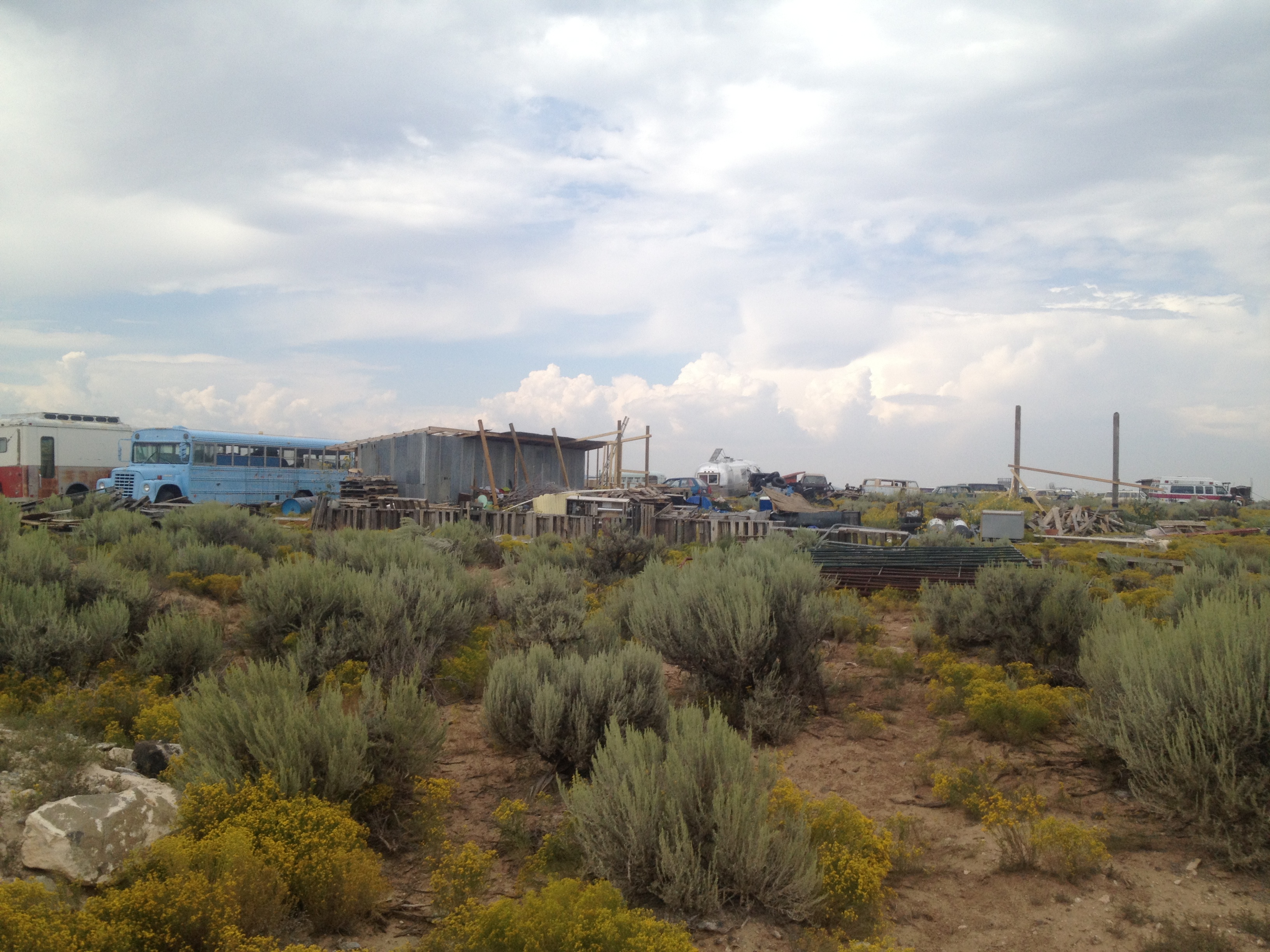
Wooden fences, old buses and shed-like dwellings – common sights on the Mesa.
If the Wild West still exists anywhere, it’s on the Mesa. Rumors abound – it’s said to be home to grungy hippies and criminals evading the law; a haven for writers, hermits, artists and outlaws escaping so-called civilization. Land sells for as little as $650 a 1/4 acre (people who purchased it years ago allegedly bought it for as little as $5). There are no building codes, no paved roads, and dwellings range from trailers to handmade hobbit homes to relatively upscale houses. Unless you have thousands of dollars with which to drive a well, the only available water is from a communal site. One adventurous Sunday afternoon, I joined several other farmworkers to visit Tres Orejas, or Three Peaks – one of the Taos Mesa’s three main subdivisions. We passed the Gorge bridge, where tourists pause to ogle down rocky walls to the Rio Grande far below, and pulled off the main highway; about four miles down, a sign that read “Evolve” was flanked by a few shreds of fabric flapping in the breeze.

The turn-off to the Three Peaks Mesa.
Easing onto the dirt road, we surveyed the post-apocalyptic scene around us. Colorful, mutant animal sculptures hovered amid patches of yellow chamisa flowers. Abandoned buses spotted the fields, and ramshackle fences protected residents from scrutiny. Behind one such fence, we could glimpse pieces of a broken-down trailer. Other dwellings were more carefully constructed, made of cement or adobe and boasting large, healthy solar panels. We drove up and down the main road, past a half-finished house with crows perched on its posts and bits of garbage littering the yard. A free pile of secondhand clothes sat next to a community board with a torn sheet lamenting a “Lost Dog.”

If you’re not sure where to go, this creepy pink finger will direct you.
Soon, we realized why it felt so strange – there was absolutely no-one around. There we were, at 4:00 pm on a Sunday afternoon, and there wasn’t one person sitting outside on a porch; there wasn’t one person walking to their car; not one person, as far as we could see, gazing out from behind the cracked window pane of an old school bus. The Mesa, it appeared, was the epitome of a desolate wasteland. In a last-ditch effort to encounter humans, we stopped at the “Sky Café” – a trailer painted turquoise and decorated with phrases such as “Please sign your artwork” and “I love my life.” We approached the door and peered inside – it was like the residents had walked off one day and had simply disappeared (or – dare I say it? – had been abducted by aliens). There was a thin layer of dust over everything, and even the water tank was dry.
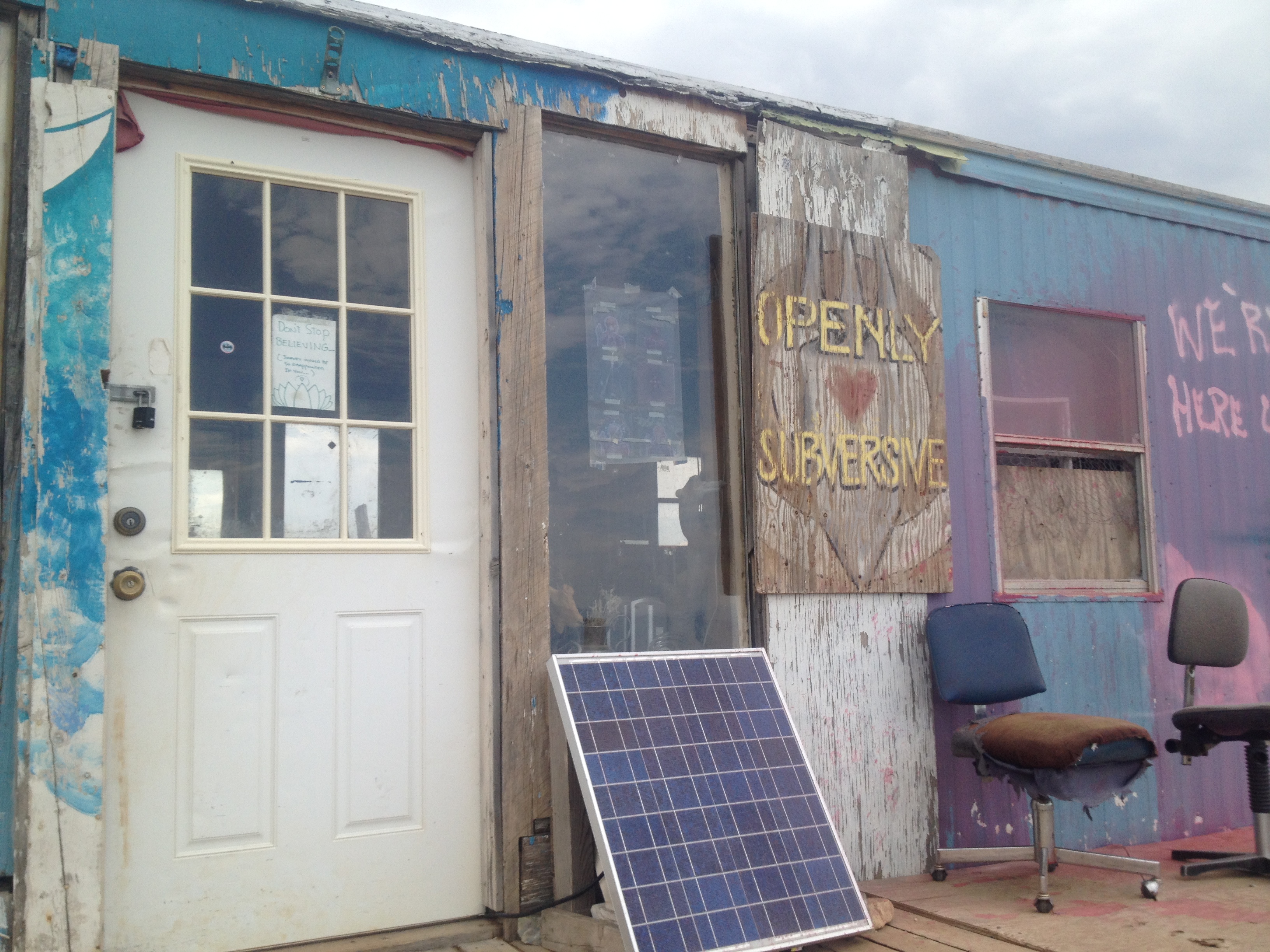
The abandoned Sky Café.
What had happened there? Taos is said to be a place that welcomes some, and quickly drives others away. “The mountains either like you or they don’t,” I’d been told. Another person had informed me of the Taos Hum – a small percentage of people in Taos, he explained, experience a grinding, low-level hum in their ears, and the noise has forced many to flee. “Maybe it’s the land defending itself,” he said. “Maybe that’s how it decides who can stay and who should go.”
I, for one, didn’t have any answers. But the longer I stayed in Taos, the more its strange beliefs began to feel normal – after all, in Taos they were the norm. Perhaps they weren’t so strange after all. Perhaps they were no stranger than the idea that everyone should follow a similar trajectory in life – that they should get an education, take on a high-paying job to pay for that education, buy a house, have children, drive to work every day, blow-dry their hair and keep their toenails freshly painted. Perhaps it made just as much sense to wear clothes from the free pile, buy land on the Mesa and get abducted by aliens. Who was I to say?
Regardless, one thing was clear – it was important that everyone adhere to some sort of belief. After all, people were counting on one another to conform, even if that meant not conforming. As the sign on the Sky Café’s locked door admonished: “Don’t Stop Believing. Journey would be SO disappointed in you.”
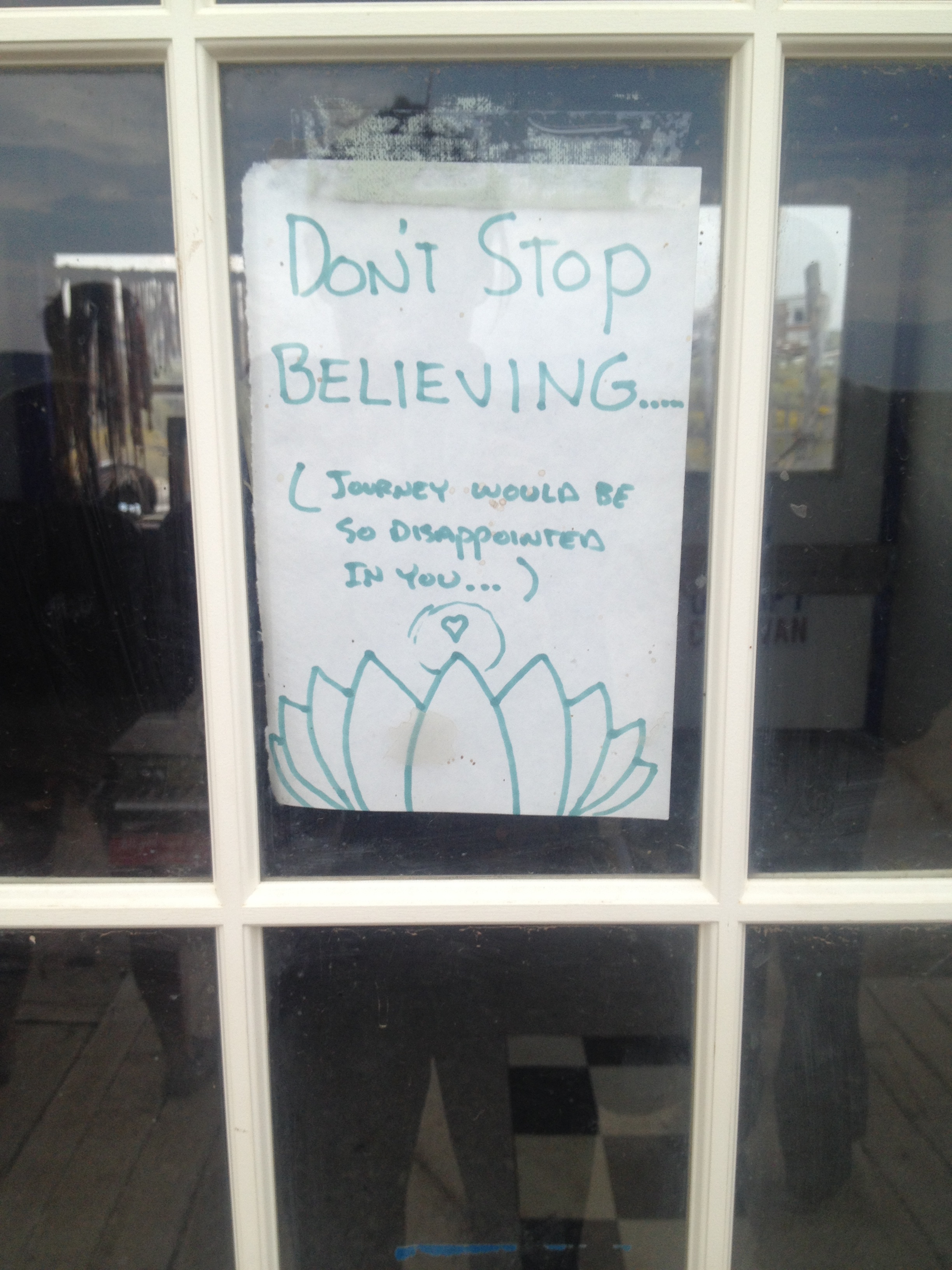
Sign on the abandoned Sky Café.


Wow! It really is the Wild Wild West. You definitely are encountering a lot of people who are making their own unique paths in life and are very interesting. I’d like to go to Taos. I wonder if they would take to my theories about Beyonce’s life…perhaps not. But maybe I would adopt some of their beliefs about aliens. I loved reading this post! And I’m glad it allowed you to quote yourself because it was a wonderful quote 🙂
LikeLike