“Oh, we can populate the dark with horrors, even we who think ourselves informed and sure, believing nothing we cannot measure or weigh. I knew beyond all doubt that the dark things crowding in on me either did not exist or were not dangerous to me, and still I was afraid. I thought how terrible the nights must have been in a time when men knew the things were there and were deadly. But no, that’s wrong. If I knew they were there, I would have weapons against them, charms, prayers, some kind of alliance with forces equally strong but on my side. Knowing they were not there made me defenseless against them and perhaps more afraid.” – John Steinbeck, Travels with Charley.
María Lionza and I left Oakland one hot summer afternoon, only five hours later than planned. We piled our few remaining belongings into the yet-unnamed Honda Civic, and meandered our way along the traffic-congested 580-E and down the I-5 south toward Los Angeles. We passed yellow, drought-stricken hills, relieved only occasionally by the muted green of cornfields and grapevines and almond groves. Near Fresno, signage bellowed its support for agriculture during what has been California’s worst drought on record: “Is using water to grow food a waste?” demanded one. Another, slightly more poetic, mused that “Food grows where water flows.”
“What do you think, María?” I asked, and she responded with a single “Mew” from inside her carrier. Drought-caused desert gave way to actual desert as we entered the Mojave. Cacti spotted the sands and red rocks loomed against the blue and purple of the sky. By the time we were approaching Las Vegas, night had draped the horizon, and the freeway had become tighter and more crowded, blocked at intervals by large semis. María Lionza and I were both anxious to get out of the car, so I navigated my way eagerly toward Afton Canyon Campground – a site that I’d chosen for its good reviews, pleasant scenery and convenient location. As we pulled off the freeway and onto a dirt road – something of a surprise – I reassured María Lionza, who was growing more restless: “Don’t worry, we’re almost there.” She mewed loudly in response, and though I didn’t realize it at the time, she was almost certainly telling me I was wrong.
The road was empty and dark. The further we got from the freeway, the rougher and bumpier it became, and María Lionza jostled back and forth in her carrier. I tried to calm her as I navigated the potholes, soon realizing that we were far past the 0.3 miles that my directions had indicated. They must have been referring to the canyon’s entrance, not to the campground itself, I realized, and briefly considered turning around – but we had already come this far. Then, I saw something that made my stomach drop. In the middle of the dirt road there stood a single man with a flashlight, waving it back and forth in an indication to stop. Behind him hovered the silhouette of a van, flanked by several shadowy figures.
As a solo female traveler, there is always an extra layer of fear when encountering the unknown. I’ve passed hours in useless rehearsal of what I would do if a predatory man came upon me living alone in my tent. I’ve traveled with pepper spray, and I’ve used it. I’ve punched a guy in the face, and I’ve had to fight a guy off and run. I’ve spent bus and train rides scrunched up against windows and away from overly friendly men. I’ve been offered a ride to Paris from a Greek truck driver – one that I had no intention of accepting – whose Greek truck driver friends warned me that he was not, in fact, going to Paris. A single woman traveler must rely on her instincts far more often than usual, and must come to terms with the fact that situations will arise for which she simply cannot be prepared.
As I approached the man I slowed to a stop and lowered the window, watching for any indication that I should make my escape. I was immediately relieved by his bright, cheery attitude. “Good evening!” he said. “Are you going to the campground?”
“Yes,” I said warily. María Lionza responded with another “Mew” of protest.
“I’m sorry, we’re conducting a military exercise right now, so you’ll have to wait it out,” he said. “It’s just about to start. I wouldn’t want you going in there and getting shot at, even though they’re not real weapons. I mean they are real weapons, but they’re not real bullets.”
“All right,” I agreed. I realized that the shadowy guys by the van were decked out in full military gear, including machine guns and night vision goggles. As we waited, the sound of gunfire spattered through the night.
“Do you come here often?” I asked. Then, realizing that it sounded like a pickup line, I added lamely, “for training, I mean.”
“It’s our first time out here,” he said. “I didn’t even know there was a campground. How did you find it?”
“Google.”
He looked at his watch. “They should be finishing up by now,” he said. “There’s 30 of them and they only have to take out 10 guys.”
“Well the 10 guys are doing pretty well then, aren’t they?” I asked.
“I guess.” He seemed unimpressed. “They’re just defending.”
Slowly, the gunfire came to a halt, and one soldier passed us on his way back to the van. “Hey, you should take a selfie with that guy!” my new military guide told me.
“That’s all right,” I said. Then I reconsidered. “But maybe I could try on his night vision goggles?”
“Probably not, they’re attached to his helmet. But it looks like they’re finished. Why don’t I escort you down the road? It rained this morning and it’s a little rough down there.”
He climbed into his SUV and as I followed behind him, it became clear that “a little rough” was an understatement. Loose sand spun from my tires, and thick mud gripped at the wheels. Just before the campsite, a wide puddle threatened to halt us for good, but we made it through, only to encounter another guy with a flashlight standing there and waving me over.
“You’re staying here tonight?” he said. “All alone? It’s pretty far from the road.”
“I’m not too worried about being alone,” I told him, realizing as I said it that it was something of a lie. It was true that I’m usually OK with camping alone. It wasn’t true that I was always OK with camping alone, especially when strangers knew I’d be there camping alone – even when those strangers were helpful, friendly soldiers such as himself. “I’m more worried about the road,” I amended. “I wasn’t expecting it to be that bad.”
“Yeah,” he agreed. “We had to pull a truck out of there this morning. And it might rain again tonight.”
“Huh,” I said, looking down at my little Civic. “And this is not a truck.”
“No, it’s not,” he said.
It was somehow comforting that we had agreed on the obvious. I pulled my phone out to check the weather, and the first headline that came up was: “Storms Bring Flooding in a Flash to Los Angeles, Las Vegas and Phoenix areas.” Not looking good. Next, I checked the campsite on my phone to see what else was nearby, and noticed a red marker that hadn’t been there when I’d first found it: “Permanently closed,” it read.
“So…I probably won’t stay here tonight,” I told him. I promised María Lionza that we’d find a cheap motel as quickly as possible, and we did – just off the freeway in Baker, Ca. The fact that it was a classy joint was made apparent by its name – “Motel” – as well as the roughly painted walls and the boldly advertised “Internet,” which turned out to be a guest password for the Wells Fargo bank. Regardless, María Lionza was highly relieved to exit her carrier and stretch her legs, and I was grateful for a hot shower and a bed.
The following day, we had barely gotten on the road when María Lionza began to protest her carrier. And who could blame her? With some trepidation, I set up the alternative – a large, foldable Japanese-made contraption that I’d ordered from Amazon, big enough to contain its own bed and litter box. After stopping for fuel I released her into the car, and with a little prodding and encouragement, she headed straight back into her travel box and remained there for the most of the journey, napping on her cushion or gazing out the front windshield at the wide, desert sky.
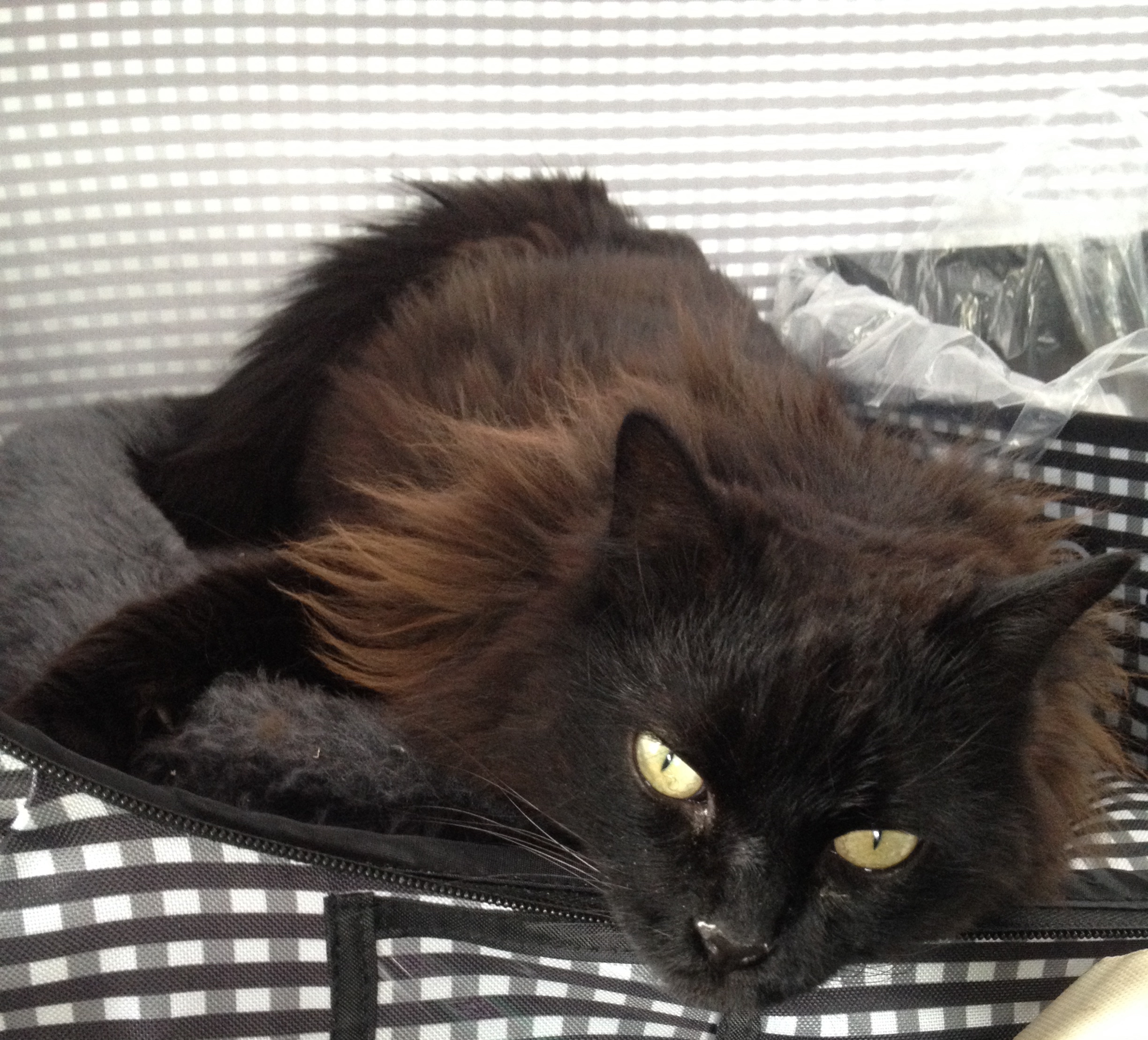
María Lionza chilling in her car travel box.
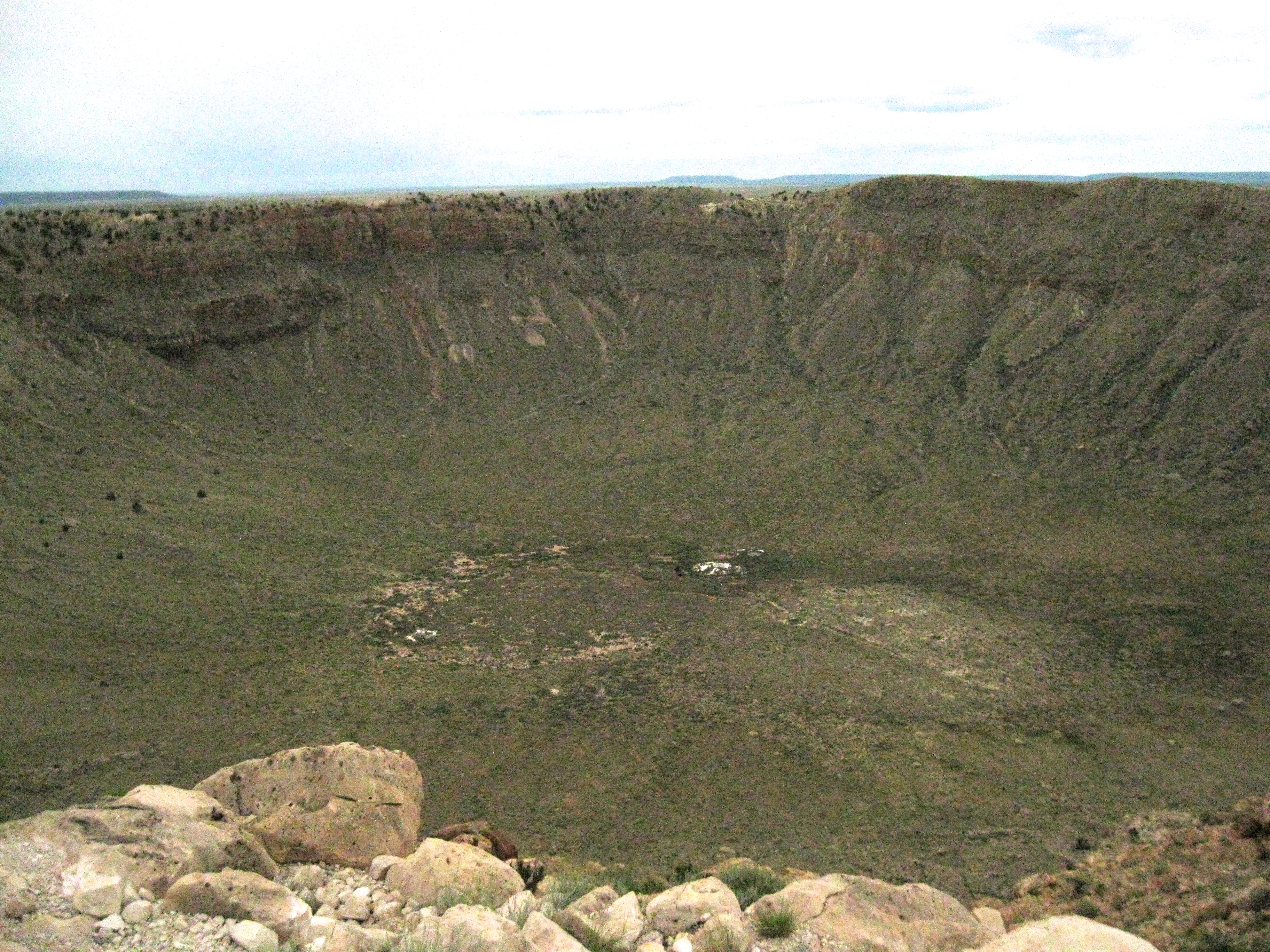
Meteor Crater in northeastern Arizona, caused 50,000 years ago by the impact of an asteroid traveling at 26,000 miles per hour.
We stopped briefly at Meteor Crater in Arizona, and by nightfall found ourselves on a long stretch of road approaching El Morro National Monument, empty save for the bunnies and rodents that scampered across it at intervals. It was nearly midnight when we arrived, and – too tired to cook dinner – I set up the tent, fed María Lionza, and collapsed into bed under a star-filled sky. We woke in the morning to bright sunlight and a cheery greeting from our neighbor, Emmet. “Hello!” he enthused as I stumbled wild-haired and sleepy-eyed from the tent. “When did you arrive?!”
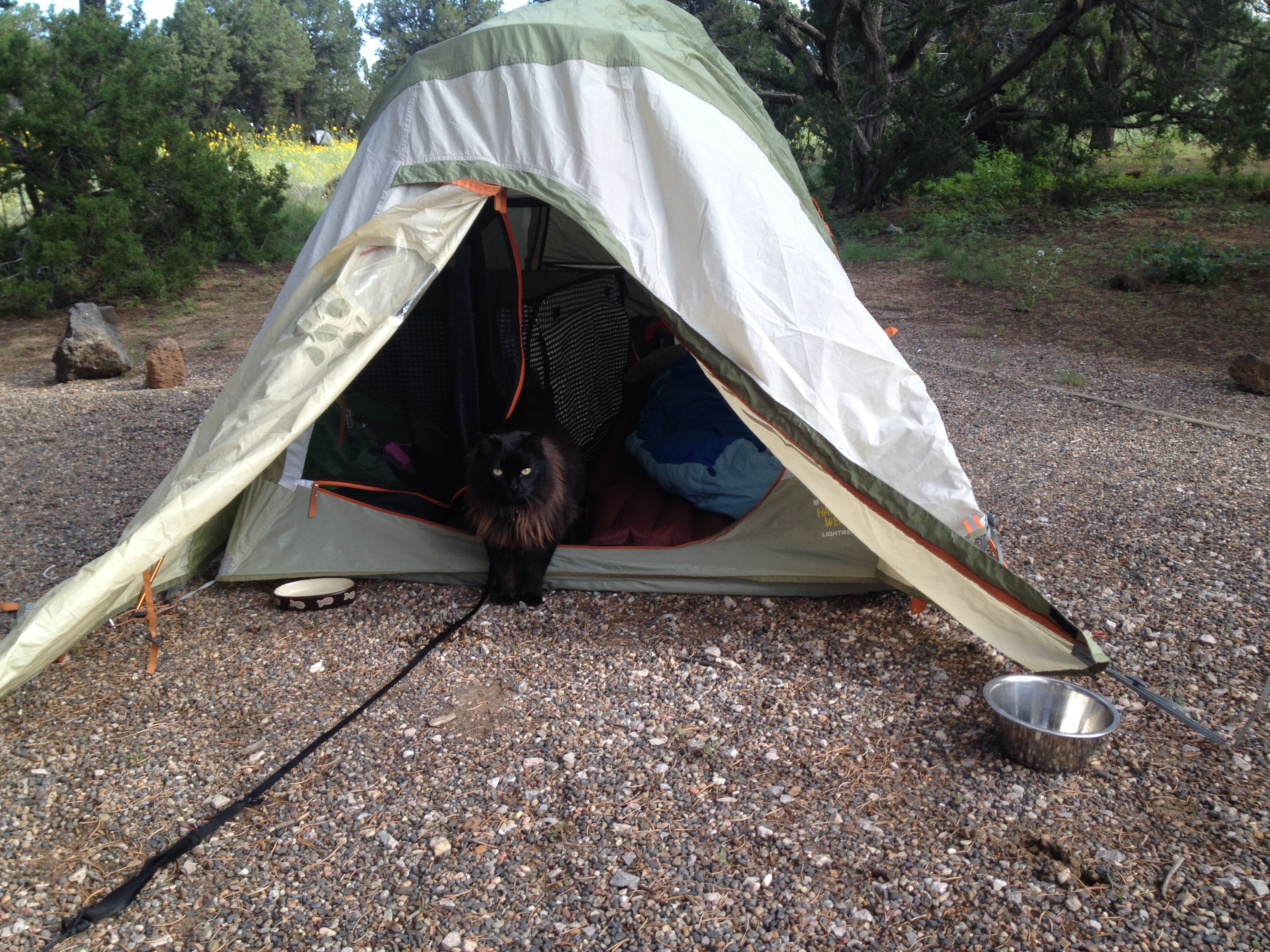
María Lionza steps out to explore El Morro National Monument in western New Mexico.
I explained that I’d gotten in late the previous night. Emmet commented on my tent (“What a great tent! What kind is it?”) and my cat (“In 53 years, I’ve never seen a cat camping!”). He then wanted to know if he could ask me a favor. Sure, I said. He walked over, cupping something in his hand, and offered me a seashell hanging from a piece of ribbon. “It’s a gift,” he said. “You know that when you give something, you are really the fortunate one, the one who receives. But you need someone to give it to.” I agreed and thanked him, and he donned his ankle-length robe and wide-brimmed hat, and headed off into the desert.
Thinking that I should return the favor, I took one of a small handful of crystals that I had with me – a piece of bloodstone, something I assumed he’d appreciate – and left it with a note on his picnic table. “Here’s a little something in return,” the note read. “Safe travels.” I had almost finished packing my car and was about to leave when Emmet’s voice sounded from the neighboring campsite.
“Hey!” he said. “Is this you?” I told him that it was. “Wow, I’m so glad I came back when I did,” he said, clutching the note to his chest. “It had blown off the picnic table and would have disappeared.”
“Oh good, well I’m glad I could return the favor,” I smiled. I picked up my remaining things and was on my way to my car when I realized that Emmet was again approaching, this time holding a string of beads.
“You don’t really wear beads, do you,” he said.
“No, not really.”
“Well, these are Navajo beads. They’re made of conifers – junípero, piñon – and they’re meant to protect you. They’re very special because they have six directions rather than four. They go up into the heavens and down inside of you.”
I thought back to what the monk had said about the mountains, about reaching into the heavens and the earth. “Thank you,” I said, accepting them. Small brown seeds were dispersed at intervals along four strings of white beads, splitting into six at the bottom. I wondered if I should give him something else in return, and imagined our exchange escalating, going on indefinitely until we were giving one another clothes and tents and suitcases and cars. Then I decided that that would be like the reverse of sharing a dessert and continually dividing it into smaller and smaller portions, so I took the beads and left it at that.
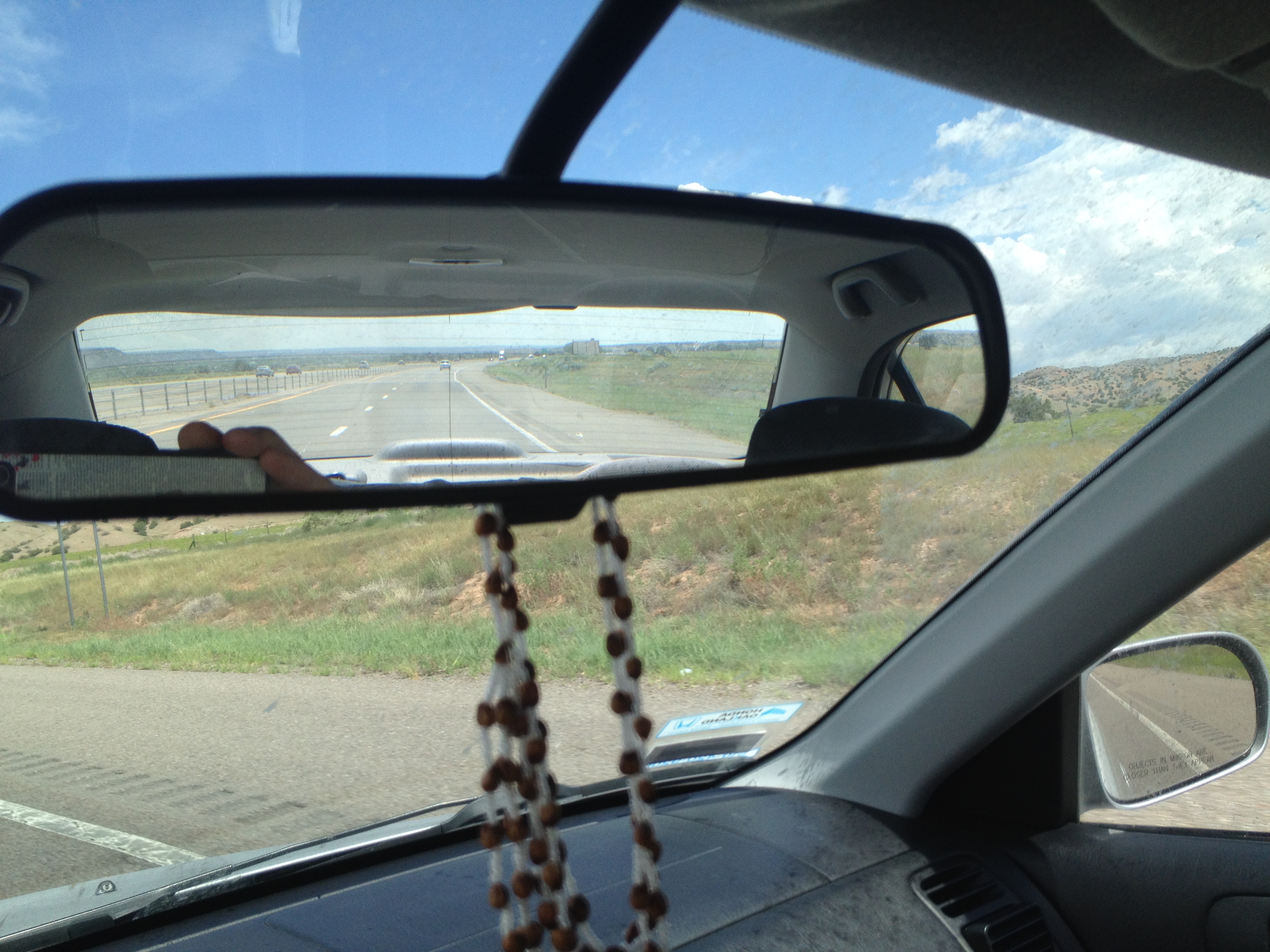
Navajo beads to keep us out of harm’s way.
As I drove off under the great New Mexican sky, the beads dangling from my rearview mirror, I hoped they would provide the protection that they promised. Regardless, I told myself, I’d be fine. I was hardly the first woman to travel alone – there was Martha Gellhorn and Emily Carr. There was Laura Dekker, the 14-year-old Dutch girl who had sailed the world solo. And besides, as my Dad had pointed out, I wasn’t alone – I had a companion. I looked back at María Lionza, lounging lazily on the back seat, and smiled.
 travels with maría lionza
I like the writing, don’t worry about us we’re doing fine, by the time Sept. 5th comes around Ninja will be ready for his checkup, We will write later and send you Claudine’s # in Taos, Old girlfriend, good people. Take care and remember this is the dream, this is just a movie, . Only your soul is real, and not everyone can see the real you.
My favorite view is of the ocean from the mountain. Ciao splendida, ciao bella, tanti aguri, arrivederchi, and Cheers! Mark & Ninja
LikeLike
Beautifully written Rachel! I can’t wait to hear more about your travels. You are still the coolest person I know! (Speaking of cats, I was going through my pics and I found one of Nick and the kitty we named Francine – remember her? I’m going to some more scanning soon, so I’ll send you some more pics soon). xoxo Amy
LikeLike
What a night you had! I’m glad you and Maria were okay. I had no idea the military does testing out in random places. The gift giving exchange with Emmet was sweet and touching. It also made me feel somewhat awkward as I imagined being in a similar situation of potential endless gift exchanges. The blog is very engaging and brings your experience to life. One of the best things about is I can hear your voice in my head telling the story.
LikeLike