The Mystery of Wyoming’s Giant Bones

Sometimes, when a mystery presents itself, there’s a need to investigate further. This recently happened to me, when I became fascinated with the giant bones of Wyoming.

The Thermopolis library is a small but friendly place, where they agreed to issue me a library card despite my lack of residency (“Oh, I know Sonja,” the librarian told me). It’s the only library I’ve seen that separates its fiction from its literature, and as it boasted only a few shelves of “literature,” I soon found myself gravitating toward first-hand accounts of life in the region by early timers such as “Buffalo” Bill Cody and various Native American peoples. In my reading, I came across two strikingly similar accounts of a “race of giants” that had occupied the area prior to the first Native Americans. The first of these, in “Buffalo Bill’s Life Story: An Autobiography” (copyright 1920), told this tale from the early 1870s:

“While we were in the sandhills, scouting the Niobrara country, the Pawnee Indians brought into camp some very large bones, one of which the surgeon of the expedition pronounced to be the thigh bone of a human being. The Indians said the bones were those of a race of people who long ago had lived in that country. They said these people were three times the size of a man of the present day, that they were so swift and strong that they could run by the side of a buffalo, and, taking the animal in one arm, could tear off a leg and eat it as they ran.”

IMG_0080

Portrait of Buffalo Bill at the Whitney Western Art Museum in Cody, Wyoming.

The second appeared in “Pretty Shield: Medicine Woman of the Crows” (copyright 1932):

“‘Did you ever hear that a tribe of very large people once lived on this world, Sign-talker?’

‘No,’ I answered.

‘Well, once when I was a girl, and our village was at The-place-where-we-eat-bear-meat [near the present Headgate] several of us girls walked up to The-dry-cliff. This was, to me, a strange place. A great herd of buffalo had some time been driven over the cliff, and killed by the fall to the rocks below. There were many, many bones there that told a bad story. And on top, stretching out onto the plains, there were long lines of stones in this shape [she made a V with her hands] with the narrow part at the cliff’s edge. These had helped to lead the running buffalo over the cliff. I have heard old women tell of such things being done before the horse came to the plains; and yet this herd of buffalo that went over The-dry-cliff may have been driven to death by another people.

The cliff was high, sloping in a little from the top. At its bottom were the bones, many, many bones. I noticed a dark streak on the face of the cliff. It was narrow and straight, reaching from the bottom of the cliff to the rim above. It looked to me as though the smoke of a fire that had burned there for many snows had made this dark streak on the smooth stone, and yet I had never heard anybody mention this. I could not keep my eyes from looking at this dark streak as we girls were walking toward it.

We had brought some pemmican, and I had my ball with me, because we intended to stay all day. The sun was past the middle when we began to dig with a root-digger at the bottom of the cliff. We were not looking for any particular thing. We were only playing. But our playing stopped suddenly when, in digging, we brought up a man’s skull that was twice as large as that of any living man; and with it there were neck-bones that were larger around than a man’s wrist.

We ran away from that place, and I was first to run. The size of the skull frightened me. Upon reaching our village I told my father what we had found. He said that he wanted to see the skull. We took him to the place, sitting off quite a distance while my father smoked with the skull. He said that it was a medicine-skull, and powerful. While we girls watched him my father wrapped the great skull in a buffalo robe and buried it.

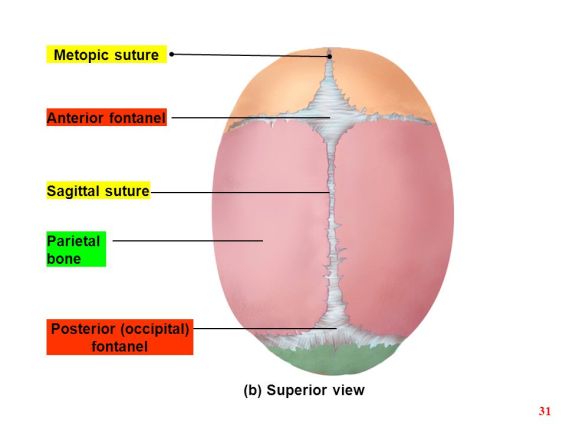
It was Shows-the-lizard who dug up that skull; and we found the blackened sticks of an old fire there, too. Yes,’ she said thoughtfully, ‘I believe that another kind of people once lived on this world before we came here. This big skull was not at all like our skulls. Even though I did not stay there very long I noticed that its seam ran from front to back, straight, with no divisions.’”

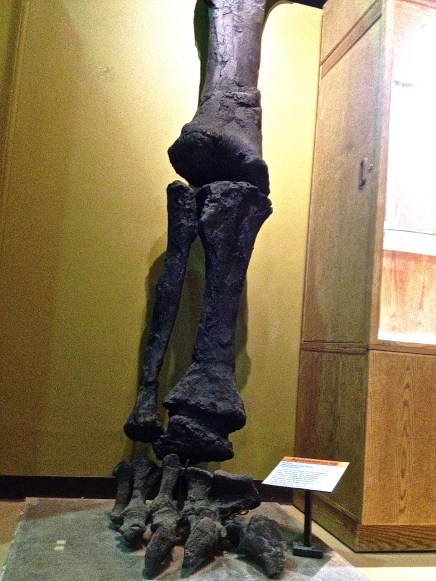
This was curious – the accounts came from similar time periods, covered similar geographical areas (Wyoming, Nebraska, Montana, the Dakotas), and reported similar findings. Why had I never heard of a race of giant people in the Northwestern plains? I began to ask around. One person suggested they could have been dinosaur bones – Wyoming is known for its massive deposits of dinosaur bones, and Thermopolis is home to the Dinosaur Center, where, during the summer, people can participate in excavations at a nearby dig site. (“Hmmm, ‘Shows-the-lizard,’” I thought.) But as I visited the center, gazing up at a cast of the second and most complete Supersaurus ever found – at 32 meters long, basically an Apatosaurus on steroids – I found it a stretch that someone would mistake a dinosaur bone for a human femur, and even less likely, a dinosaur skull for its human counterpart. Something else was going on.

IMG_0292

Cast of “Jimbo” – the longest scientifically accurate mount of a Supersaurus in the world.
 
IMG_0296

Apatosaurus replica. Apatosaurus means “deceptive lizard” because it was originally mistaken for a mosasaur. Could it also be mistaken for a giant human?

This was clearly a mystery that I couldn’t solve on my own. So I wrote to George Gill, professor emeritus at the University of Wyoming – an anthropologist and expert in skeletal biology. What could these accounts be referring to? He kindly responded, and agreed that both were likely reports of human bones. “I think that an early day surgeon would know a human femur when he saw one,” Gill wrote. “A lot of amputations were done in the old days! So, perhaps the bones brought in for examination were a mix of a human bone or bones and some other larger bones or fossils of large mammals or even dinosaurs. The surgeon probably had no comment on those specimens that he did not recognize.”

“Regarding the other story,” Gill said, “everything this woman describes seems to fit the archaeological and osteological record of our region. She obviously had encountered a Buffalo jump site from a previous era, and she knew what she had found! And I think that the skull she found was likewise from an earlier era. Some groups in Wyoming around 2,000 years ago and earlier did have much larger and longer skulls than the Late Prehistoric and later people of our region. I have documented this from the skeletal record in our area, and published on it in a few places.”

One such place is a dense tome called “Skeletal Biology and Bioarchaeology of the Northwestern Plains.” I ordered it through an inter-library loan (“Oh, you’re getting a fun book,” the librarian said) and checked out the chapter that Gill suggested. Sure enough, he had documented the skeletal remains from various sites, and had found that earlier specimens did have larger, longer cranial forms, and exhibited greater similarities with ancient Paleoamericans (such as Spirit Cave Man and Kennewick Man) than with the later Northwest Plains Indians. “Some of these also show a 10 percent frequency of the metopic suture (almost never seen on later Native American skulls) that joins the sagittal suture and makes a complete separation of the skull from ‘front to ‘back,’” Gill explained in his email.
 

slide_31

A skull showing metopic and sagittal sutures. A metopic suture occurs when the frontal suture fails to close in childhood.

So what did any of this mean? In his book, Gill suggested that the longer, larger skulls most likely represented “an isolated remnant of some earlier North American population that simply missed incoming migrations or other sources of later gene flow.” In short, they were likely an earlier people, and nobody is quite sure what happened to them.

But the Pawnee have their own explanation, according to Buffalo Bill.

“These giants, said the Indians, denied the existence of a Great Spirit. When they heard the thunder or saw the lightening, they laughed and declared that they were greater than either. This so displeased the Great Spirit that he caused a deluge. The water rose higher and higher till it drove these proud giants from the low grounds to the hills and thence to the mountains. At last even the mountaintops were submerged and the mammoth men were drowned.

After the flood subsided, the Great Spirit came to the conclusion that he had made men too large and powerful. He therefore corrected his mistake by creating a race of the size and strength of the men of the present day. This is the reason, the Indians told us, that the man of modern times is small and not like the giants of old.”

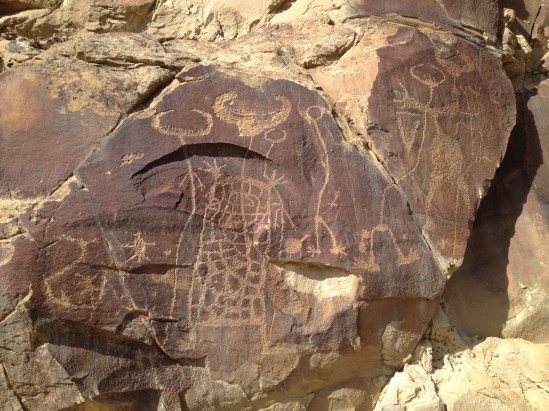
I was reminded of this story recently when visiting Legend Rock. The petroglyph site sits off of highway 120 down a long, dusty road. The looming red and yellow rocks overlook a relatively lush valley, with a gurgling creek and sprinklings of sagebrush – an understandable location for ancient peoples to make camp. I stood studying the drawings – anthropomorphic and zoomorphic forms depicting elk, thunderbirds and people with headdresses. Many of the drawings are in the Dinwoody style (named after the Dinwoody canyon in the Wind River Mountains) and are estimated to be more than 2,000 years old – the same time frame as the earlier peoples whose remains were found in eastern Wyoming.
IMG_0441

Human figures with horns and headdresses, in the Dinwoody style, at Legend Rock.

The Dinwoody style is characterized by large humans and small animals – as opposed to later drawings (beginning around 900 years ago), which show small humans and large animals. Does this change indicate an actual difference in human size? Or is it simply a change in humans’ way of thinking, a revised way of looking at the world; an appreciation of something bigger, a demonstration of respect?

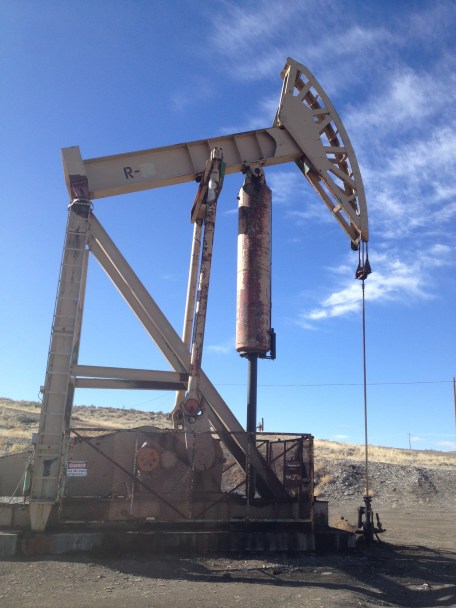
I didn’t have any answers. But it seemed apparent, from observing the world around me, that this sense of appreciation and respect had diminished in recent years – and in some cases, had all but disappeared. As I gazed across the valley to the hill opposite, where pumpjacks hammered down into the Hamilton Dome oilfields, I considered how powerful we humans had become, regardless of our size.
IMG_0462

A pumpjack working at Hamilton Dome, across from the Legend Rock petroglyph site.

Those that came before us left small drawings on rock walls, pits full of buffalo bones and a scattering of skeletal remains. What would we leave in our wake? How would the earth respond to our own intrusions? What would it take to bring us back down to size – a flood, a drought, some other climate change-induced disaster? Whatever it was, I had no doubt that the earth was more than capable of delivering – and I suspected that, quite likely, the process had already begun.


Life – and Death – on the Farm

When I was 14 years old, I picked up a book at the library that changed me. It had a faded paperback cover, and yellowed pages that explained in gruesome detail – made more vivid by the accompanying line drawings – the horrific conditions on factory farms. How chickens were packed so tightly together they could barely move; how cows were left chained and covered in feces; pigs, stuffed together in sterile pens, suffered from constant anxiety. As an animal lover (and really, who isn’t?), I was appalled, and when we drove home later that afternoon, I turned to my mom and announced: “I’m going to be a vegetarian.”

And I was – for about a year, until the memory of those pages was swept aside by the more urgent desire to visit my aunt’s place, in Ontario, for the summer (I was told that I couldn’t go if I was a vegetarian, and so I was no longer a vegetarian). Somehow, after that, I didn’t give much thought to farm conditions – until years later, in adulthood, when I stopped eating most meat for health reasons, and kept at it because I’d recalled what I’d first learned on those yellowed pages at the library. I didn’t have a problem with killing animals for food – after all, animals everywhere kill one another for food – but I recoiled at the thought of their constant torture; the absolute lack of respect we often demonstrate for the very forms of life that sustain us.

When I arrived at the Becker Family Stock Farm last October, I still didn’t eat much meat. But as I told Sonja Becker in our telephone interview, “I’d probably eat what you’re producing.” Knowing that the animals were living freely and happily and cared for – grazing on fertile land; roaming greedily, healthily, in the open air – I didn’t see why I’d have a problem. And I didn’t. When Hank, the pet pig who’d grown from a bottle-fed runt to a full-sized adult, went to the butcher’s shortly before Christmas, I went to scratch him one last time behind the ears, gave him one of the Christmas cookies I’d just baked and bid him an admittedly sad farewell. Later, when I mentioned that I was eating some of Hank, Sonja asked how it felt to call my food by a name. “Strangely good,” I answered, realizing that it was true. “Much more personal.” Eating a “Hank sandwich,” as I found myself calling it, was unexpectedly heartwarming, knowing that it came from a creature that I’d loved and cared for myself – a creature whose bright personality and eager appetites had been given a place and a time in the world to flourish. As Sonja explained, when people asked her how she could eat an animal she’d named, her response was: “How can you eat one that you haven’t?”

Pigs

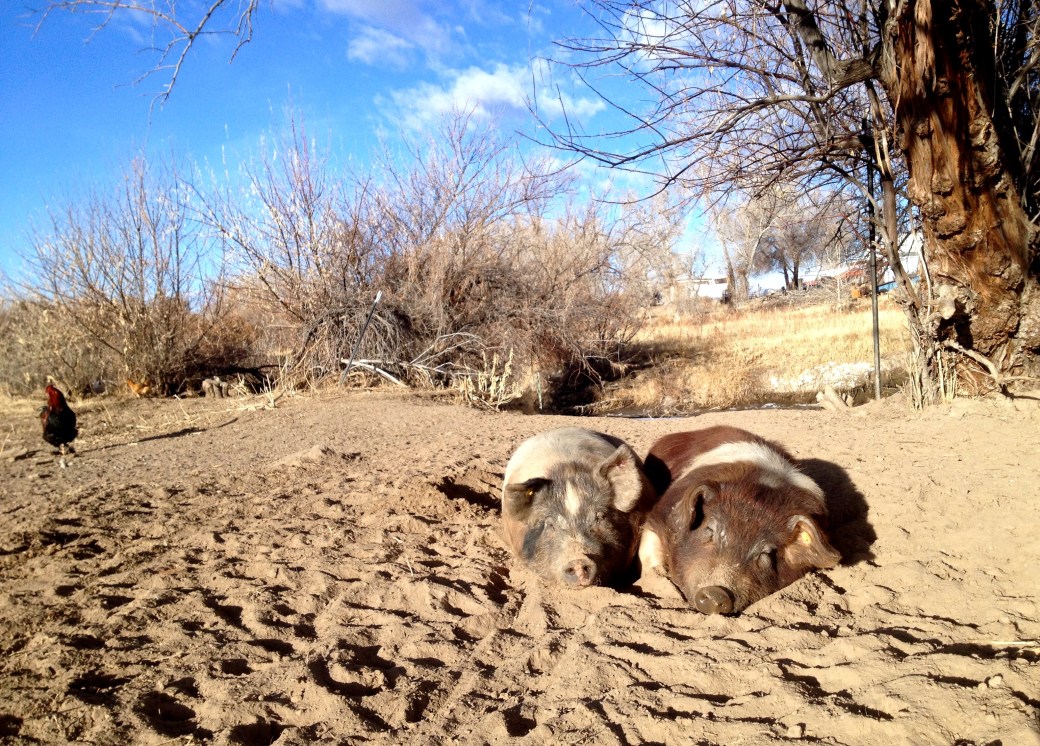
Happy pigs, sunning themselves near the creek.

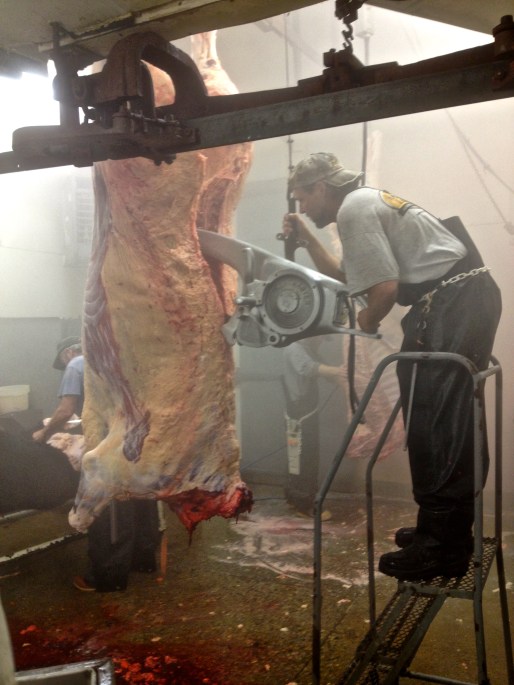
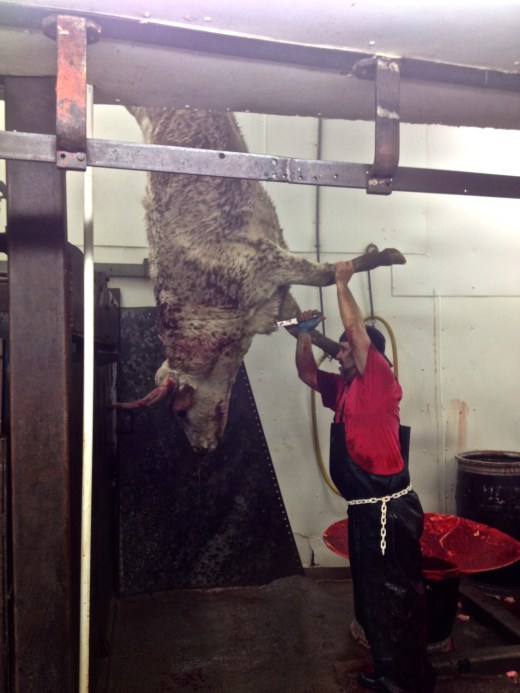
I’ve always felt that if I was willing to eat something, I should not only try to ensure it had been treated humanely, but I should also be willing to kill it myself. So when Sonja asked if I wanted to sit in on a “kill day” at the local butcher’s, to see how they did it, I said yes. The Wind River Processing company hovers in a low building up on a hill near the edge of town. When I arrived early one morning, wearing rubber boots and a grim expression, Wayne the butcher greeted me and ushered me inside, to where the process was already in full swing. One cow stood in a narrow chute; a man in a floor-length black apron used a bolt gun to the back of its head to knock it out. The cow dropped to the ground, still thrashing but clearly unconscious.

IMG_0279

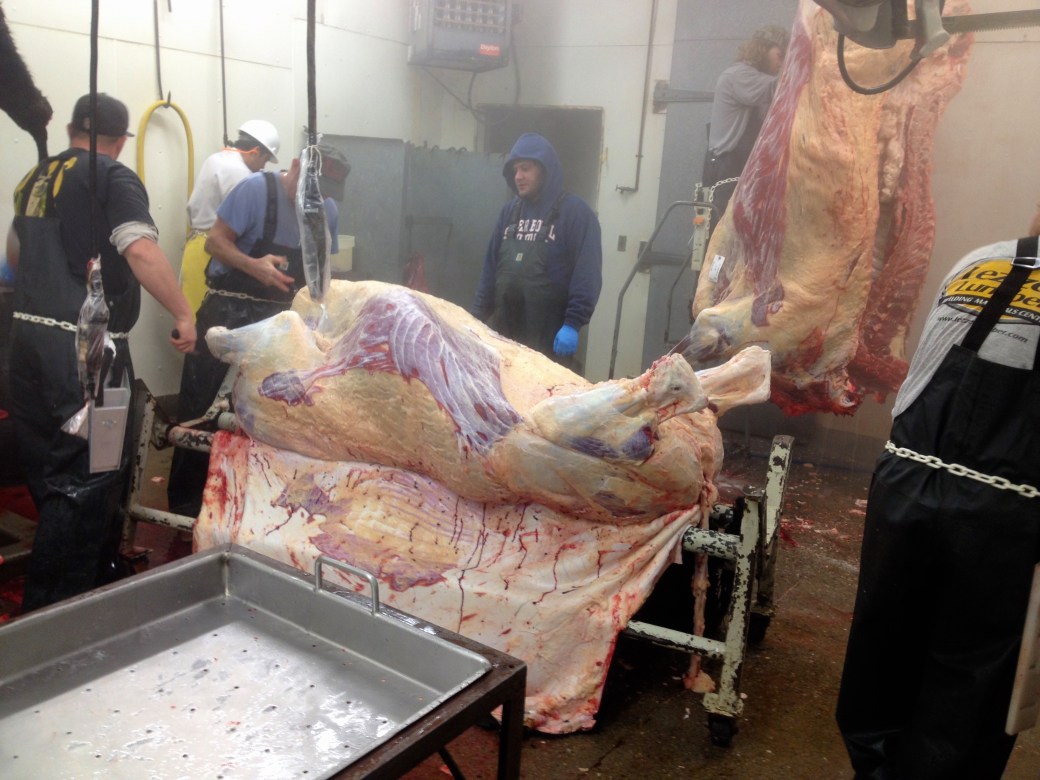
Next, the same man hung it upside down by its feet, and slit its throat, bleeding it out into a large rubber bin and removing the skull. Then, it was laid flat on a table, and several others skinned it and removed its feet before hanging it once more so that it could be gutted. The gutter [my term] removed the hay-filled stomachs in one piece, and dumped them – along with the intestines, and other offal – into a cart that he wheeled away to dispose of elsewhere. He then sliced the cow in half using a saw suspended from the ceiling.

IMG_0276

Yet another man washed the two halves down with a hose, removing any remaining skin or other unwanted bits, and then slid the halves, still hanging, into a freezer to chill. Then, the chute’s back door was opened, and another cow ushered in – one that had, just moments before, been sitting on the straw in the barn outside, chewing contentedly on its cud.

IMG_0268

Though I watched this process several times, and had participated in similar processes before – we’d butchered the farm’s turkeys ourselves, prior to Thanksgiving – it never failed to amaze me how quickly an active, breathing creature went from a live animal to a hanging slab of meat. The speed and efficiency of the process said much for its humanity; there were only a few short minutes when each cow was left standing in the chute, nervous due to the unfamiliar nature of its surroundings. One of the men would often wave a hand in front of its face – to distract the cow, to calm it, to take its attention elsewhere – and sometimes, in my desire to ease its anxiety, I ended up taking over the job. As a result, I would find myself gazing directly into the animal’s eyes during its final moments of life – a moment of connection, dissolving into nothingness.

It’s been said that farming puts you face-to-face with death, and I’ve found that to be true. The butchering is just one example; a farm animal can be lively and rambunctious one day, and the next, it can go downhill before you realize what’s happening. Most often, most tragically, it’s the babies – there’s a reason many animals have litters, and it’s because not all of them tend to make it. When a chicken hatched nine eggs out in November, only half of her little fluffballs survived into adolescence. When I brought Thelma – a tiny malnourished piglet – into the house in an effort to mother her back to health, she perked up for a day or two and then plummeted, passing away shortly after. Her sister, meanwhile, simply disappeared one day – all we could surmise was that she’d been trampled, and then buried in the pile of dirt that her mother had been using as a nest. Sometimes, gruesome tactics are necessary to save a life – when one lamb dies, and another needs a mother, farmers will employ a procedure known as “jacketing” to save the orphaned lamb. They take the dead lamb, cut off its skin, and put the bloodied shell over the live one so that the adoptive mother will accept it. This may sound like something from a horror film, but it does the job – and saves a young lamb’s life.

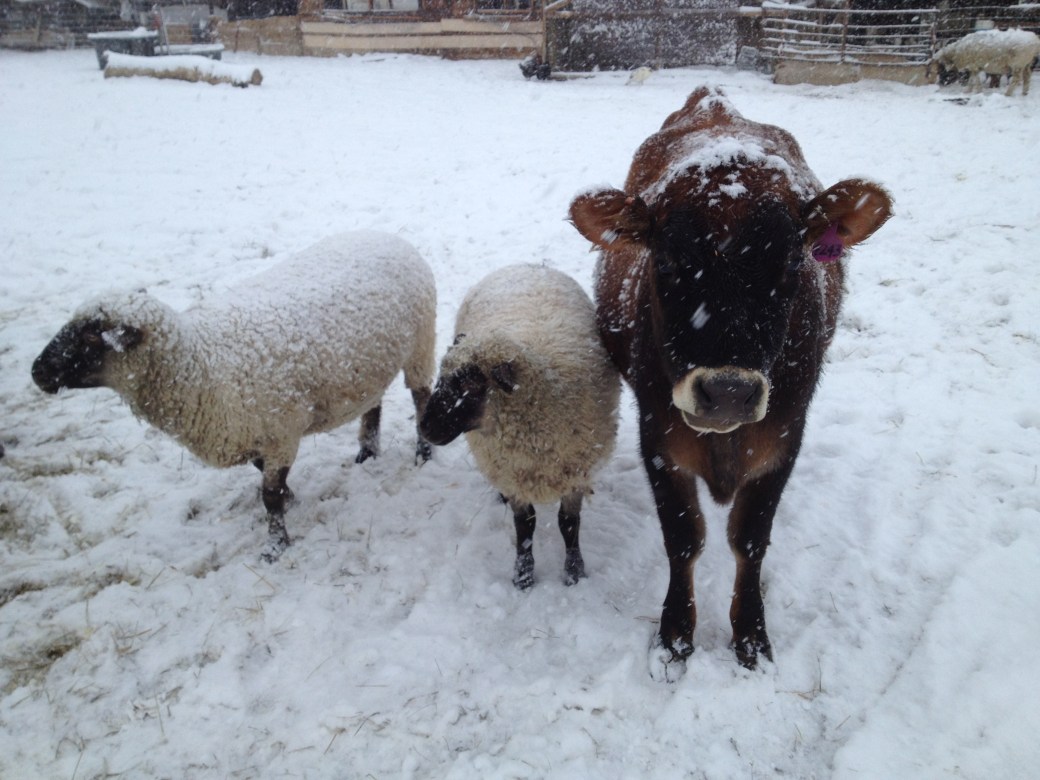
And that’s the thing on the farm – no life, no matter how small, goes wasted. We’ll drag in road kill – deer, and rabbits – to help feed the dogs. When Danielle, one of the milk cows, died unexpectedly, we cut off her legs for the dogs, and then I used the Bobcat to bury the rest of her in the compost pile. When another cow, Bella, lost her calf, the vet autopsied the body before she, too, went to the dogs, and the chickens pecked at the undigested hay spilling from her belly. Bella mooed loudly for hours, mourning the loss, and I tried to provide some comfort as I milked her each morning – some ground grain, some extra gentleness, a pat on one side. How does one comfort a cow? I wanted to believe that just recognizing what she was feeling had some small effect, but who knows.

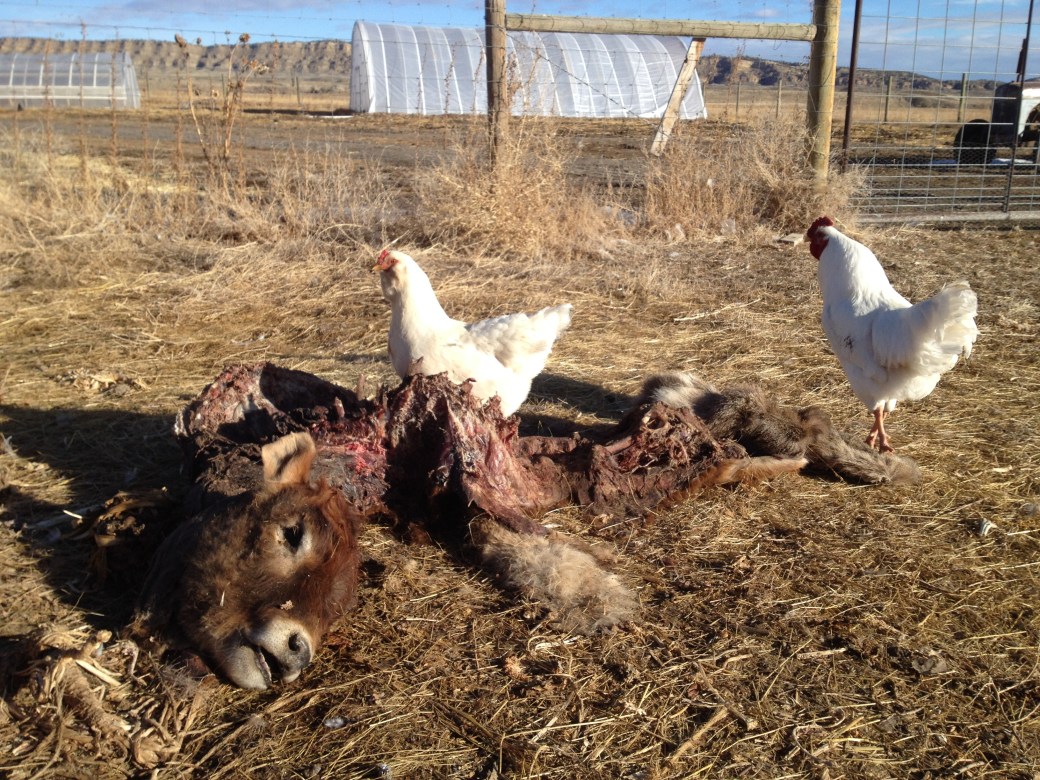
Calf

Chickens peck at the remains of Bella’s calf, most of which the dogs have already eaten.

And while it’s heartbreaking, somehow, strangely, there’s a beauty in it as well. In all of it – in the lamb encased in another’s bloody skin; the chicken clutching at its last breath in the straw; Bella’s lonely mooing, and the cow bleeding out at the butcher’s shop. There’s a beauty in it because it’s all part of the same cycle. We may be built and conditioned to only want to view one half of life’s cycle, but the thing about a cycle is that – well, it’s cyclical. It’s not static, it doesn’t stay in one place, and it doesn’t negotiate.

Because you don’t get to have one without the other. You don’t get to have life without death, or joy without sorrow. You don’t get to spend three beautiful days with a tiny piglet without taking the chance that you’re attaching yourself to a life that’s on its last legs anyway. You don’t get to find a newborn lamb an adoptive mother without bloodying yourself up to the elbows in the still-warm body of another tiny lamb. You don’t get to keep your creatures well-fed and happy without carting in the remains of dead plants and animals to sustain them; you don’t get to nourish your own body without participating in the deaths of many others. You don’t get to refrain from giving your own body in return.

And when we can recognize this cycle, as one is forced to do on a farm – embrace it even – we can start to appreciate it, to give each stage the respect that it deserves. To make conscious choices about where our food comes from, to look at how the plants and animals that feed us are treated at all stages of their lives – from their very first breath to their last. To look death in the eye, and realize that it’s only one part of the cycle, and that while it may seem final, it’s not – because inevitably, relentlessly, life will go on.


Brief Interviews with Curious Creatures

Every morning at the Becker Family Stock Farm, the barnyard erupts into a ruckus. Roosters crow to announce the daybreak; turkeys gobble and flash their tails; calves, separated from their mothers prior to milking, moo at me in demand. Hank the pig grunts and slobbers as he urges me to feed him, and, if I take too long, he mounts the fence with his front legs, his grunt escalating to a high-pitched shriek.

But once the grain is scattered, the feed dishes filled, and the ice broken in the water troughs, there comes a moment of calm. The chickens cluck and shuffle, bowing and raising their heads as they sip their water and swallow their grain. Calves butt at each other as they reach for the water, their long tongues flicking at the stream. Hank slurps at his cereal like he’s suckling his own mother. The sounds of contentment surround me, spilling out across the fields and disappearing over the horizon.

As I’ve become more attuned to the animals – their communications, their preferences, their quirks – it’s become clear to me that they, too, have voices. And so, I’ve decided to interview a sampling, to see what they have to say. Here are their stories:

Hank

Hank

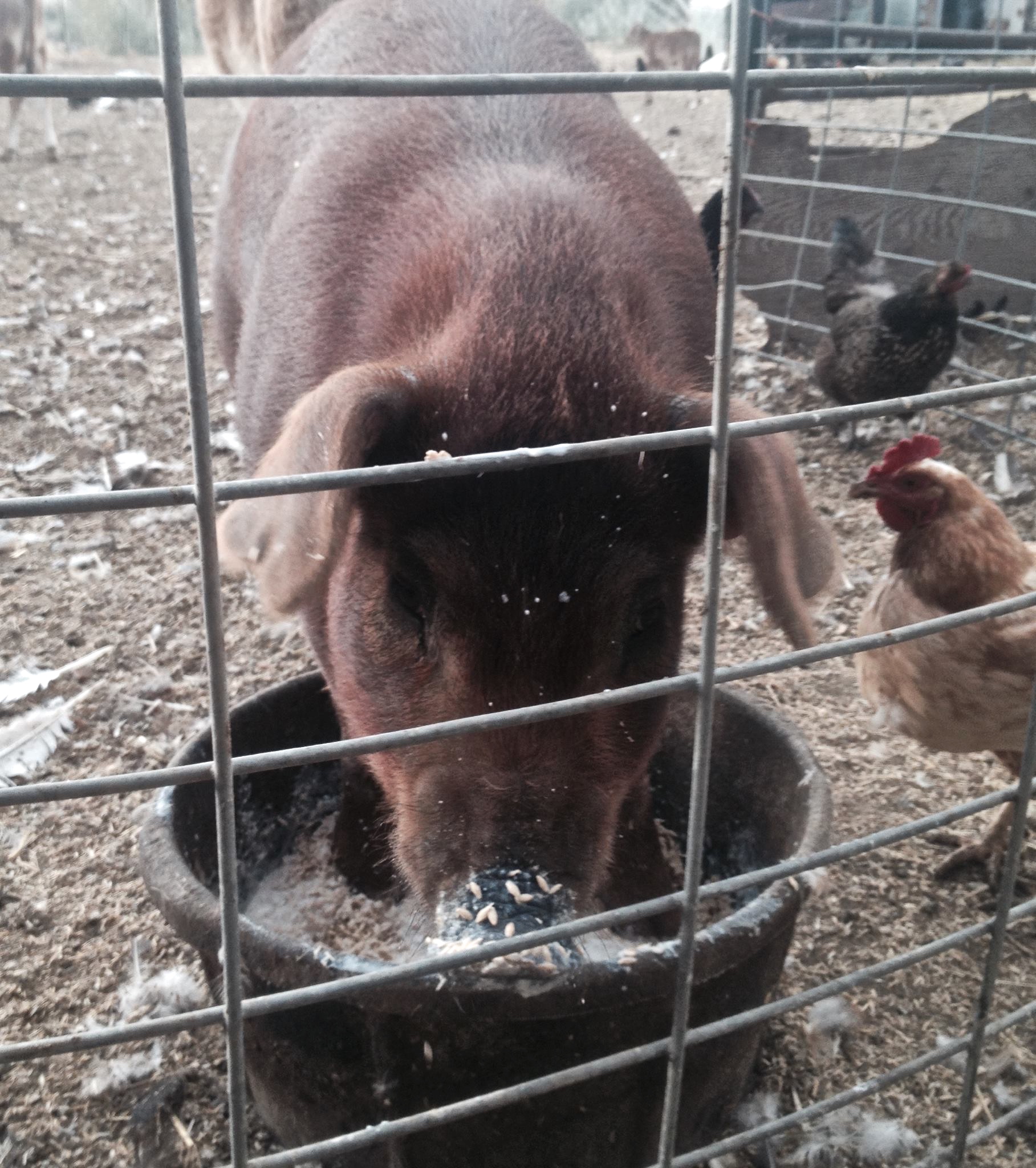
Hank is the farm’s unofficial mascot. Born a runt, he was brought into the house, and raised in the bathtub on cow’s milk. Now, he’s the only pig that lives in the barnyard (the rest have a pasture and feeders). He subsists on milk, grain and the affections of the humans that care for him.

Q: What’s your favorite thing about being here?

Hank: The food! Though sometimes I wish you wouldn’t take so long to give it to me. It’s really annoying. Also, I don’t understand why, when I root at my feed dish to give me more food, it actually results in less food.

Q: That’s because you spill it on the ground.

Hank: That doesn’t make any sense.

Q: Who’s your favorite animal in the barnyard?

Hank: That depends. Probably Lewis (the puppy). He likes to play, and even though he tries to eat my food when it’s on the ground, he’s stuck behind the fence, so he can’t really succeed. Haha, Lewis!

Q: Who’s your least favorite animal?

Hank: Snowy (the sheep). The only way I can keep her from eating my cereal is by climbing all the way into my dish. Still, I guess it’s kind of nice being in there.

Q: Why do you like having your ears rubbed so much?

Hank: What kind of question is that? Why do you like massages?

Q: Maybe I don’t.

Hank: I think you do.

Q: All right, I do. How do you feel about the fact that quite soon, you’re going to be Christmas dinner?

Hank: You know, food is pretty much my favorite thing in the entire world. So if I can provide that for someone else, it’s like I’ve given someone the very best of myself. What better way to repay someone who saved my life?

Q: What do you mean, saved your life?

Hank: I was the runt of my litter – my sister and I were both born quite small. I was raised in the house. My sister hung in there for quite a while, but she didn’t make it.

Q: I’m sorry.

Hank: It happens. That was a long time ago.

Q: I have one more question. When I come in the mornings, I often can’t find you, and then all of a sudden, you appear out of nowhere. Where have you been?

Hank: Ha! That’s my secret.

Snowy

Snowy

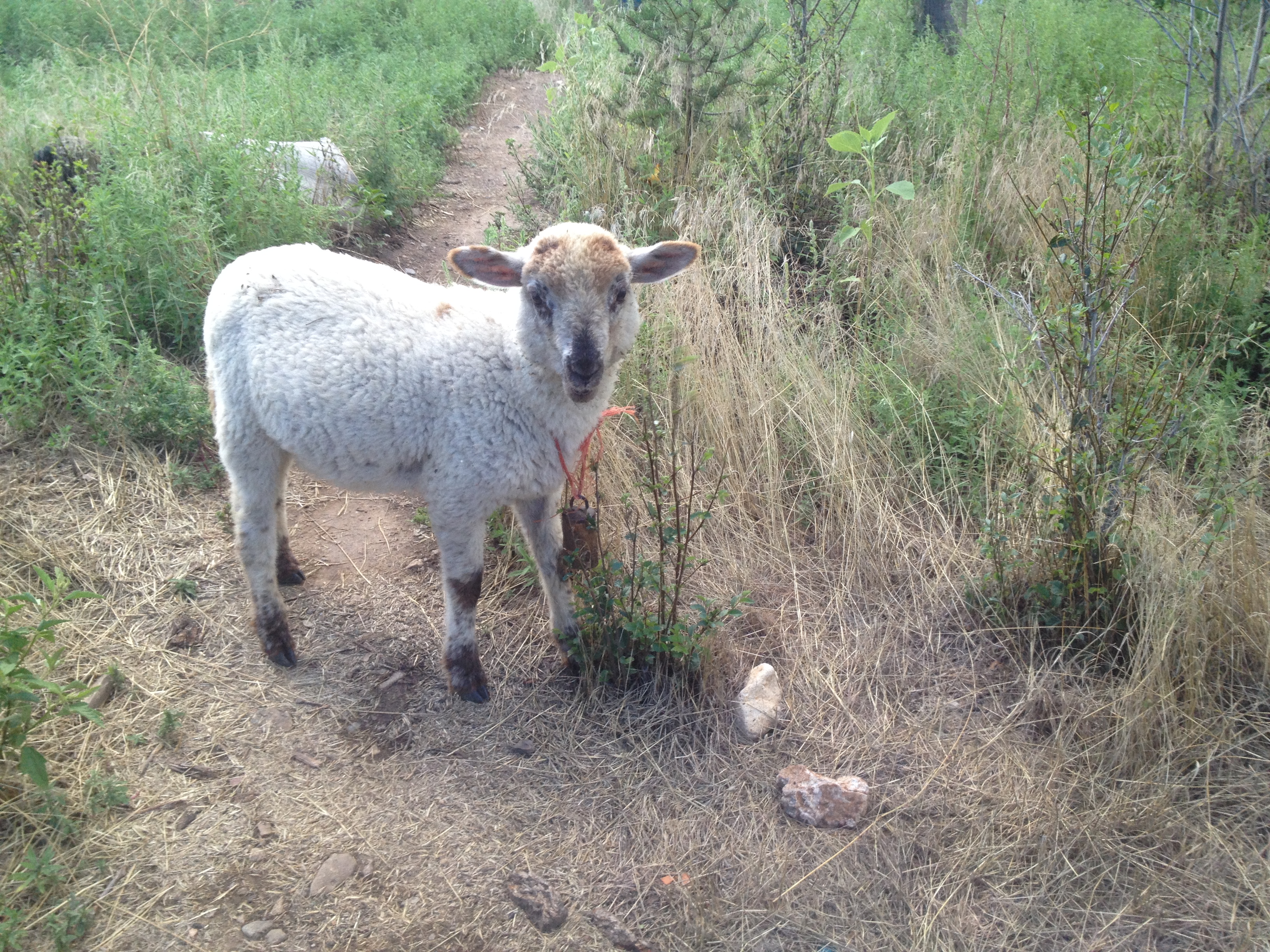
Snowy came to the farm along with several other bum lambs (lambs that are rejected by their mothers). She grew into herself, even becoming a showpiece at the fair, and now runs the show, plowing over anyone and everyone who gets in her way.

Q: Why do you sheep always climb all the way into your feeder and stand on top of your food?

Snowy: Because there’s snow on the ground. It’s cold.

Q: But you do it even when there’s not snow on the ground.

Snowy: It’s just easier to eat something when you’re standing on it. That way it can’t get away.

Q: I’ve noticed that you often steal the other animals’ food, too. How do you think they feel about that?

Snowy: No I don’t. What do you mean?

Q: Yes you do. You eat Captain’s (the dog’s). You eat Hank’s. I’ve seen you.

Snowy: All right, fine. But if they can’t stand on it and take care of it, that’s their problem. They’re supposed to be smarter than me anyway.

Q: Why do you sheep always follow each other around?

Snowy: What do you mean? We don’t follow each other around.

Q: Yes you do. When one of you runs up to me, all of you run up to me, and then you look confused like you don’t know why you’re there, and the only reason you’re there is that you followed some other sheep.

Snowy: That’s just because we want to see what’s going on.

Q: But sometimes there’s nothing going on.

Snowy: How will we ever know that if we don’t come see for ourselves?

Princess

Princess

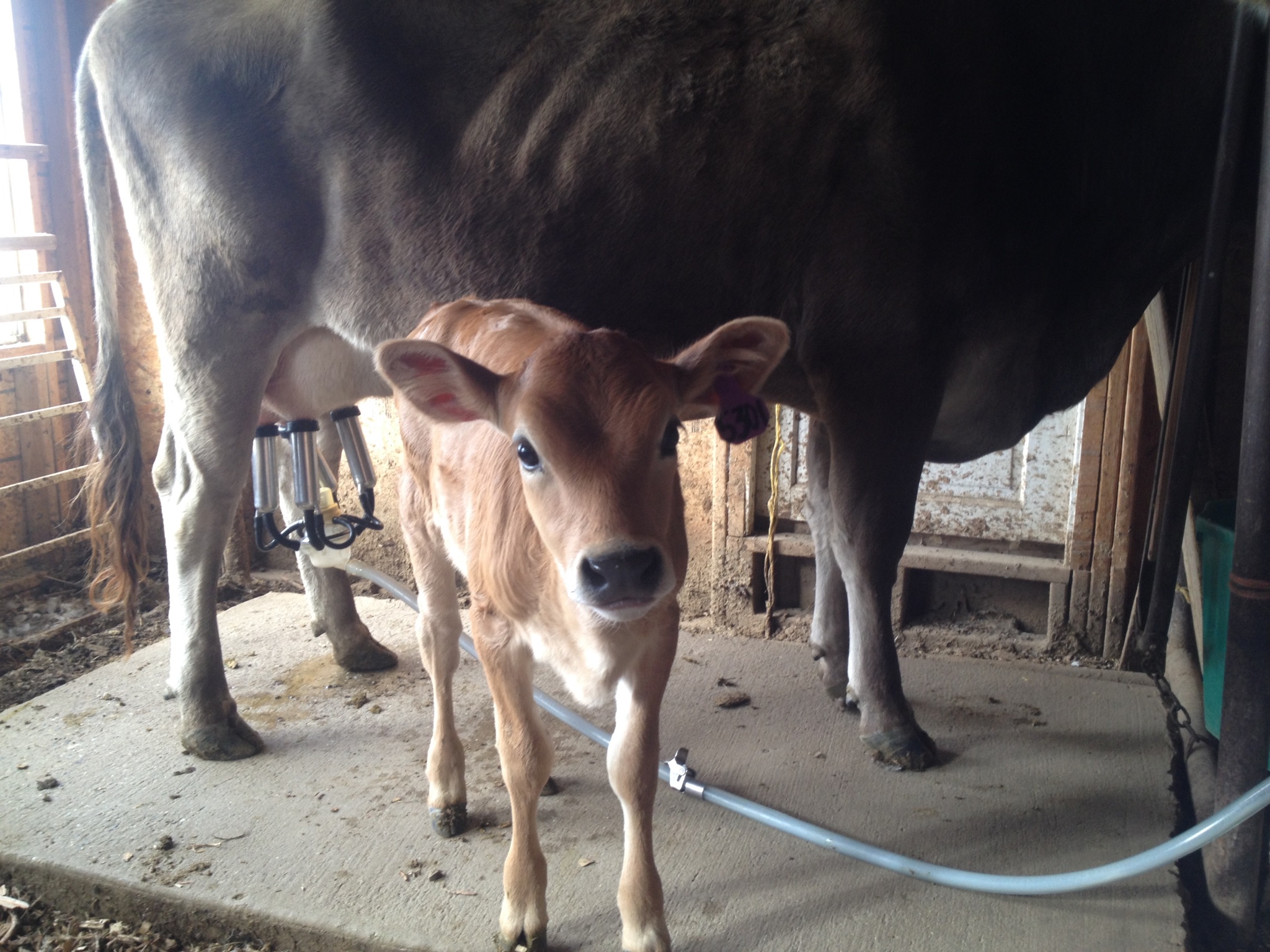
Princess is several months’ old – one of the smaller calves on the farm. Her mother, Liz, is a rather stubborn milk cow.

Q: What are you looking at?

Princess: I’m trying to figure it out. You’ve only got two legs, and you take my mom’s milk, but you’re not a calf. She doesn’t like you very much, you know.

Q: I know. She tried to kick me the other day. And she never lets her milk down.

Princess: She told me. She said that she’s not going to – that she’s saving it all for me. It’s delicious, too.

Q: What were you looking at under the old house the other day?

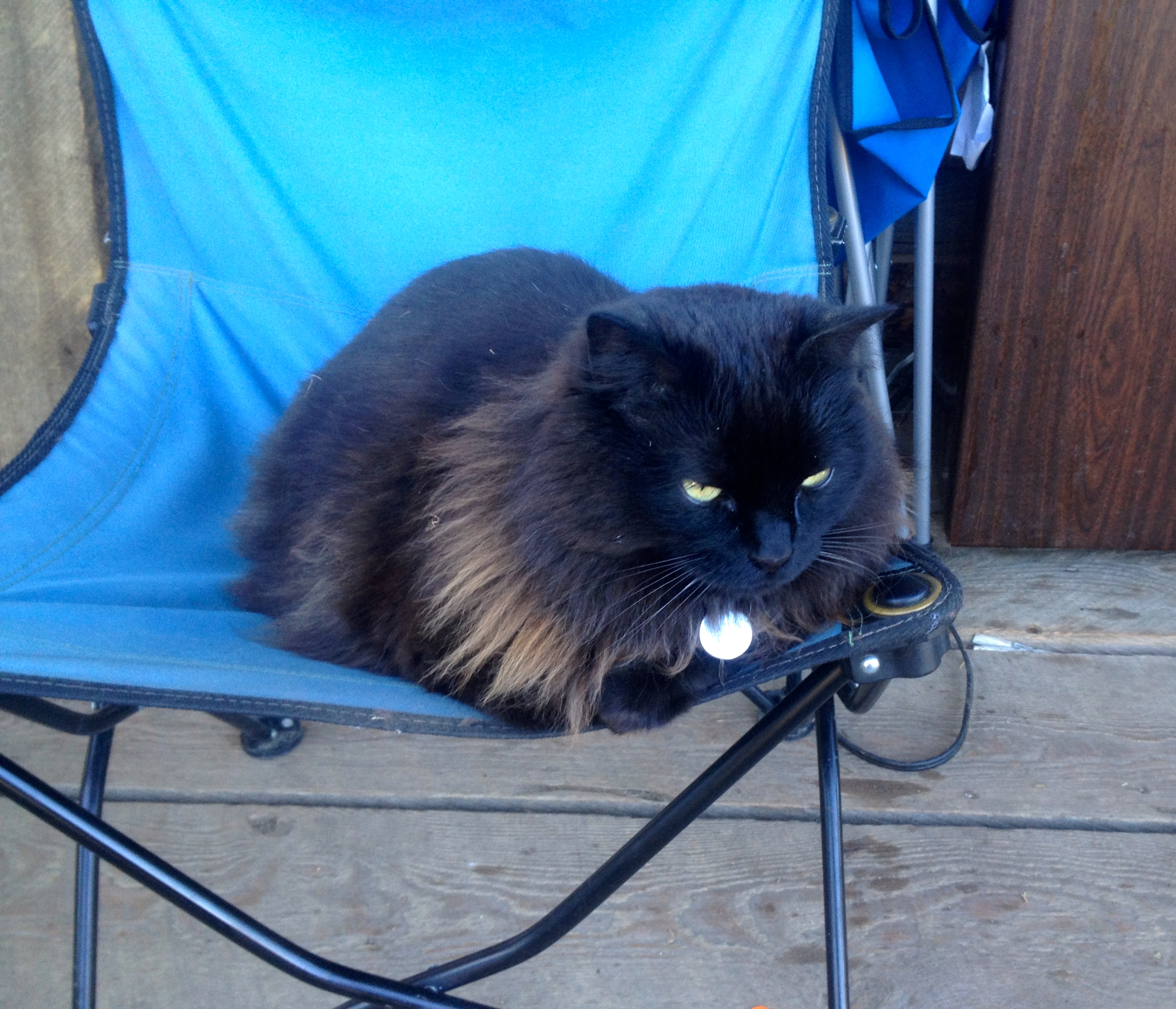
Princess: There was a furry black creature under there. I was trying to figure out what it was. It had four legs, whiskers and a tail. I had a feeling it would drink my mom’s milk too, if it could, but it’s too small.

Q: That was Whiskers. She’s a cat.

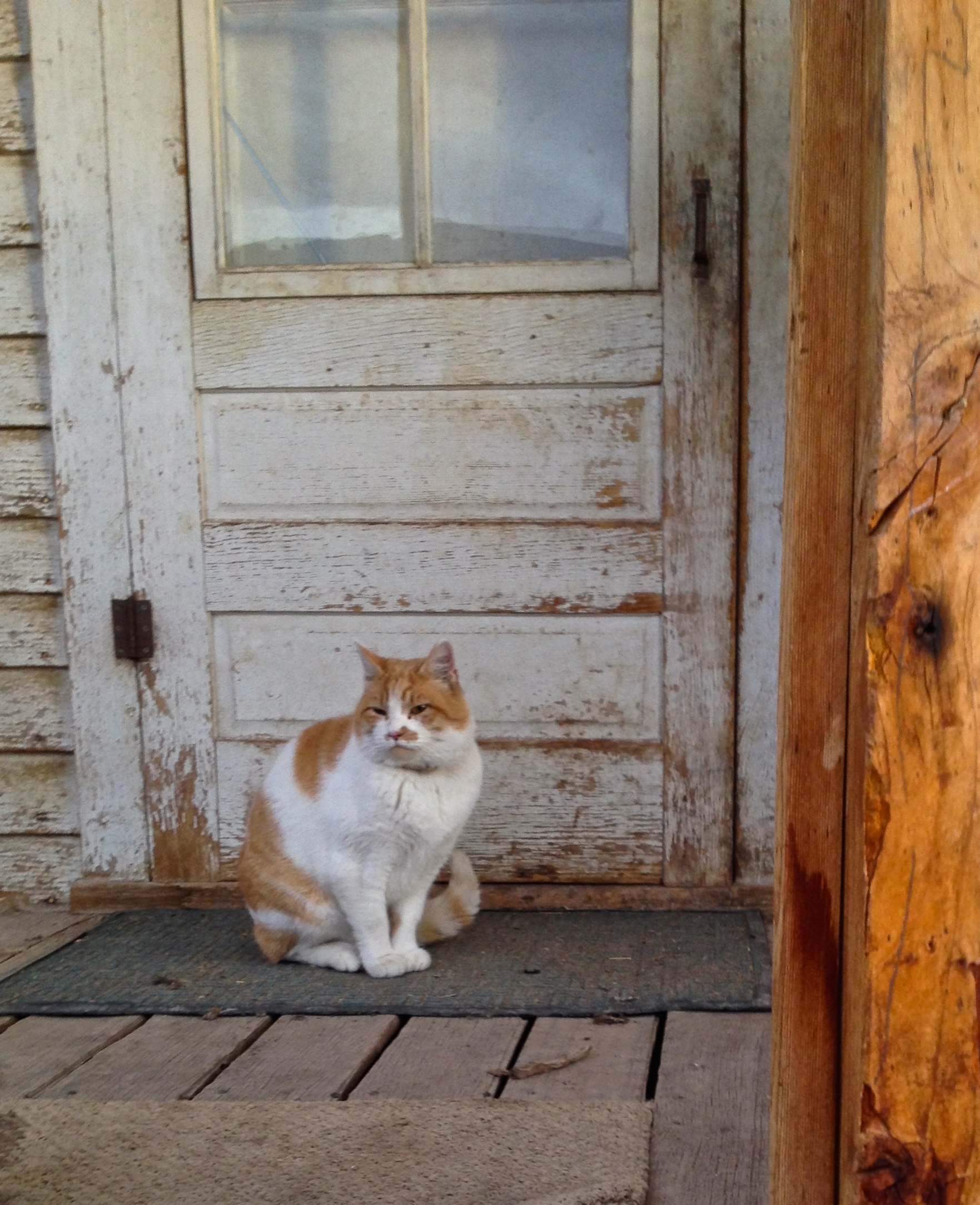
Princess: If she’s a cat, then what’s that orange-and-white thing with the squeaky voice?

Q: That’s Tiger. He’s a cat, too.

Princess: I think you’re lying to me. I’m going to ask my mom.

Paco

 Paco

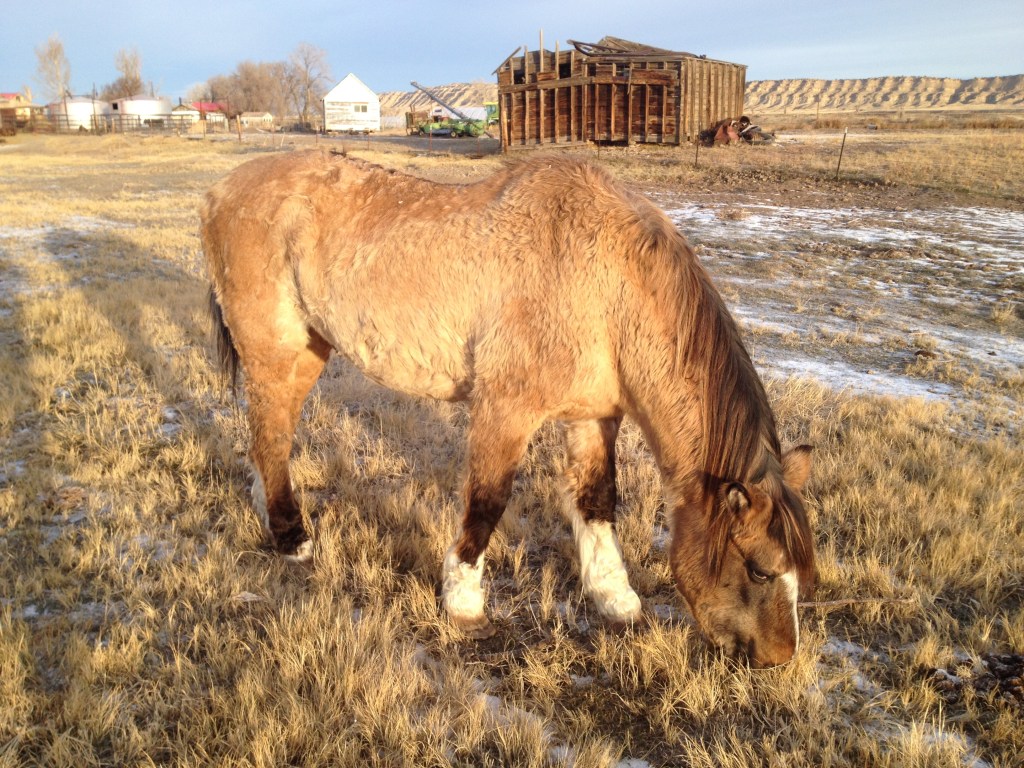
Paco is a retired trail horse. Purchased for Sonja’s daughter, he proved somewhat stubborn, and not quite appropriate for a new teenaged equestrian.

Q: Hey Paco. Can I ask you a few questions?

Paco: Leave me alone.

Q: Come on, it will only take a couple of minutes. I’ll give you some oats!

Paco (eats oats): Go away.

Q: Please? Just this once?

Paco (Sighs): Fine. But hurry up. I’ve got things to do.

Q: What do you have to do?

Paco: That’s none of your business.

Q: All right. Well, I was wondering if you like it here?

Paco: I mean, it’s much better than where I used to be. People mostly leave me alone and I can wander around. There’s plenty of grass to eat. Some people have tried to ride me, but I showed them.

Q: What do you mean?

Paco: I bucked them, or just refused to go where they wanted me to go.

Q: Oh. So you don’t like people riding you?

Paco: You know, all of my life I was a trail horse. Plodding along, carrying snot-nosed kids from one end of the trail to the other. How would you like to do that all day?

Q: It doesn’t sound like much fun.

Paco: And now that I’m old and retired, these people climb up on my back and start telling me what to do? Who do they think they are?

Q: Uh…I don’t know.

Paco: Exactly. All of my life, people have just taken from me. Even when they brushed me, it was only so that I would look nice and shiny for the children. When they brought me oats, it was only because they wanted something from me. Isn’t that what you just did?
Q: I guess I did.

Paco: Will you come by later and hang out? Just to hang out?

Q: Sure.

Paco: Really? Great! You can bring some more oats if you want, too.

Gertrude

 Gertrude

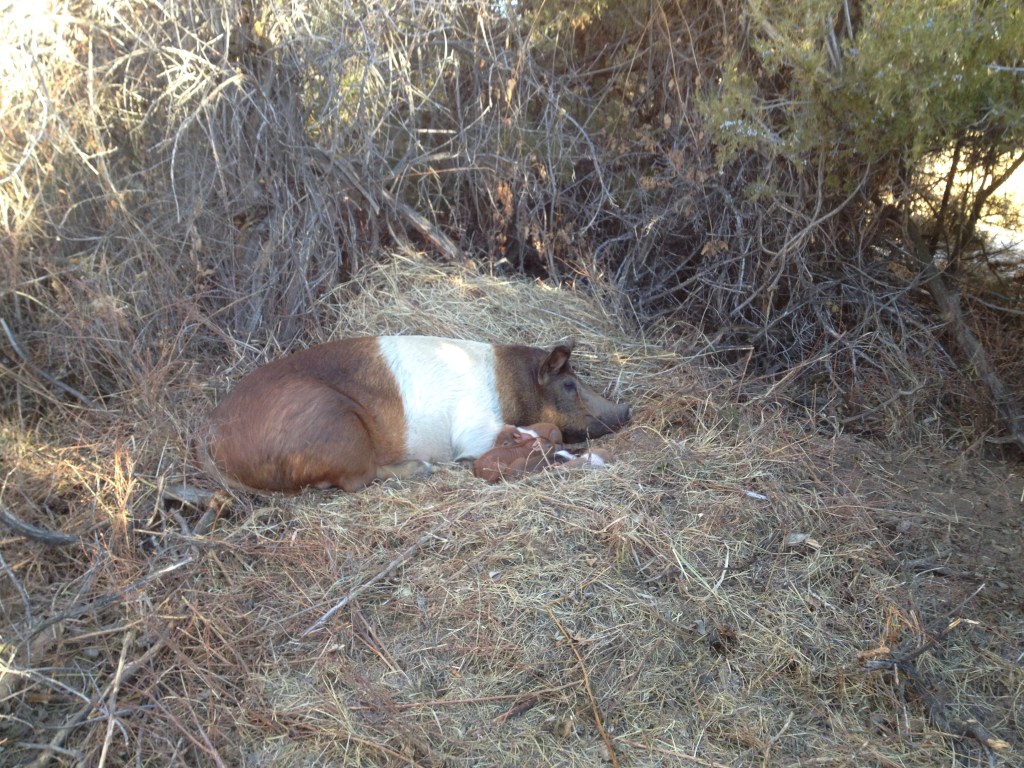
Gertrude is the farm’s newest sow. She arrived pregnant, and recently gave birth to six piglets.

Q: This is a nice spot you have here, down by the creek. How did you find it?

Gertrude: It wasn’t so hard. They had me in this sterile pen up in the pig pasture. But who wants to give birth in there? I’m kind of a hippy, I prefer the natural, home-birth sort of thing. So I broke out, came down here, scrounged around, and found some grass to build a nest-house. And voila – pig heaven.

Q: It’s certainly quite pleasant. How was the birth?

Gertrude: Well, this is my third time, and there were only six of them, so it wasn’t so bad. Man, those hooves can hurt! But I just did my breathing exercises, and it was all good.

Q: Any more plans for the pad?

Gertrude: Well I’ve been doing some renovations. After the snow came I got some more grass and made it into a high-rise. Sometimes I bury the piglets under there to see if it helps them stay warm, but eventually they come tumbling out.

Q: Do you have a favorite?

Gertrude: I can’t tell you that. I hope the little gal, Thelma, makes it though; she’s definitely on the small side.

Q: Yeah, me too. I’m rooting for her.

Gertrude: I root for her every day.

Piglets

Since this interview took place, Gertrude moved her piglets back up to the pen in the pig pasture, saying that they’re ready for the big world. But Thelma, the runt – the one with the horseshoe shape on her back – just kept getting weaker and skinnier, so I took her into the house and spent several days and nights trying to nurse her back to health. However, she didn’t make it, and is now buried down by the creek, near their original nesting site.

Lily

Lily

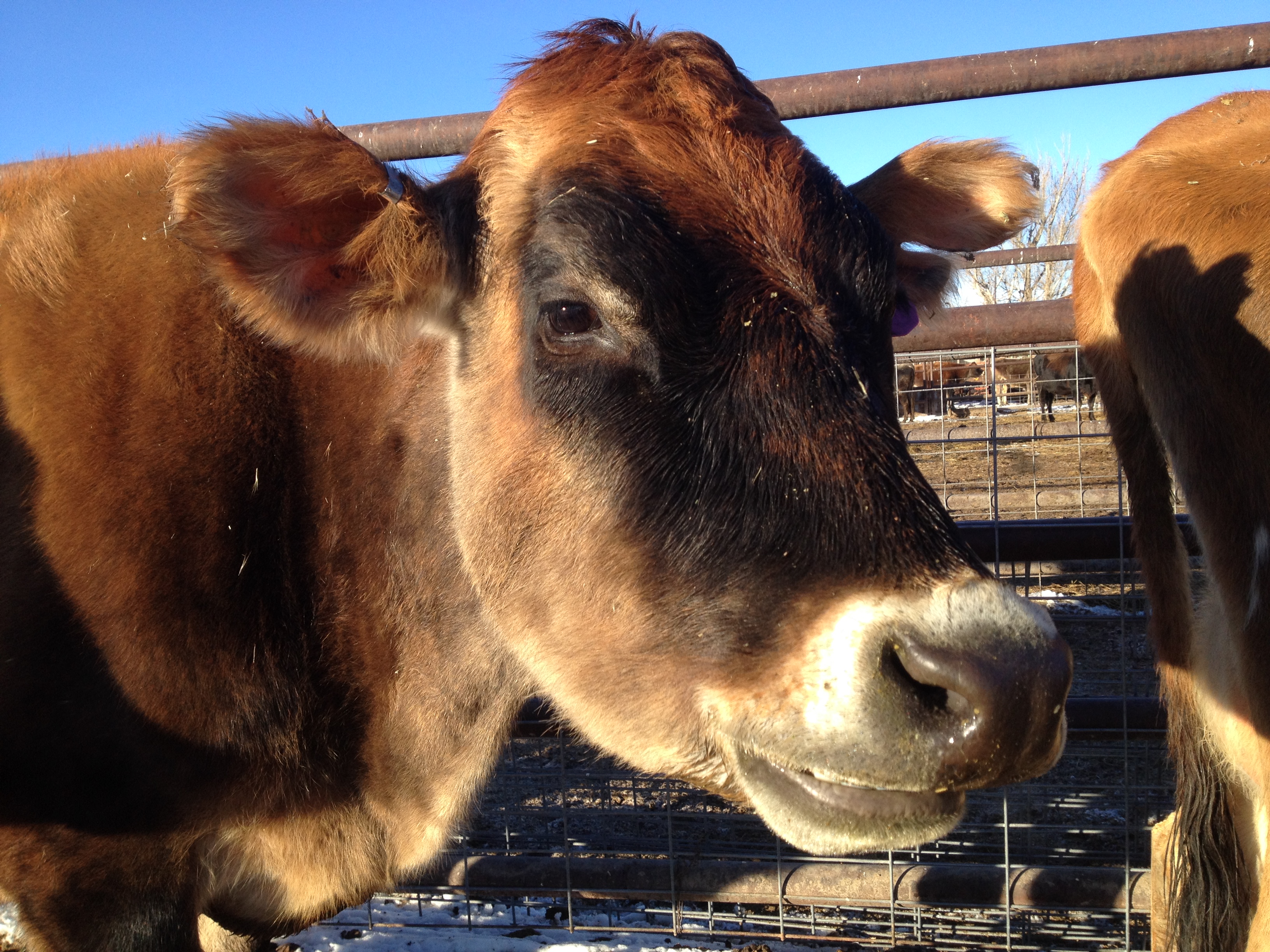
Lily is one of the milk cows, and probably the friendliest. You have to get up in her face and physically push her forehead in order to get her to leave the milk parlor. 

Q: Give me a hug.

Lily: OK.

Q: How come you’re so comfortable around people? Most cows are kind of shy, especially when people approach them straight on.

Lily: I don’t know. Are you a person?

Q: Um…I think so.

Lily: Could have fooled me. 

Queenie

 Queenie

Queenie is one of the guard dogs. She’s affectionate but independent, disappearing for long stretches to roam around the fields. 

Q: What are you up to?

Queenie: Oh, you know, just running around, keeping an eye on things. I’ve got this deer leg here, I’m going to chew on it for a while.

Q: Looks delicious. Did you go on any adventures today?

Queenie: I went down to the sheep pasture to see if there was anything going on, but it was kind of boring. All of the sheep are up here with the cows now. I went and nipped Snowy’s heel just to bug her. And then I rambled on down by the creek to look for rabbits.

Q: Did you find any?

Queenie: No, but I saw a skunk. And I found this old deer leg that I left there. I forgot I had it.

Q: Did you see Gertrude?

Queenie: No, who’s Gertrude?

Q: The new mama pig, she has a bunch of piglets down there.

Queenie: Ah, more pigs. Pigs are boring.

Q: Who do you like hanging out with?

Queenie: Mostly the chickens, the cows and the sheep. I like people too, but sometimes they think my smile is menacing.

Q: Yeah, you do have some rather crazy teeth going on there. No offense.

Queenie: I think they’re beautiful. 

Chicken Mama

CM

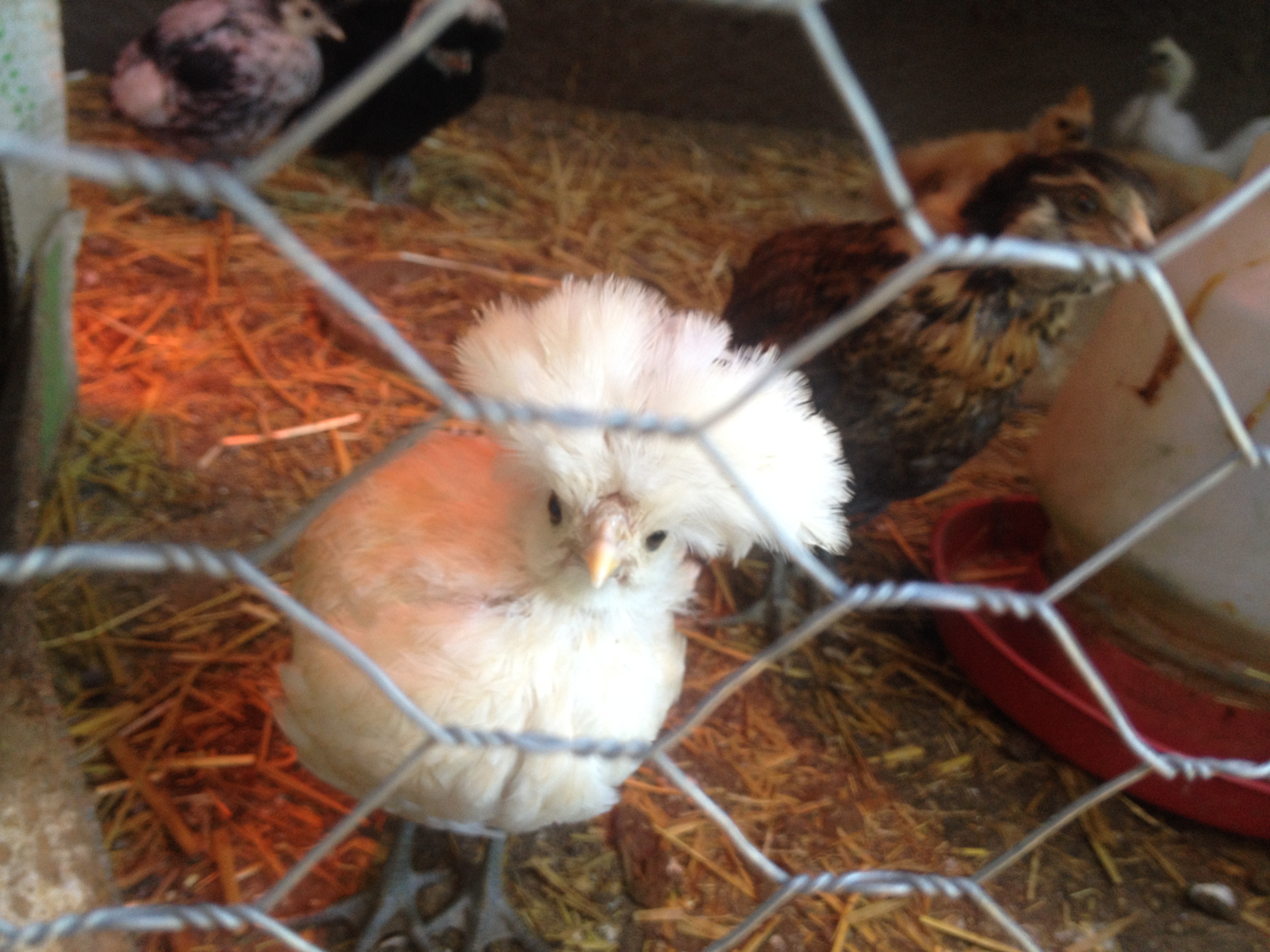
Since she doesn’t really have a name, I just call her Chicken Mama. She appeared one day in mid-November with a crew of baby chicks, completely off schedule. Despite a few casualties, the majority of them have survived, and she’s raising them under a heat lamp at the back of the milk parlor.

Q: Why did you decide to go ahead and hatch a bunch of eggs in November? Don’t you think that was a bad idea?

CM: Not really. Now I get to live in the back of the milk parlor, under the heat lamp, while all the other chickens are freezing their butts off in the snow. Besides, look how cute they are!

Q: They’re pretty cute. Though I have to say, you make it kind of hard for me to see them. Every time I try to pick one up you freak out and fly at me like I’m a terrorist.

CM: Well how am I supposed to know that you won’t eat one?

Q: Why would I want to eat one? They’re way too small. Besides, I’d rather let them grow up and eat their eggs. Unless one of them is a rooster. I might eat a rooster.

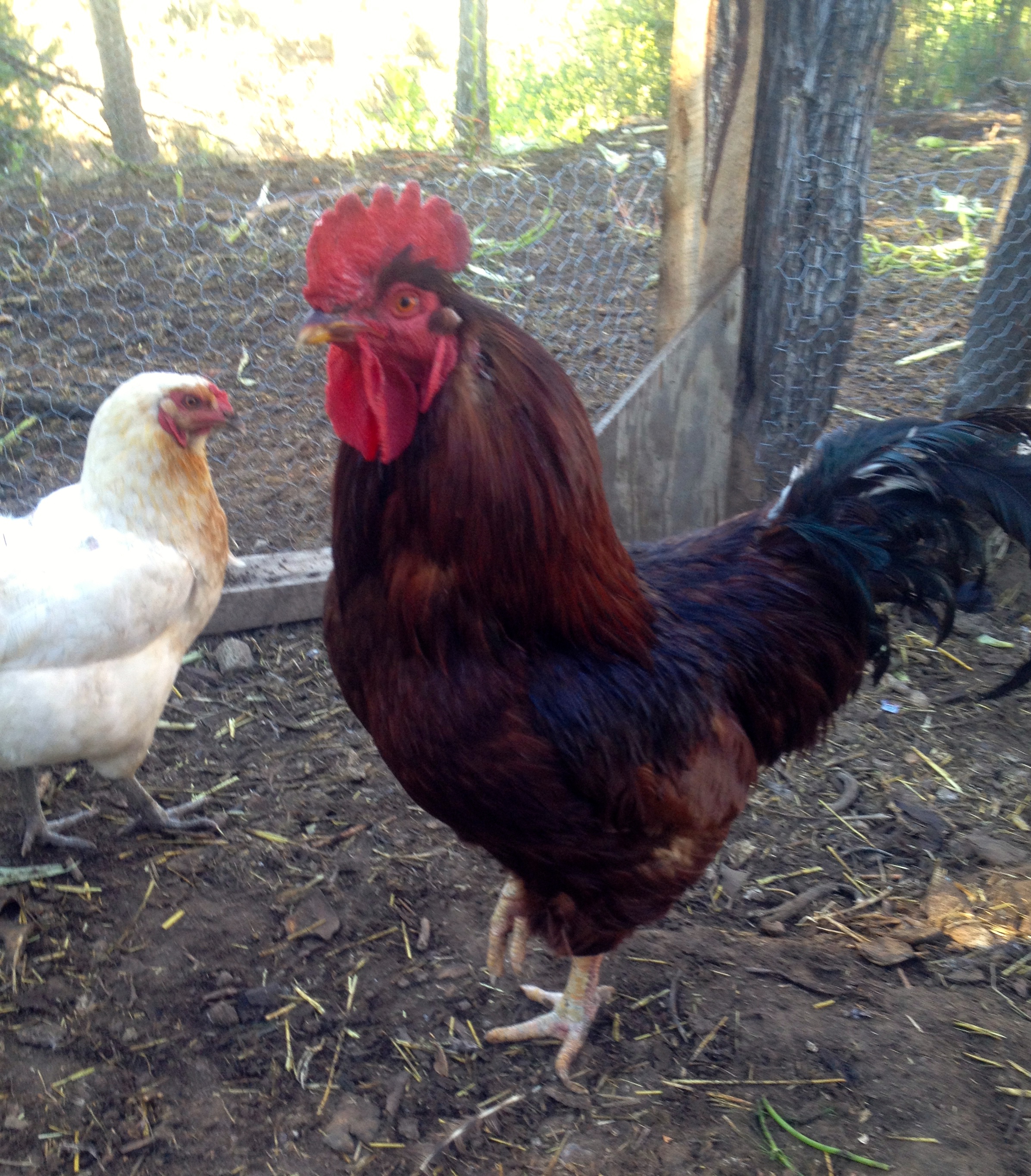
CM: What do you have against roosters?

Q: I’ve seen what some of them do to you hens – hold you down, rape you, pluck out all your back feathers. Why are you defending them?

CM: Well, if one of my babies is a rooster, I’m going to raise him to be different.

Q: Good luck with that.

Tiger

Tiger

Q: As far as I can see, there are now five cats on the farm. How do you feel about that?

Tiger: Five? What do you mean, five? I thought it was just me, Donay, and Whiskers. We’re the original three. That new one, María Lionza – she thinks she owns Whiskers’ old house, but I’m going to get her out of there.

Q: Well there’s the new little black kitten, Tricksy. The one that showed up on Halloween.

Tiger: I haven’t seen her, but if I do, I’ll scare her way, just like I’m doing with María Lionza.

Q: Speaking of which, what’s going on with you and María Lionza?

Tiger: She’s basically my nemesis. If I see her hanging out in the window, I’ll get up in her face and we’ll yowl at each other through the glass. My yowl is louder than hers, though, so I’m winning.

Q: Yeah, I’ve seen you. Once I was actually in my bedroom, and María Lionza launched herself up to the window, just below the ceiling, and was hanging there by her paws like an acrobat. I couldn’t figure out what she was doing, but then she slowly pulled herself up and screeched, and then I realized that you were out there, screeching back.

Tiger: That’s nothing. I could do at least three pull-ups.

Q: Really? That’s three more than me.

Tiger: Is she going to be at the window later? Maybe around 5 p.m.?

Q: I don’t know. Why are you looking for her? I thought you hated her.

Tiger: No reason.

Q: I actually think her yowl is louder than yours, you know. Your voice is kind of squeaky – and I’m not the only one who says that.

Tiger: Squeaky? Hmph. You have no idea what I’m capable of.

Call of the Wyoming Wild

“Curious how a place unvisited can take such hold on the mind so that the very name sets up a ringing.” – John Steinbeck, Travels with Charley.

María Lionza and I arrived in Wyoming in mid-October. We’d driven up through Colorado, as golden aspen leaves wafted from silver branches to the ground. I’d frolicked in the sand at Great Sand Dunes National Park, participated in a sweat lodge at the at the Aztlan Native American Earth Farm, and learned how to trim freshly harvested buds of cannabis. María Lionza had chased tiny chipmunks through forests, sunned herself in the Colorado Rockies and huddled with me, against the frost, in my tent. All in all, we’d had quite the adventure.

IMG_0755

Sand in the mountains? Why not? Great Sand Dunes National Park in Colorado.


IMG_0788

María Lionza guards our tent among the apsens.

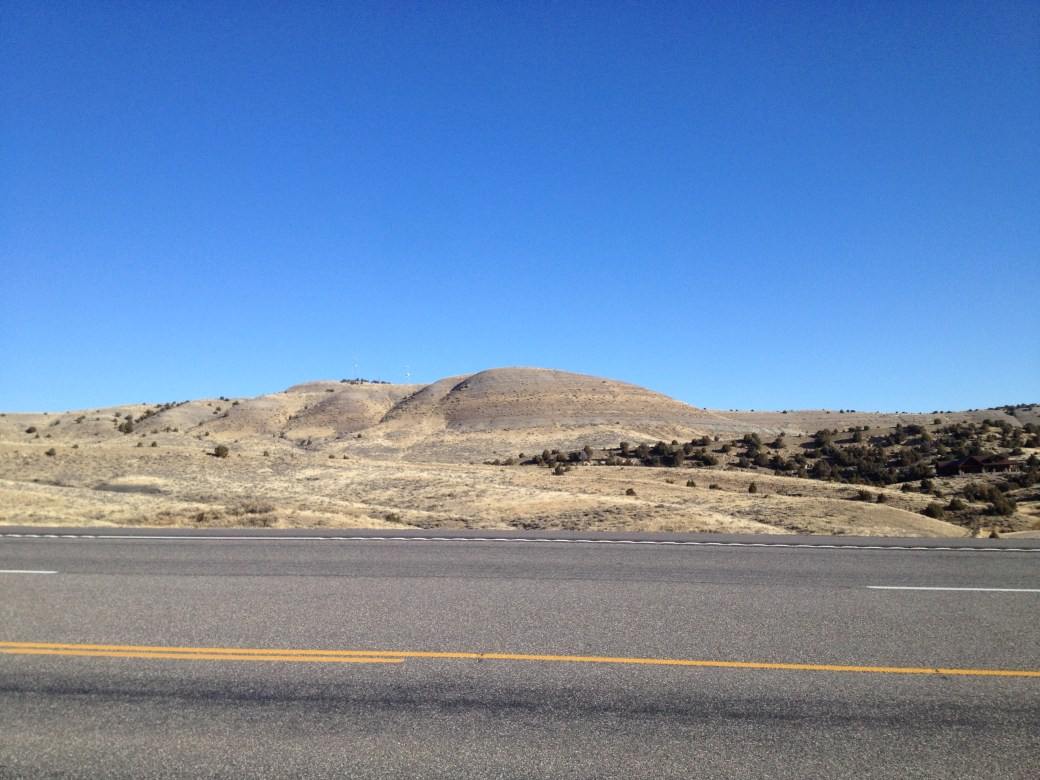
So as we entered Wyoming, I wondered what it was about this empty land, in particular, that drew me. Low-lying, dusty hills stretched before me in endless succession, each one as cracked and barren as the last. The roadsides were desolate and empty, and there wasn’t a convenience store or gas station to be found. We stopped at a dreary motel in Rawlins, where we nevertheless reveled – after weeks of camping and sleeping off-grid – in the luxury of beds and hot showers. In the morning, I shared coffee and pastries with the other passers-through; rugged-looking men in hefty jackets and jeans. “So, where are you going?” asked one Colorado native, who’d been up hunting moose and deer with a friend. I explained that I was on my way north, to a livestock farm near Thermopolis, and he raised his eyebrows. “Oh?” he said. “So you like this land.”

IMG_0040

The rolling dirt hills of the Badlands.

And it appeared that I did, though I wasn’t sure why. Wyoming seemed like a strange and mysterious place (“Does Wyoming actually exist? Do you actually know anybody from Wyoming?” Mark – Ninja’s new human – asked when I told him where I was going). And it was true that I had gone from the most populous state in the U.S. – California – to the least. Perhaps it was the emptiness of it – the way the space around me stretched and yawned and exhaled to an endless horizon. Or the strong winds that unfurled across the plains, their forces untamed by mountains or bushes or trees. The power of the land was palpable; the presence of humans, by comparison, felt like an afterthought. Towns resembled trading posts more than urban centers, and it was easy to travel long stretches of freeway without seeing another vehicle.

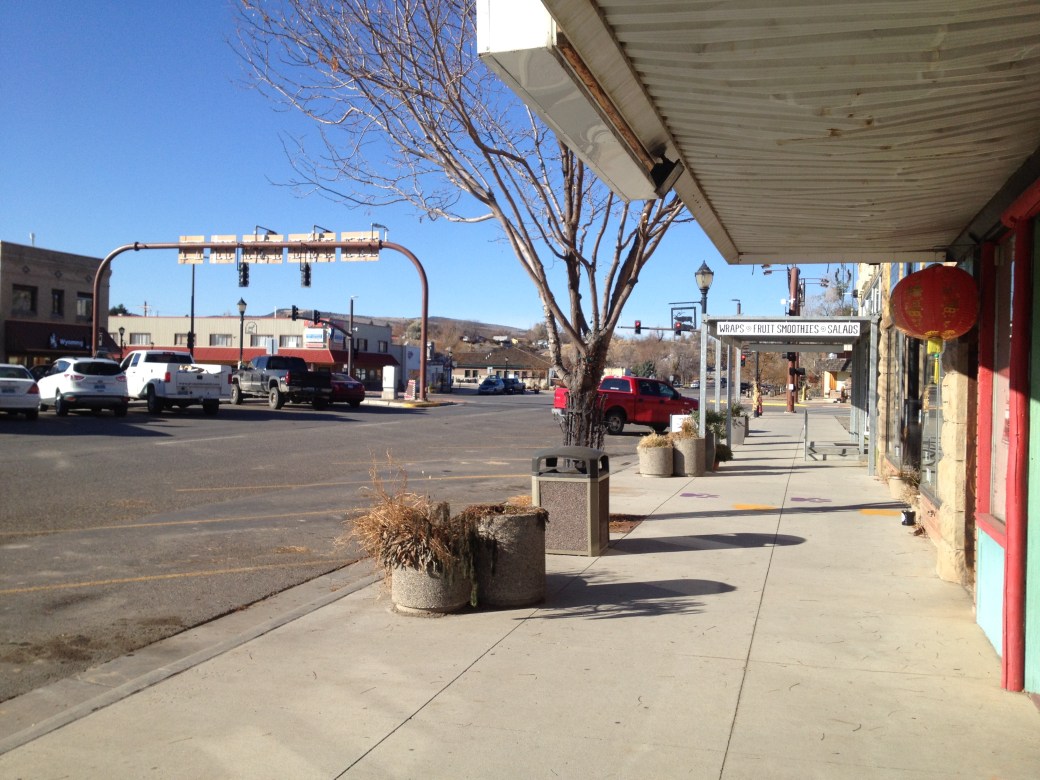
As I reached the Wind River Canyon, the landscape changed to accommodate a wide lake and jagged outcroppings of red rock. I forged through several tunnels and soon found myself approaching Thermopolis: Population 3009 (Did I need to report my presence somewhere? I wondered). I caught a brief glimpse of the main street, lined with small shops, then it was gone, and I was heading northwest – past strange-looking tabletop hills, the color of sunsets – to the Becker Family Stock Farm. Sonja Becker welcomed me, explaining that she had some 720 acres of land – her grandparents had bought it for a mere $12,000 back in the day – and she used 150 of that to raise cows, sheep, pigs, chickens and turkeys. Some of it she leased to a neighbor to graze his cattle, and the rest remained in its natural state, untouched by human hand or plow.

IMG_0041

The booming metropolis of Thermopolis.


Hills

Red dirt hills, many of them flat-topped, rise from the land around Thermopolis.

When I had time to explore my surroundings, I found myself awed by the area’s beauty, humbled by its vastness, and outnumbered by the many creatures that called it home. Running in the evenings down a quiet back road, herds of deer would often stop to watch me, their ears alert and curious, before springing away, perky-tailed, into the bushes. Sometimes I’d pause to pet a horse – one of many – that peered over a fence, and it would nuzzle me, its nostrils flaring. Rabbits with cartoon-like tails raced next to me; inevitably, they would win. Once, a herd of cattle stampeded up to the fence – their eyes wide and challenging, dust billowing from their hooves – and stared at me intensely before turning, as a group, and galloping away in a mass of swirling grasses.

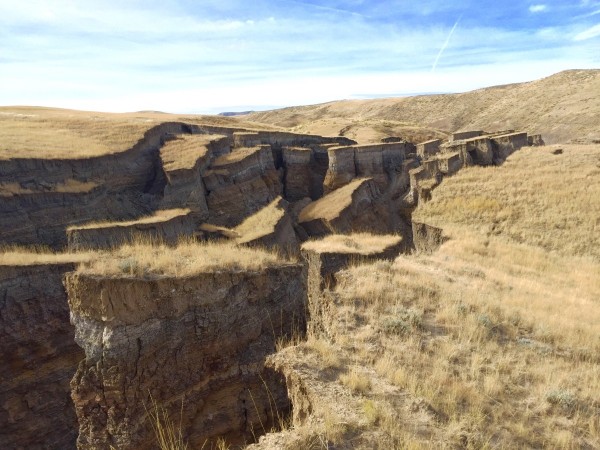
So when I heard about the Giant Crack that had formed in the earth just north of me, near the Big Horn Mountains – creating a crevice that some had dubbed a miniature Grand Canyon – I was hardly surprised. It seemed like just the kind of thing that would happen in Wyoming. News outlets had jumped on the story with headlines that labeled it a “Giant Crack;” a “Mysterious Gash;” and a “Yawning Hole.” There were rumors of super volcanoes and earthquakes. It was said to be the size of six football fields, and to have been caused when groundwater instigated a slow-motion landslide. When I ventured north on my next day off, planning to hike the Big Horns before the roads closed for the winter, it seemed only logical that I’d stop in the tiny town of Ten Sleep (Population: 260) to ask around. I found one open café on the main drag – The Crazy Woman Café – and bought an apple fritter and a hot chocolate before taking a seat next to the only two men in the shop. They were already regarding me with curiosity, so I leaned over. “Can you tell me anything about this giant crack in the ground?” I asked.

the-crack-Randy-Becker-Casper-1-e1446470317996

The Crack. Photo by Randy Becker, who came across it while hunting.

The men were pleased to oblige. The crack, they told me, was some 30 miles out, half of that on a gravel road, and situated somewhere in the middle of a private ranch. “You can call Rob up and see if he’ll let you on to see it,” one said. “But otherwise there’s not much point in driving out there.” I asked for Rob’s phone number, and made the call.

“I’m not sure how much I’ll be able to help you,” Rob said, when I got him on the phone. “You could come and see it if you want, but it’s really not worth your time. It’s just some dirt that sloughed off. Someone came and looked at it who didn’t know what they were talking about. It’s really not that big a deal.”

“Oh,” I said, disappointed. What about the Giant Crack? The Yawning Hole? The Mysterious Gash? Actually, when I thought about it, I realized I’d seen some strange-looking cracks on my own drive up from Colorado – nothing the size of six football fields, but still impressive fissures, to be sure. A blond woman had joined the men at their table, and when I got off the phone, they informed her that I was thinking about driving out to see the crack. The woman, who lived in that same area, looked skeptical. “Do you have 4-wheel drive?” she asked. I told her that I didn’t. “Well you can’t go out there without 4-wheel drive,” she said. “Besides, we’re supposed to get some weather.” I looked outside at the blackened sky; the first snowflakes of the year were just beginning to fall. I told her that Rob hadn’t been too encouraging anyway, crumbling my dream of a miniature Grand Canyon into a heap of sloughed-off dirt.

IMG_0013

First snow at the Becker Family Stock Farm.

“Strange how big it got, though,” I mused, thinking of the media frenzy. Even Gawker had covered it, asserting: “These are the End Times.”

The woman – thinking I was referring to the size of the crack – nodded eagerly. “We had something strange happen on our own land,” she said. “Groundwater came seeping in under this cliff and caused what was like a big blister in the soil. And then in the spring, when it thawed, a huge chunk of land came off and was carried away.” Her story only served to confirm what I’d already suspected – that Wyoming’s land was wild and untamable, and the crack was just one incident among many, albeit a rather large and impressive one. Perhaps, in a place like Wyoming – where the land is vast and the people are few – these things are just more obvious. Perhaps it’s clearer, and therefore somewhat easier to accept, that we can’t control our surroundings. If the land wants to tear itself apart, or wash away, or form a yawning hole to nowhere, that’s just what’s going to happen.

I finished up my hot chocolate, thanked the kind people of Ten Sleep, and headed off to the Big Horns. Snowflakes splatted against my windshield and fog shrouded the road, obscuring rugged canyon walls that reached to a white sky. I turned off down a side road to a closed campground that someone had recommended – a spot with a well-marked ATV trail – and parked amid snowdrifts. Pulling on my hat, hiking boots and gloves, I hefted on a backpack with water, sandwiches and some other supplies, and headed off across the expanse of white meadow toward pine tree-laden hills. The snow was ankle-deep and falling softly all around me. There were no tracks aside from the cloven marks of deer hooves, and as I crossed a half-frozen creek on snow-covered rocks, I decided that I’d made the right call. Wyoming’s cracks and crevices may be sudden and dramatic, but they had nothing on the white-shrouded treetops of unexplored forests; the living silence of a mountain’s first snowfall.

21 Views of the New Mexico Sky

There is something different about New Mexico, and it’s reflected its sky – the one thing that’s both constant and ever-changing. Every hour of every day the sky exhibits distinct shapes and colors, but it remains equally immense, overwhelming and fascinating. As Georgia O’Keeffe said of New Mexico: “There’s something in the air that’s different. The sky is different; the stars are different; the wind is different.”

All of these photographs were taken in the village of San Cristobal, some 11 miles north of Taos. Many of them were taken from the road leading up to D.H. Lawrence’s old ranch, where I often went running in the evenings. The road afforded a vast view of the heavens, stretching from one horizon to the other, and it never ceased to amaze me. On my final evening there, I found myself slowing to a reverential walk, better to appreciate the spectacle that, it seemed, was revealing itself just for me.

Reading D.H. Lawrence in New Mexico

“I am an avid reader of all signs, and I find that in the historical markers the prose of statehood reaches its glorious best, and most lyric. I have further established, at least to my own satisfaction, that those states with the shortest histories and the least world-shaking events have the most historical markers. Some Western states even find glory in half-forgotten murders and bank robberies. The towns not to be left behind proudly announce their celebrated sons, so the traveler is informed by signs and banners – Birthplace of Elvis Presley, of Cole Porter, of Alan P. Huggins. This is no new thing, of course. I seem to remember that small cities in ancient Greece quarreled bitterly over which was the birthplace of Homer.” – John Steinbeck, Travels with Charley.

Many of the greats in the arts and literature have called New Mexico home. And while some signs remain to indicate their presence, New Mexico – unlike the western states of Steinbeck’s experience – has no need, or perhaps no real desire, to advertise its ties to fame and notoriety. Prints of work by R.C. Gorman, one of the best-known Navajo painters, stare out from Taos gallery windows with minimal introduction. Georgia O’Keeffe – who famously spent 40 years replicating the stunning landscape surrounding the Ghost Ranch in Abiuqiu – has left behind little more than the home she once occupied, and a modest museum in Santa Fe. In fact, the longer one spends in New Mexico, the more one realizes that even the most mundane of objects could well retain ties to the greats. After a few days at the Taos Gogi Eco Lodge in San Cristobal, I learned that the outhouses next to my bunkhouse weren’t just some dilapidated old structure – they’d been built, it was said, by none other than Aldous Huxley.

Outhouses – One of Huxley’s lesser-known achievements.

Outhouses – One of Huxley’s lesser-known achievements.

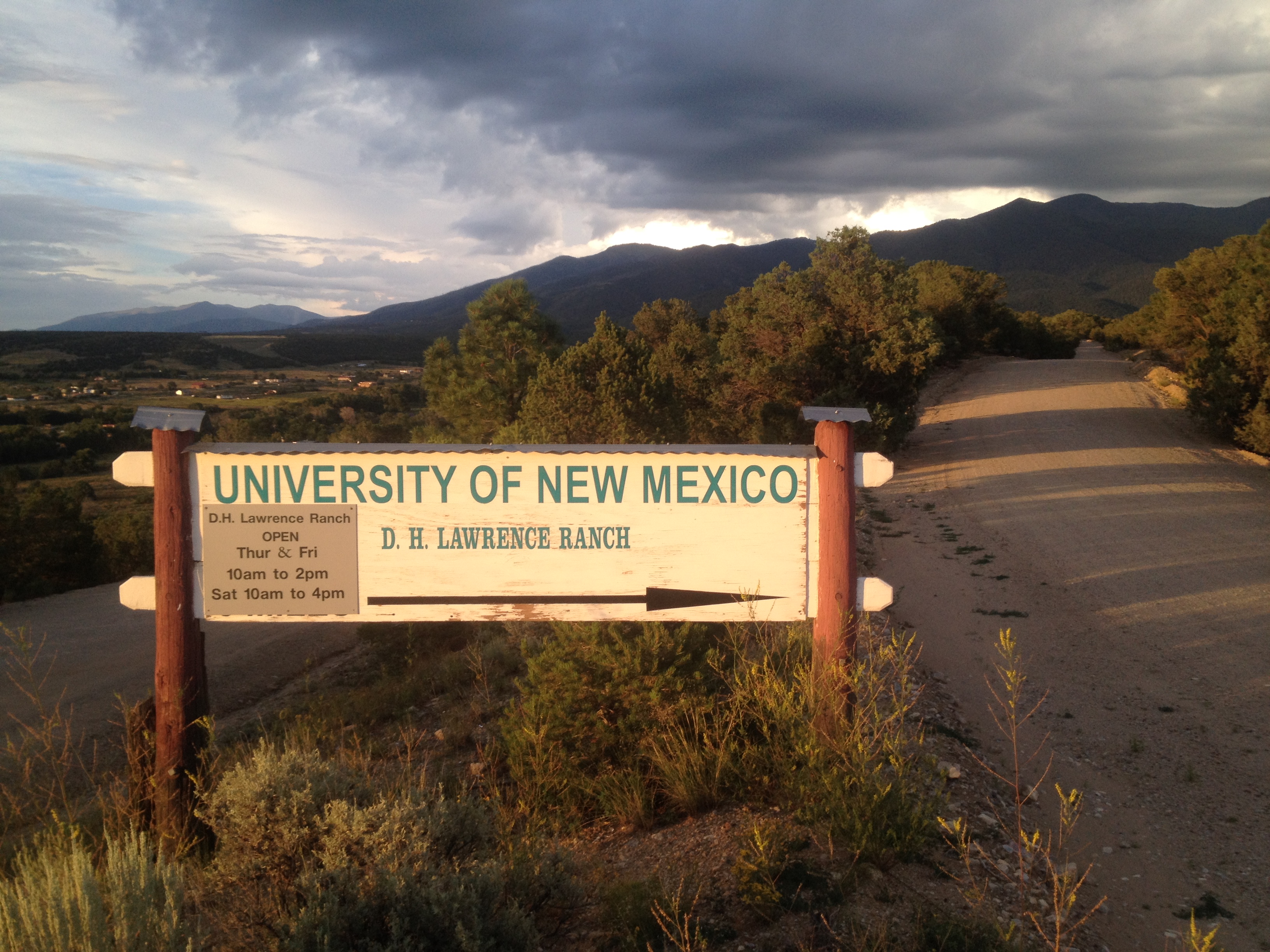
Some of the most prominent advertising, at least in San Cristobal, is linked to D.H. Lawrence’s old ranch – but even that’s minimal. A small sign off the freeway indicates the turnoff, and a slightly larger version at the fork relates the odd hours that it’s open to visitors.

The turn-off to D.H. Lawrence's old ranch.

The turn-off to D.H. Lawrence’s old ranch.

The noted English author spent several months at the ranch from 1922-25, where he produced a variety of work – pieces such as the grippingly symbolic, if disturbingly stereotypical, short story, “The Woman Who Rode Away”; several poems whose sounds and images resonate deep within one’s chest; and a rather bizarre essay titled “Reflections on the Death of a Porcupine,” among others. Reading these pieces on New Mexican soil, one is transported into Lawrence’s own conflicted world – a place where indigenous peoples are stereotyped, spiritualized, and recognized as being both stereotyped and spiritualized; a place where nature is both trance-inducing and deadly; a place where humans exhibit the darkest of desires – none more prominent than the desire to gain power, dominance and control over one another, whether overtly or covertly. As Lawrence notes in “Reflections on the Death of a Porcupine” – “it is always conquest, conquered and conqueror, for ever.”

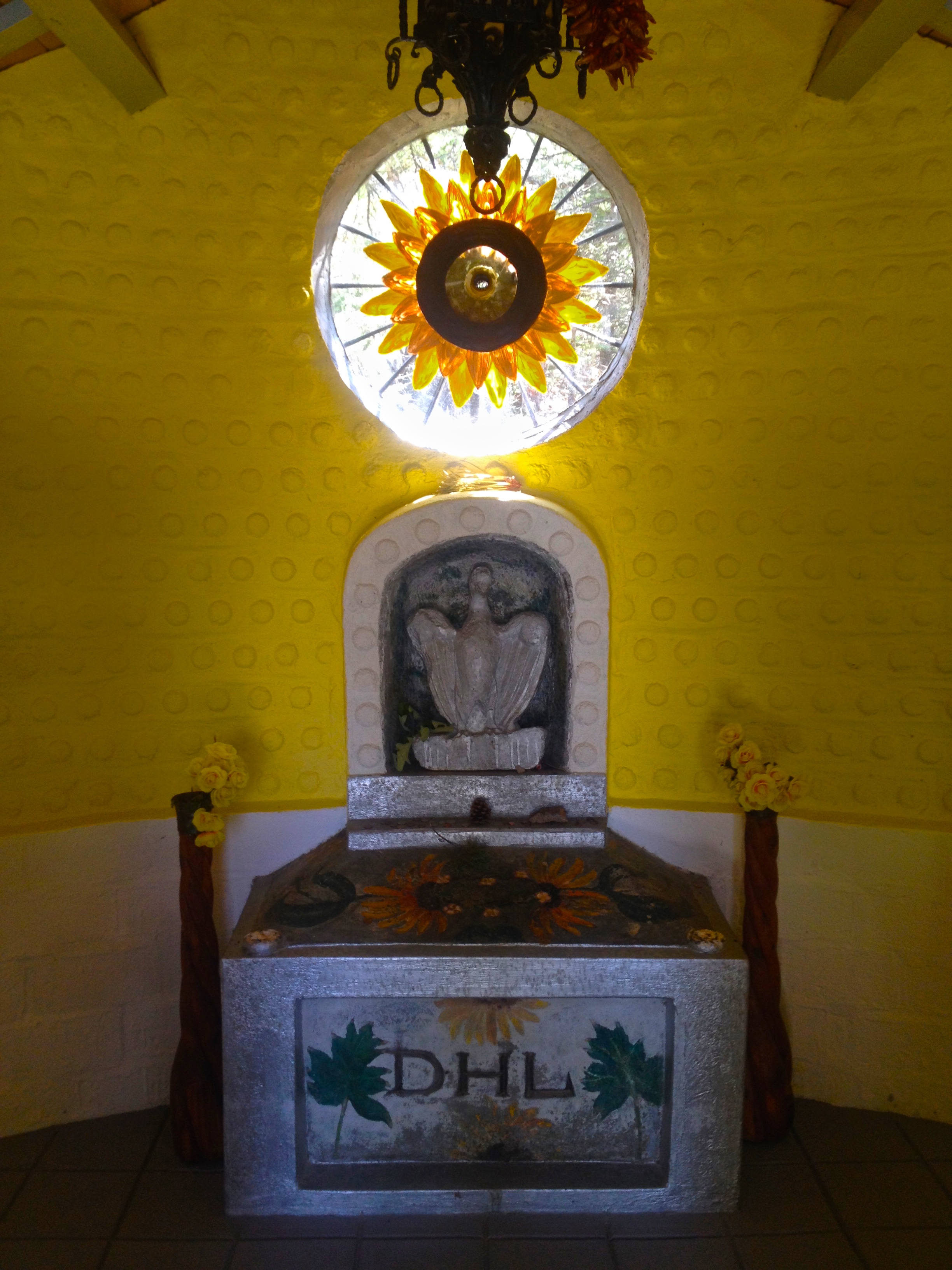
This violent and competitive worldview pervades many of Lawrence’s writings, and seems to have informed his personal relationships as well – his marriage suffered from its share of physical brutality. Lawrence ostensibly moved to New Mexico with the idea of starting a utopian community called Rananim – but only his wife Frieda, his friend Dorothy Brett and his American patron Mabel Luhan (who owned the ranch, and eventually gave it to the Lawrences in exchange for the manuscript of “Sons and Lovers”) actually showed up. According to signs at the ranch, the three women “often competed for his attention,” and after his death from tuberculosis in 1930, they continued to battle over his ashes. When Brett and Luhan expressed a desire to spread them across the ranch, the story goes, Frieda dumped them into a wheelbarrow of fresh cement, saying, “Now let’s see them steal this!” Today, the ashes are allegedly cemented into a rather gaudy altar at the Lawrence Memorial, topped by a statue of Lawrence’s “personal symbol”: the phoenix. This phoenix – unlike the fiery figure of death and rebirth immortalized in Lawrence’s poetry – is rather sad-looking, faceless, and resembles something more along the lines of a plucked chicken.

The D.H. Lawrence Memorial shrine.

The D.H. Lawrence Memorial shrine.

Lawrence’s novels were contentious as well – The Rainbow (1915) and Lady Chatterley’s Lover (1928) were both considered “obscene” and suppressed in England – and his series of oil paintings that were shown at a London gallery in 1929 were promptly confiscated by police and banned from English soil for similar offenses. Nine of these now reside at the La Fonda Hotel in the Taos plaza, protected by a curtain. One afternoon I wandered down there with the intent of seeing the “D.H. Lawrence Forbidden Art Collection,” as it was called; a postcard of the paintings showed several naked people frolicking with fawns in a garden. I’d visited his ranch; I’d read most of his writings on New Mexico – all that remained, it seemed, was to view his hidden paintings.

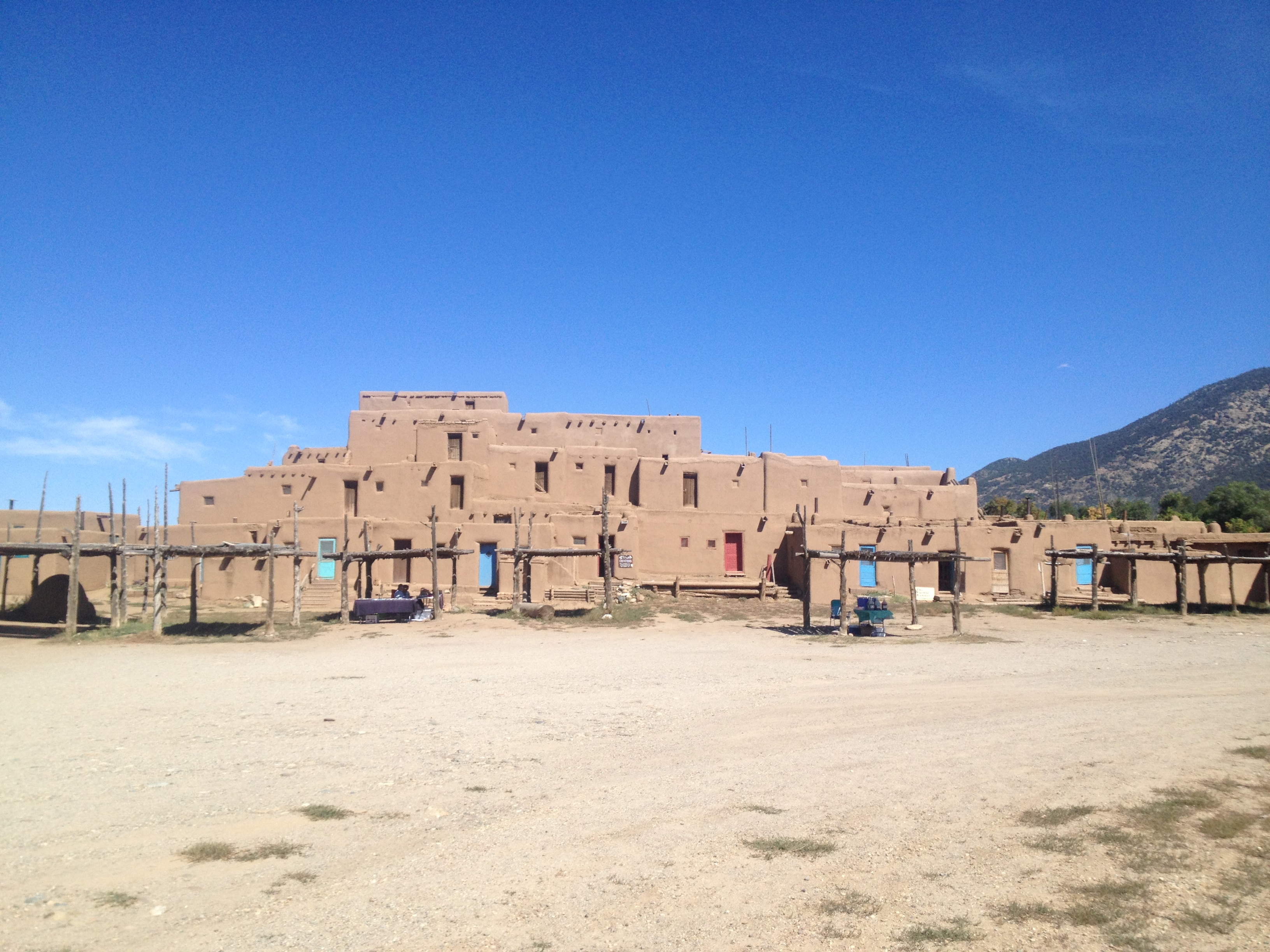
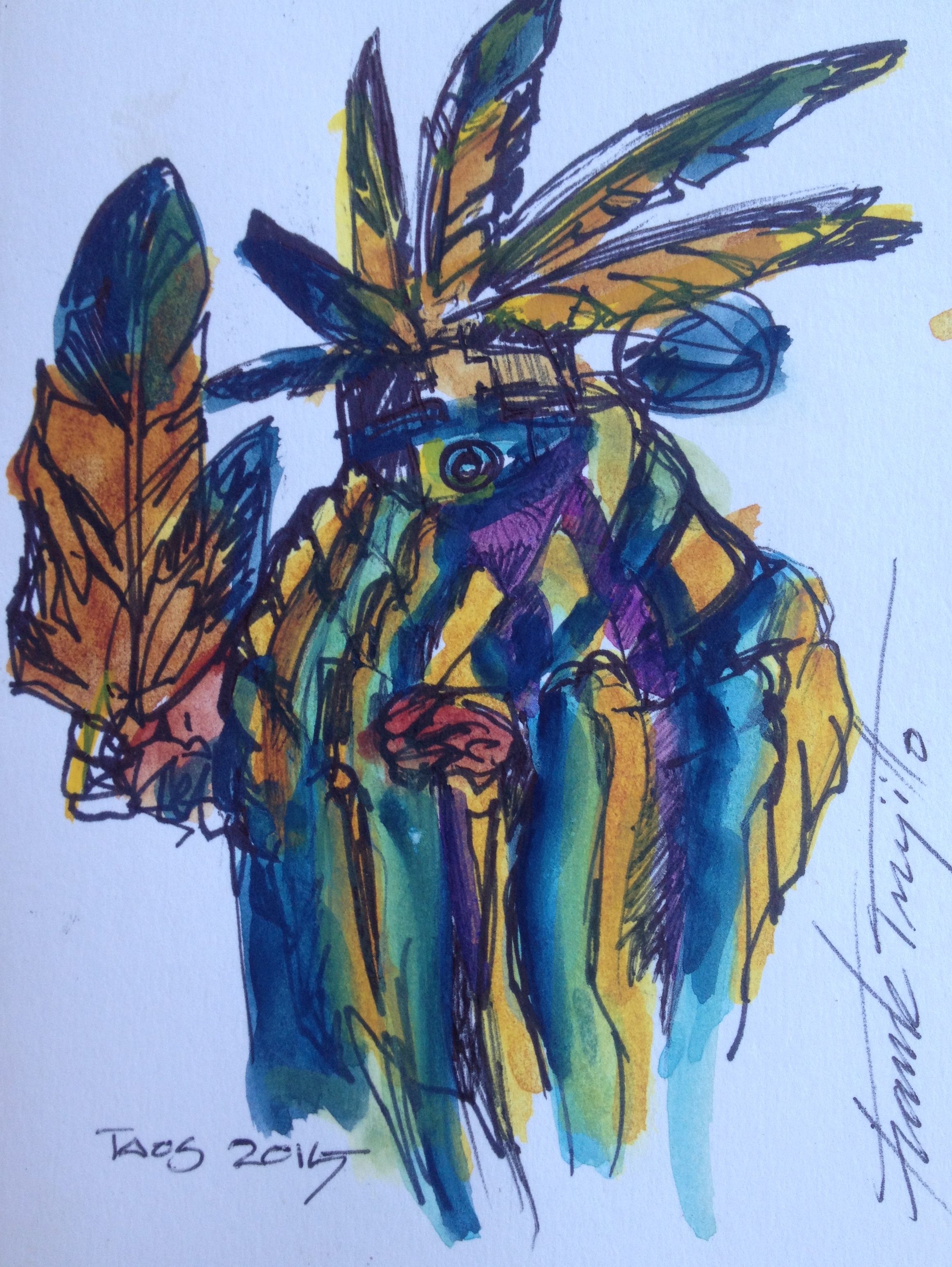
But as I wandered around the plaza, waiting for the tour to start, I noticed a man seated on the steps, painting on small paper cards. He had long black hair and weathered skin, and introduced himself as Frank Trujillo, an artist from Taos Pueblo – one of the oldest continuous settlements in the U.S. and home to the Tiwa people, about whom Lawrence had written several essays. (Lawrence’s writings on Native peoples range from sympathetic to racist to insightful to absurd; he calls them “savages” in one breath, and in the next, argues that they should keep their lands.) Frank invited me to sit down, and showed me his work – beautiful watercolors of animals and landscapes. He was currently painting a raven, and one side of the bird was dark as the night sky and filled with stars; the other was pure white.

The Taos Pueblo.

The Taos Pueblo.

“Each of my cards has a meaning,” Frank explained. “This is the raven. One side is black because it represents curiosity and intuition. But the other is white, because it represents the other side of the raven – the trickster.” Then, Frank pulled out a plastic-covered photo album and began showing me the chalkboards that he’d done for various businesses – including a number of cafés in Denver, where he used to live. He began reminiscing about one particularly successful chalk piece he’d done in Taos – Dennis Hopper’s character from “Easy Rider.”

“I did this life-sized portrait, for Dennis Hopper Day,” he said, tossing out another big New Mexico name. “People loved it – they were all stopping to take photos with it.”

“Wait a minute,” I said. “There’s a Dennis Hopper Day?”

“Oh yeah,” Frank said. We continued to chat, and soon moved away from celebrities and on to more personal subjects. Frank told me about his childhood, and about his biggest regrets in life. He encouraged me to accomplish whatever it was that I wanted to accomplish. I explained that I was less interested in accomplishments lately, and felt more that I was following a path that was somewhat out of my control. Frank paused thoughtfully. Then, he said: “You know, I didn’t grow up in the kiva, so I trained to do sweat lodges in the Lakota tradition. I was in charge of keeping the fire. At first, I was scared of the fire. I would wear big coats, and keep my distance from it. But my teacher told me that I had to make friends with the fire. So I learned how to do that, and in the end, I would tend the fire wearing just a loincloth.” We talked some more, and then I gave Frank a book of poetry that I was carrying. He gave me one of his cards – a shaman holding an eagle feather. By the time we were finished, some hours had passed, and I’d missed my chance to see Lawrence’s infamous paintings. Instead it was just one woman meeting a man, in a place where nothing ever happened, under the big New Mexican sky.

Frank Trujllo's card, picturing a shaman holding an eagle feather.

Frank Trujillo’s card, picturing a shaman holding an eagle feather.

Later, I finished the book of D.H. Lawrence’s writings on New Mexico, and discovered that the ashes in the shrine were quite possibly not Lawrence’s at all (according to Keith Sagar’s account, Frieda’s next husband, not wanting to deal with the bother of transporting them from France, had replaced them with ordinary cinders). I wondered what Lawrence would have made of the switch. I wondered what he would have made of my detour earlier that day; of my appreciation of Frank’s artwork in lieu of his own. What would have been the conquest? Who would have been the conqueror, and who the conquered?

In the end, though, it didn’t really matter – his worldview was not my own. Sometimes it’s simply more important to appreciate what’s vital and alive and right in front of you than what someone else has said, or done, or hidden behind the curtain of some fancy hotel. Sometimes you set out in search of one thing, and find another. Sometimes, ashes aren’t what they seem – and sometimes, when life demands it of you, you have to make friends with the fire.

Don’t Stop Believing

“I feel that there are too many realities. What I set down here is true until someone else passes that way and rearranges the world in his own style.” – John Steinbeck, Travels with Charley.

“Everyone in Taos believes in everything,” I told an anthropologist friend of mine as we chatted over Skype. He was showing me his 6-month old son, and his view across the Aegean Sea to Gallipoli. I was showing him the bunkhouse where I was living and the goats I’d just fed. It was 7:00 am in New Mexico; 4:00 pm in Turkey.

“Wait,” my friend said. “Did you just say that everyone in Taos believes in everything? That’s a great first line for an article. Now you just have to find somebody that you can quote saying it.”

“Great idea,” I said. But then, suddenly, I realized that I had a blog. Aha! I could just quote myself.

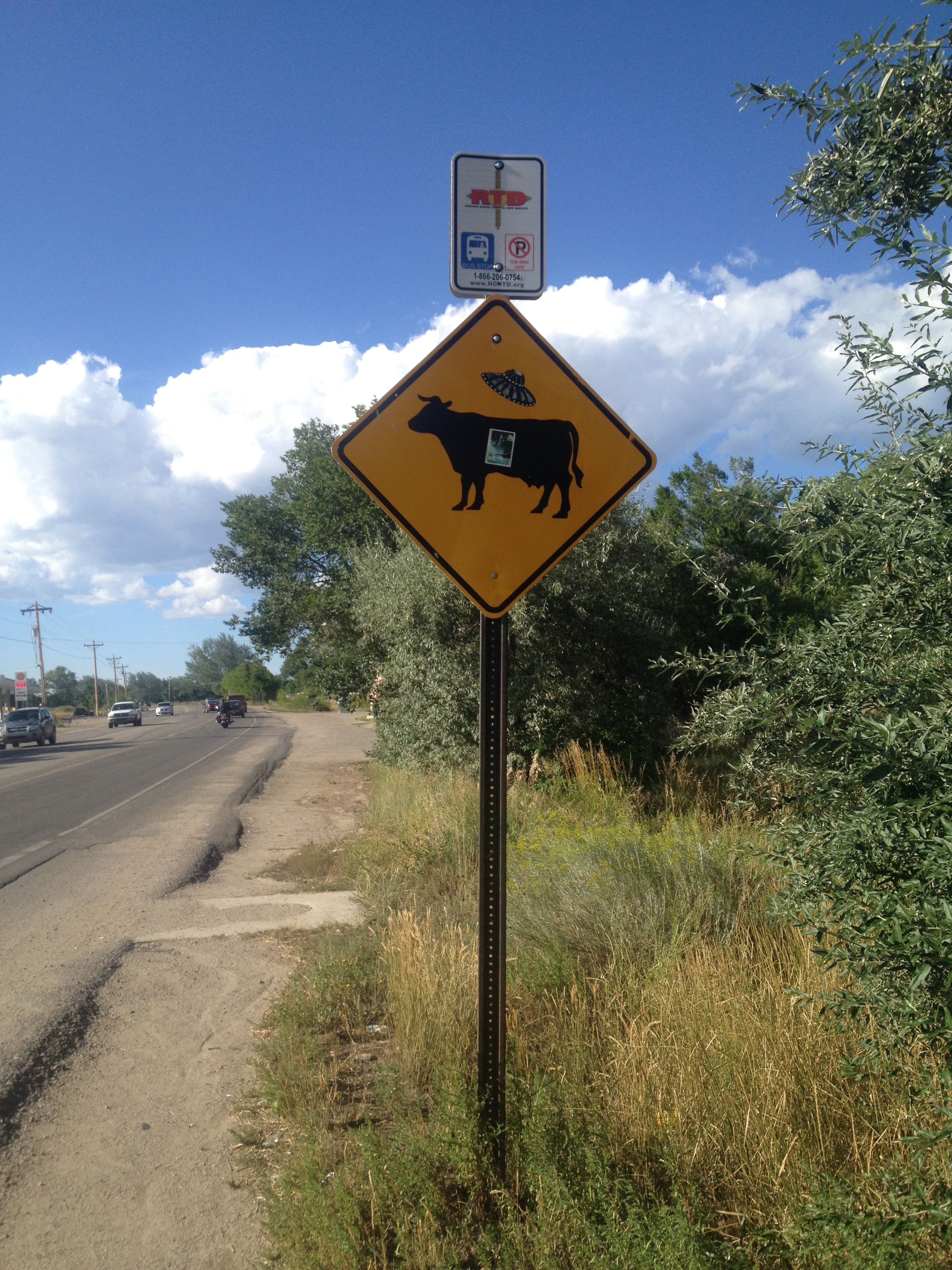
Cow crossing or UFO abduction?

Cow crossing or UFO abduction?

And it’s somewhat true, at least – everybody in Taos kind of does believe in everything. Alien interventions, government conspiracies, Bigfoot, witchcraft – it’s all just par for the course. The roads around Taos are peppered with yellow, diamond-shaped signs with a silhouette of a cow at the center, to indicate that cattle may be crossing. While this may be somewhat normal, most are also plastered with stickers of UFOs hovering above the poor, unsuspecting beasts. Some believe it’s a prank, while others find it further indication that aliens are to blame for unexplained cattle mutilations. Conversations regularly veer into the supernatural and surreal – and never more often than at Eske’s, a local brew pub that boasts a lively bluegrass jam on Wednesdays.

(Plastic Jesus – one of many possible entities in which to place one’s belief.)

My first evening at Eske’s, we shared a table with a man dressed in a cowboy hat and jeans, who asked where I was from. When I told him California, he nodded in confirmation. “I can tell you’re not from here,” he said. “You’re too dressed up.” I looked down at my outfit – a striped shirt-dress from Target, a fleece jacket and oversized flip-flops. I was wearing no makeup, I hadn’t blow-dried my hair in weeks, and my toenail polish had grown out so that only my big toes were partially red. Still, compared to many of the locals – dreadlocked, bearded, and decked out in dusty thrift store finds – I guessed he could be right. He told me about his aerial photography business, and his efforts to fix up his house in Taos. Then, he moved on to the Illuminati.

“I’m not sure that I believe in the Illuminati,” I told him.

“Huh.” He snorted dismissively, one eyebrow raised. “Do your research.”

A couple of weeks later, a similar conversation took place with a man who identified himself as White Dog, a garrulous Pennsylvania native who’d recently moved out to the Mesa – the legendary, rather lawless stretch of cheap desert land west of Taos. White Dog had a scrappy beard, a well-worn hat, and plenty of strong opinions, including somewhat similar anti-government views. “Are you all up to date on the military assault on Bundy’s ranch?” he wanted to know. I told him that I wasn’t, so he filled me in on Cliven Bundy, a Nevada rancher who’s engaged in a long-term standoff with the BLM over the right to graze his cattle on federal land. “I was there, you know,” he said proudly. Then, he told me about moving out to the Mesa. He’d driven out there, map in hand, he said, following signs that read, “Land for Sale.” He’d pulled to a stop somewhere, and one girl came out of her house to ask him what he was doing. “I could see pretty quickly that she was a crackhead,” White Dog said. Nevertheless, he bought the land, and had since been living there, off-grid, largely avoiding his neighbors.

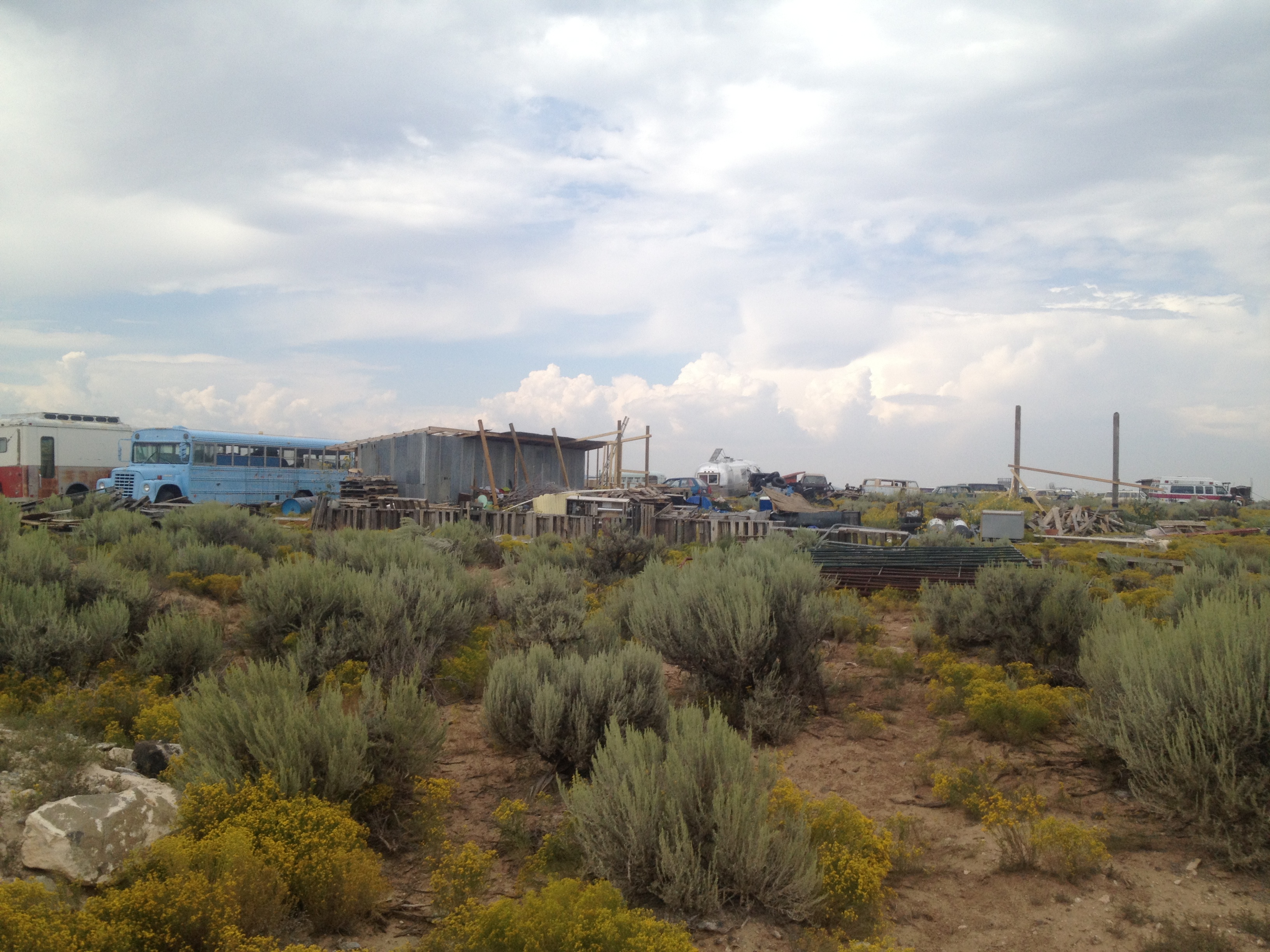
Wooden fences, old buses and shed-like dwellings – common sights on the Mesa.

If the Wild West still exists anywhere, it’s on the Mesa. Rumors abound – it’s said to be home to grungy hippies and criminals evading the law; a haven for writers, hermits, artists and outlaws escaping so-called civilization. Land sells for as little as $650 a 1/4 acre (people who purchased it years ago allegedly bought it for as little as $5). There are no building codes, no paved roads, and dwellings range from trailers to handmade hobbit homes to relatively upscale houses. Unless you have thousands of dollars with which to drive a well, the only available water is from a communal site. One adventurous Sunday afternoon, I joined several other farmworkers to visit Tres Orejas, or Three Peaks – one of the Taos Mesa’s three main subdivisions. We passed the Gorge bridge, where tourists pause to ogle down rocky walls to the Rio Grande far below, and pulled off the main highway; about four miles down, a sign that read “Evolve” was flanked by a few shreds of fabric flapping in the breeze.

Evolve

The turn-off to the Three Peaks Mesa.

Easing onto the dirt road, we surveyed the post-apocalyptic scene around us. Colorful, mutant animal sculptures hovered amid patches of yellow chamisa flowers. Abandoned buses spotted the fields, and ramshackle fences protected residents from scrutiny. Behind one such fence, we could glimpse pieces of a broken-down trailer. Other dwellings were more carefully constructed, made of cement or adobe and boasting large, healthy solar panels. We drove up and down the main road, past a half-finished house with crows perched on its posts and bits of garbage littering the yard. A free pile of secondhand clothes sat next to a community board with a torn sheet lamenting a “Lost Dog.”

If you’re not sure where to go, this creepy pink finger will direct you.

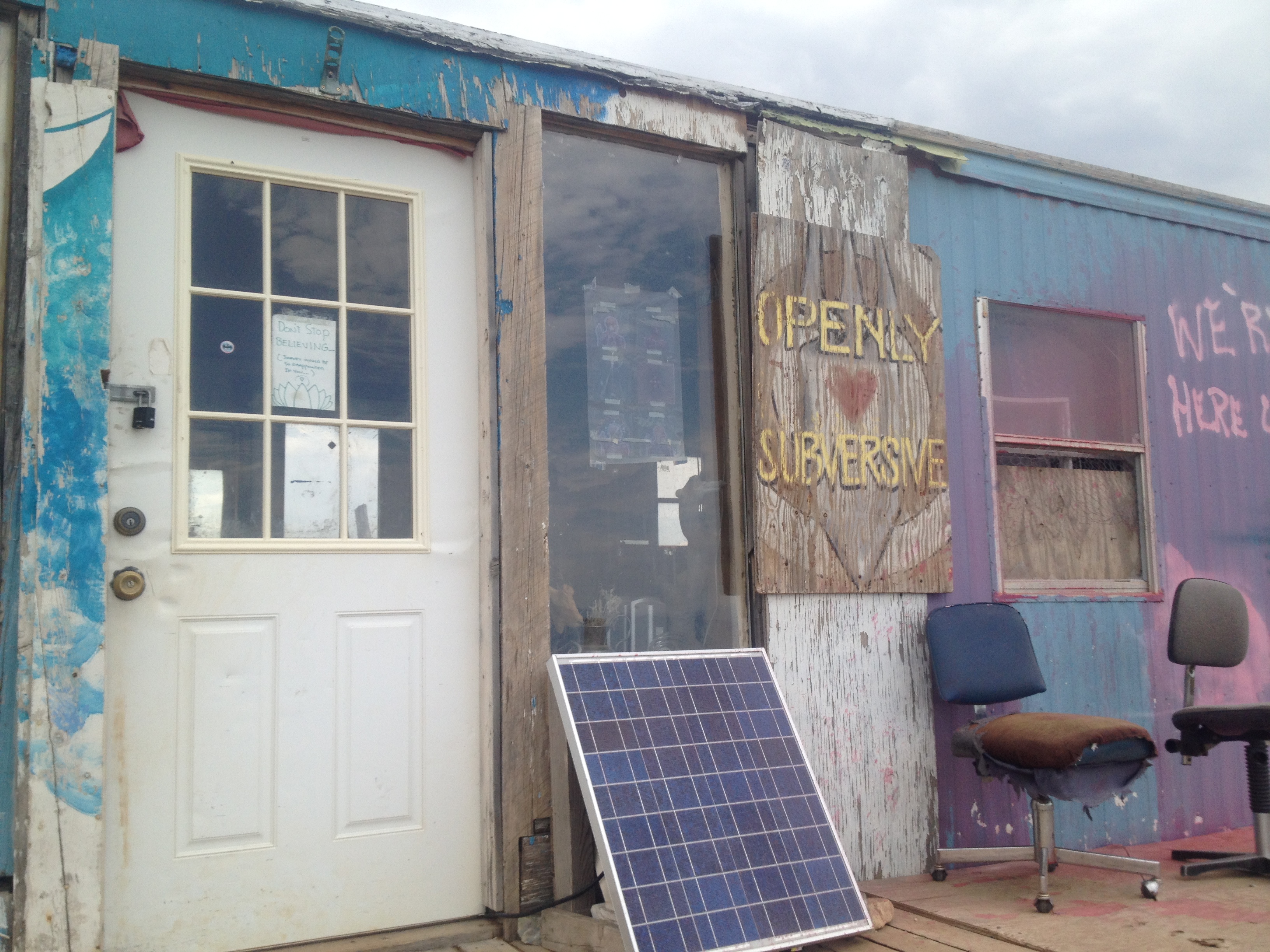
Soon, we realized why it felt so strange – there was absolutely no-one around. There we were, at 4:00 pm on a Sunday afternoon, and there wasn’t one person sitting outside on a porch; there wasn’t one person walking to their car; not one person, as far as we could see, gazing out from behind the cracked window pane of an old school bus. The Mesa, it appeared, was the epitome of a desolate wasteland. In a last-ditch effort to encounter humans, we stopped at the “Sky Café” – a trailer painted turquoise and decorated with phrases such as “Please sign your artwork” and “I love my life.” We approached the door and peered inside – it was like the residents had walked off one day and had simply disappeared (or – dare I say it? – had been abducted by aliens). There was a thin layer of dust over everything, and even the water tank was dry.

The abandoned Sky Café.

The abandoned Sky Café.

What had happened there? Taos is said to be a place that welcomes some, and quickly drives others away. “The mountains either like you or they don’t,” I’d been told. Another person had informed me of the Taos Hum – a small percentage of people in Taos, he explained, experience a grinding, low-level hum in their ears, and the noise has forced many to flee. “Maybe it’s the land defending itself,” he said. “Maybe that’s how it decides who can stay and who should go.”

I, for one, didn’t have any answers. But the longer I stayed in Taos, the more its strange beliefs began to feel normal – after all, in Taos they were the norm. Perhaps they weren’t so strange after all. Perhaps they were no stranger than the idea that everyone should follow a similar trajectory in life – that they should get an education, take on a high-paying job to pay for that education, buy a house, have children, drive to work every day, blow-dry their hair and keep their toenails freshly painted. Perhaps it made just as much sense to wear clothes from the free pile, buy land on the Mesa and get abducted by aliens. Who was I to say?

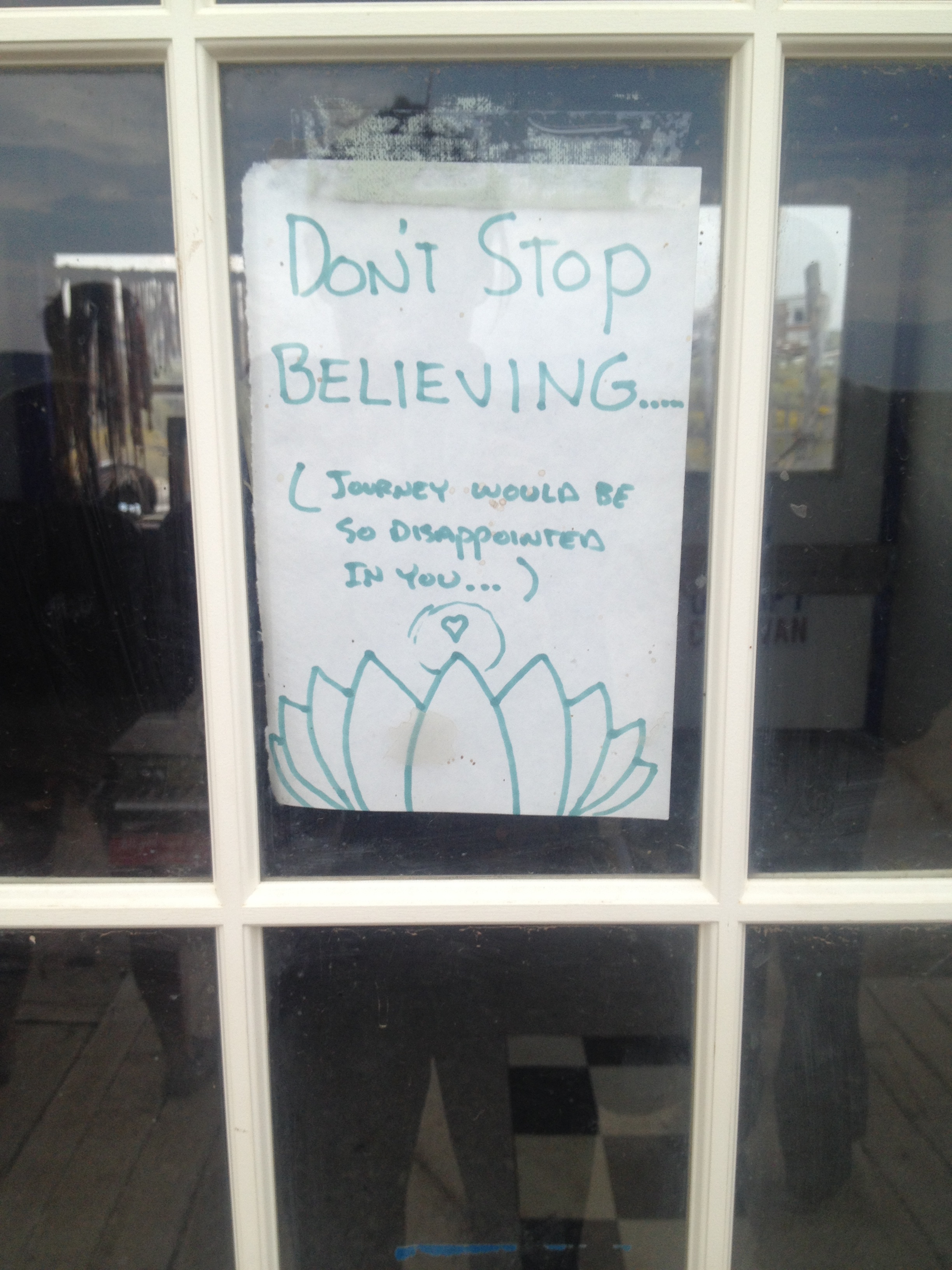
Regardless, one thing was clear – it was important that everyone adhere to some sort of belief. After all, people were counting on one another to conform, even if that meant not conforming. As the sign on the Sky Café’s locked door admonished: “Don’t Stop Believing. Journey would be SO disappointed in you.”

Sign on the abandoned Sky Café.

Sign on the abandoned Sky Café.

Animal Farm

“I wonder why we think the thoughts and emotions of animals are simple.” – John Steinbeck, Travels with Charley.

The Taos Gogi Eco Lodge sits 11 miles north of Taos in the small village of San Cristobal, just below D.H. Lawrence’s old ranch. Its 40 acres of gogi trees, vegetable gardens and fields are nestled within the Sangre de Cristo mountains, at an altitude of some 7,500 feet. There are plenty of humans around – its owners, Eric and Elizabeth, and their children and grandchildren, as well as a handful of cabin dwellers and 6-8 temporary farmhands working in exchange for food and accommodation. But its most notable inhabitants are the animals – the goats and sheep and chickens and coyotes who populate the fields, form hierarchies, create bonds and navigate the intricacies and politics of rural life.

Sign

A sign on D.H. Lawrence’s old ranch.

María Lionza and I arrived early one evening, just as the sun was setting over the mountains to the west, streaking the sky with purple and gold. I wandered around between the rustic old buildings until I located someone who showed me to my bunker – a tiny, handmade home that María Lionza and I would be sharing with another woman. We made ourselves comfortable, and I let her out to explore. With some misgivings, she stepped from her carrier and sniffed at the open air. Did she smell the tangy red gogi berries growing in the fields below? Was she absorbing the stench of coyotes that howled in packs as they haunted the land at night? Or was it simply the knowledge, carried on the wind, that there were new animals in this place – new relationships to form, to navigate and to grow? Whether or not cats’ olfactory senses are equal to those of dogs, she was definitely garnering valuable information from the evening breeze.

María Lionza guards our bunkhouse from a comfortable spot on the porch.

María Lionza guards our bunkhouse from a comfortable spot on the porch.

I’m quite certain that María Lionza has magical powers, though I’d be hard pressed to say what, exactly, they are. After all, she’s named for a Venezuelan cult goddess – head of a religion that blends Santería, Catholicism and indigenous beliefs, and often pictured as a green-eyed, topless woman riding a tapir. Her pantheon includes an Indian chief named Guaicaipuro and the black slave Negro Felipe, both of whom were murdered by Spanish colonists, and they oversee courts of lesser deities made up of famous authors, Catholic saints, political figures and deceased criminals. How could she not be magical? When I was living in Venezuela, I attended a ritualistic annual gathering of María Lionza’s followers on Sorte – the mountain in western Yaracuy state where people make pilgrimages to walk on fire, drink copious amounts of rum and smoke cigars – and watched as a person possessed by Erik the Red chewed on shards of glass. Surely, there was a purpose for all this. And though I wasn’t sure how, exactly, my cat was somehow, quite clearly, involved.

Worshippers pay homage to the goddess María Lionza at Sorte mountain in Venezuela.

Worshippers pay homage to the goddess María Lionza at Sorte mountain in Venezuela.

María Lionza watches farm life from the comfort of her camp chair.

María Lionza watches farm life from the comfort of her camp chair.

While María Lionza had claimed our porch and garden for her own, it wasn’t long before others began approaching in an attempt to forge a friendship. Yoda – a stunted young goat that everybody had feared wouldn’t make it, one who’d only recently begun to walk – wandered over to the stoop with Shanti, the wiener dog, in tow. They sniffed at María Lionza in a friendly, welcoming manner, but she backed them off with a hiss. Undeterred, Shanti became more crafty, sneaking up on her from various other angles in an attempt to get close, grabbing a few licks of her long fur before being shooed away. Yoda simply forged straight ahead. After all, everybody else loved him, didn’t they? Surely, María Lionza would come around. But she didn’t – at least in the short term – and they finally gave up, moving on to nibble at some ragweed in the yard.

That there was a hierarchy among the animals soon became apparent. The larger goat, Luna, was clearly in charge – hurling herself recklessly on top of tree seedlings and head-butting the others into submission. Obi-Wan, the sheep, followed Luna everywhere with a blind sort of trust, happily signing on for her mission of the moment – whether it was harassing the chickens or munching on the forbidden fruits of the gogi trees. When I entered their pen in the mornings, I would often find Luna and Obi-Wan cuddling, their knobby limbs entwined in an awkward embrace. And as they took off on their daily adventures, Yoda would sometimes join them, bumbling alongside; at others, he preferred Shanti’s smaller, more manageable antics.

Obi-Wan looks wanly at the camera.

Obi-Wan looks wanly at the camera.

While the larger animals had formed a friendly cadre led informally by Luna, the real ruler of the farmyard, I soon realized, was the rooster – King of Hearts. The name was something of a misnomer; the creature was ruthless. Big and bold and handsome, he imposed himself over the hens with an iron spur – if he wasn’t raping them, he was holding them down and plucking out their feathers with his beak. Several of the hens, their backs bare from the plucking, would cower from him in terror. Emboldened, the King of Hearts strutted around the yard – his chest puffed out, one beady, round-pupiled eye on the alert.

The King of Hearts and one of his victims.

The King of Hearts and one of his victims.

A young chick with a mohawk, as yet too small to be terrorized by the rooster.

A young chick with a mohawk, as yet too small to be terrorized by the rooster.

On the alert for what, you might ask? Good question. If anybody was the Napoleon of the farmyard it was him, and I was the Jones who would one day be driven away. María Lionza and I watched the ruckus from our porch – her rather disinterested, and I pondering the possibilities. “Go with the others,” I urged her as Yoda and Shanti rambled by, extending an invitation to join them on a forage to the feed bin. “Those goats have some eyes you can trust. Go now, form allies, there’s strength in numbers!” María Lionza simply glanced over at me, unfazed –the breeze ruffling at her mane – and lifted her magical nose to the wind.

Porch

María Lionza regards the chickens from the porch, totally uncaring.

Dark Night of the Solo Traveler

“Oh, we can populate the dark with horrors, even we who think ourselves informed and sure, believing nothing we cannot measure or weigh. I knew beyond all doubt that the dark things crowding in on me either did not exist or were not dangerous to me, and still I was afraid. I thought how terrible the nights must have been in a time when men knew the things were there and were deadly. But no, that’s wrong. If I knew they were there, I would have weapons against them, charms, prayers, some kind of alliance with forces equally strong but on my side. Knowing they were not there made me defenseless against them and perhaps more afraid.” – John Steinbeck, Travels with Charley.

María Lionza and I left Oakland one hot summer afternoon, only five hours later than planned. We piled our few remaining belongings into the yet-unnamed Honda Civic, and meandered our way along the traffic-congested 580-E and down the I-5 south toward Los Angeles. We passed yellow, drought-stricken hills, relieved only occasionally by the muted green of cornfields and grapevines and almond groves. Near Fresno, signage bellowed its support for agriculture during what has been California’s worst drought on record: “Is using water to grow food a waste?” demanded one. Another, slightly more poetic, mused that “Food grows where water flows.”

“What do you think, María?” I asked, and she responded with a single “Mew” from inside her carrier. Drought-caused desert gave way to actual desert as we entered the Mojave. Cacti spotted the sands and red rocks loomed against the blue and purple of the sky. By the time we were approaching Las Vegas, night had draped the horizon, and the freeway had become tighter and more crowded, blocked at intervals by large semis. María Lionza and I were both anxious to get out of the car, so I navigated my way eagerly toward Afton Canyon Campground – a site that I’d chosen for its good reviews, pleasant scenery and convenient location. As we pulled off the freeway and onto a dirt road – something of a surprise – I reassured María Lionza, who was growing more restless: “Don’t worry, we’re almost there.” She mewed loudly in response, and though I didn’t realize it at the time, she was almost certainly telling me I was wrong.

The road was empty and dark. The further we got from the freeway, the rougher and bumpier it became, and María Lionza jostled back and forth in her carrier. I tried to calm her as I navigated the potholes, soon realizing that we were far past the 0.3 miles that my directions had indicated. They must have been referring to the canyon’s entrance, not to the campground itself, I realized, and briefly considered turning around – but we had already come this far. Then, I saw something that made my stomach drop. In the middle of the dirt road there stood a single man with a flashlight, waving it back and forth in an indication to stop. Behind him hovered the silhouette of a van, flanked by several shadowy figures.

As a solo female traveler, there is always an extra layer of fear when encountering the unknown. I’ve passed hours in useless rehearsal of what I would do if a predatory man came upon me living alone in my tent. I’ve traveled with pepper spray, and I’ve used it. I’ve punched a guy in the face, and I’ve had to fight a guy off and run. I’ve spent bus and train rides scrunched up against windows and away from overly friendly men. I’ve been offered a ride to Paris from a Greek truck driver – one that I had no intention of accepting – whose Greek truck driver friends warned me that he was not, in fact, going to Paris. A single woman traveler must rely on her instincts far more often than usual, and must come to terms with the fact that situations will arise for which she simply cannot be prepared.

As I approached the man I slowed to a stop and lowered the window, watching for any indication that I should make my escape. I was immediately relieved by his bright, cheery attitude. “Good evening!” he said. “Are you going to the campground?”

“Yes,” I said warily. María Lionza responded with another “Mew” of protest.

“I’m sorry, we’re conducting a military exercise right now, so you’ll have to wait it out,” he said. “It’s just about to start. I wouldn’t want you going in there and getting shot at, even though they’re not real weapons. I mean they are real weapons, but they’re not real bullets.”

“All right,” I agreed. I realized that the shadowy guys by the van were decked out in full military gear, including machine guns and night vision goggles. As we waited, the sound of gunfire spattered through the night.

“Do you come here often?” I asked. Then, realizing that it sounded like a pickup line, I added lamely, “for training, I mean.”

“It’s our first time out here,” he said. “I didn’t even know there was a campground. How did you find it?”

“Google.”

He looked at his watch. “They should be finishing up by now,” he said. “There’s 30 of them and they only have to take out 10 guys.”

“Well the 10 guys are doing pretty well then, aren’t they?” I asked.

“I guess.” He seemed unimpressed. “They’re just defending.”

Slowly, the gunfire came to a halt, and one soldier passed us on his way back to the van. “Hey, you should take a selfie with that guy!” my new military guide told me.

“That’s all right,” I said. Then I reconsidered. “But maybe I could try on his night vision goggles?”

“Probably not, they’re attached to his helmet. But it looks like they’re finished. Why don’t I escort you down the road? It rained this morning and it’s a little rough down there.”

He climbed into his SUV and as I followed behind him, it became clear that “a little rough” was an understatement. Loose sand spun from my tires, and thick mud gripped at the wheels. Just before the campsite, a wide puddle threatened to halt us for good, but we made it through, only to encounter another guy with a flashlight standing there and waving me over.

“You’re staying here tonight?” he said. “All alone? It’s pretty far from the road.”

“I’m not too worried about being alone,” I told him, realizing as I said it that it was something of a lie. It was true that I’m usually OK with camping alone. It wasn’t true that I was always OK with camping alone, especially when strangers knew I’d be there camping alone – even when those strangers were helpful, friendly soldiers such as himself. “I’m more worried about the road,” I amended. “I wasn’t expecting it to be that bad.”

“Yeah,” he agreed. “We had to pull a truck out of there this morning. And it might rain again tonight.”

“Huh,” I said, looking down at my little Civic. “And this is not a truck.”

“No, it’s not,” he said.

It was somehow comforting that we had agreed on the obvious. I pulled my phone out to check the weather, and the first headline that came up was: “Storms Bring Flooding in a Flash to Los Angeles, Las Vegas and Phoenix areas.” Not looking good. Next, I checked the campsite on my phone to see what else was nearby, and noticed a red marker that hadn’t been there when I’d first found it: “Permanently closed,” it read.

“So…I probably won’t stay here tonight,” I told him. I promised María Lionza that we’d find a cheap motel as quickly as possible, and we did – just off the freeway in Baker, Ca. The fact that it was a classy joint was made apparent by its name – “Motel” – as well as the roughly painted walls and the boldly advertised “Internet,” which turned out to be a guest password for the Wells Fargo bank. Regardless, María Lionza was highly relieved to exit her carrier and stretch her legs, and I was grateful for a hot shower and a bed.

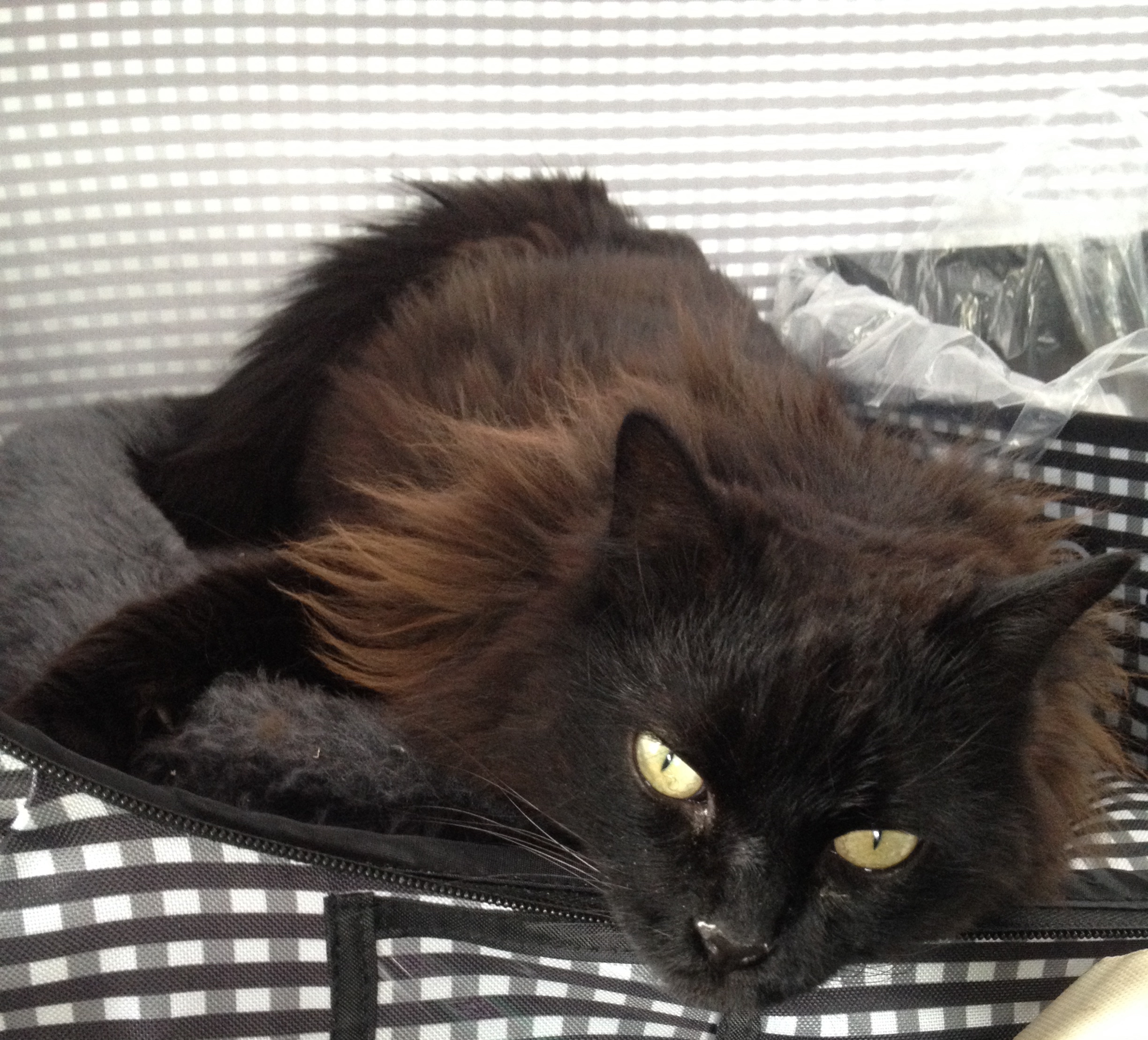
The following day, we had barely gotten on the road when María Lionza began to protest her carrier. And who could blame her? With some trepidation, I set up the alternative – a large, foldable Japanese-made contraption that I’d ordered from Amazon, big enough to contain its own bed and litter box. After stopping for fuel I released her into the car, and with a little prodding and encouragement, she headed straight back into her travel box and remained there for the most of the journey, napping on her cushion or gazing out the front windshield at the wide, desert sky.

María Lionza chilling in her car travel box.

María Lionza chilling in her car travel box.

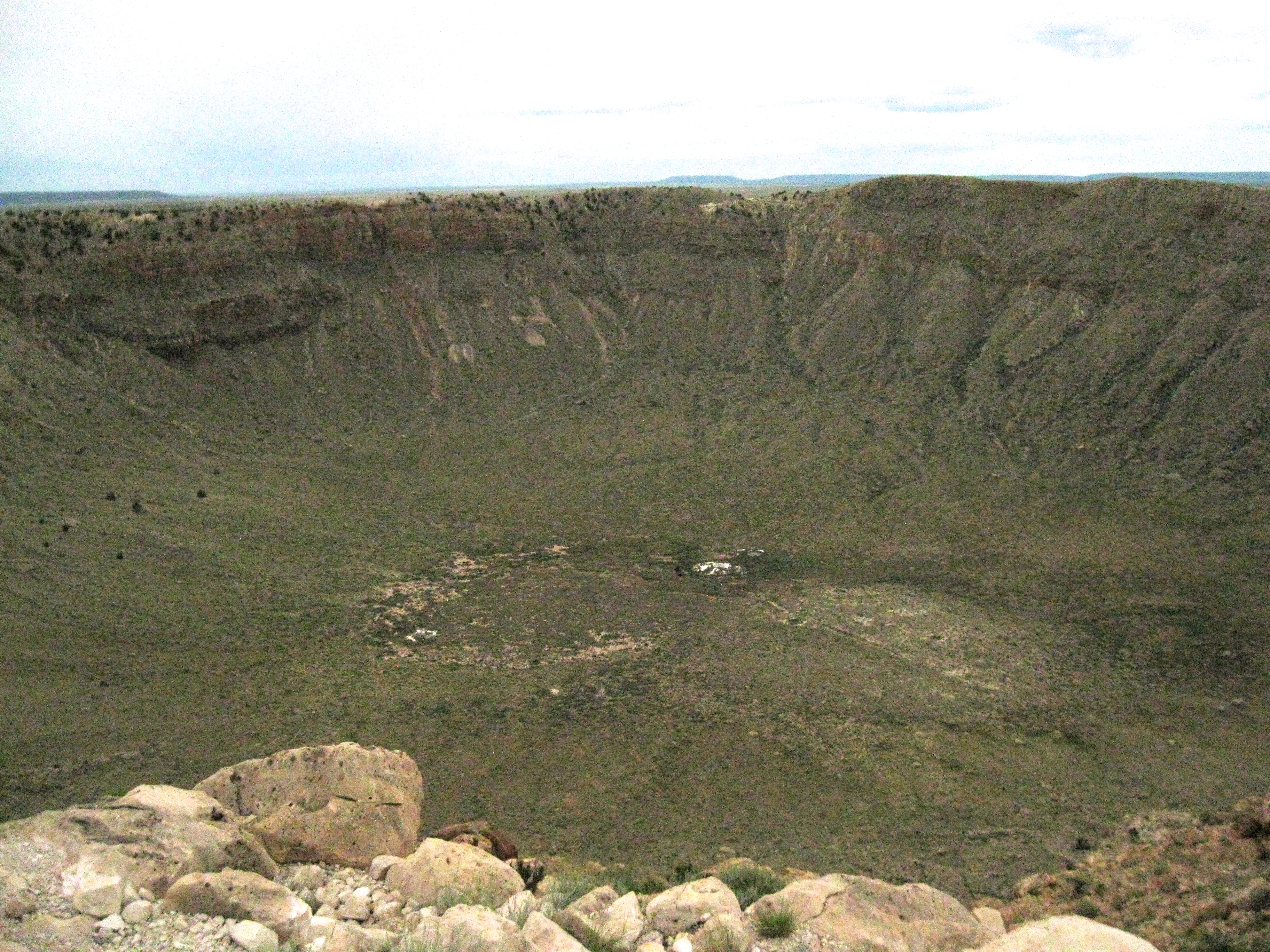
Meteor Crater in northeastern Arizona, caused 50,000 years ago by the impact of an asteroid traveling at 26,000 miles per hour.

Meteor Crater in northeastern Arizona, caused 50,000 years ago by the impact of an asteroid traveling at 26,000 miles per hour.

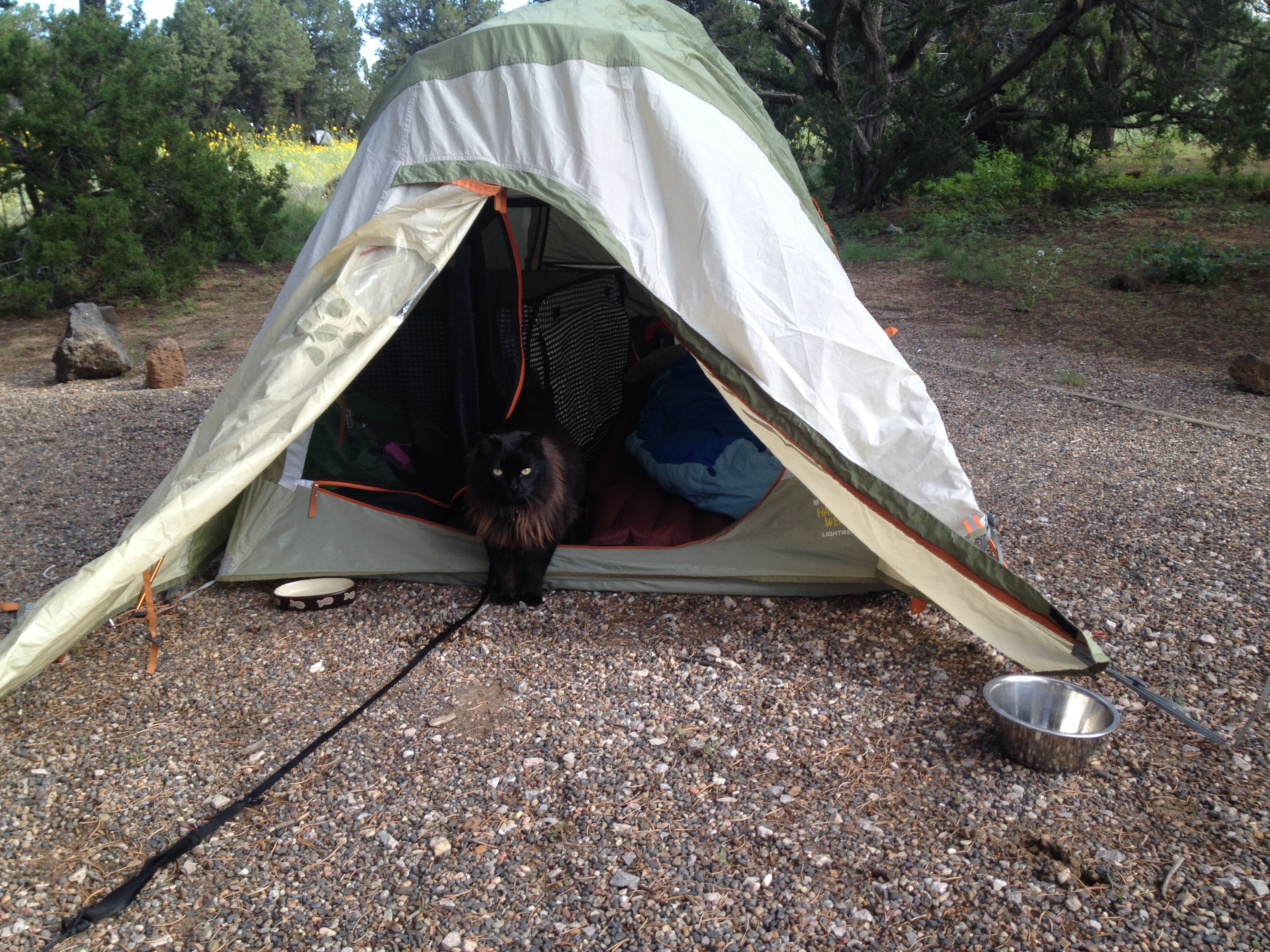
We stopped briefly at Meteor Crater in Arizona, and by nightfall found ourselves on a long stretch of road approaching El Morro National Monument, empty save for the bunnies and rodents that scampered across it at intervals. It was nearly midnight when we arrived, and – too tired to cook dinner – I set up the tent, fed María Lionza, and collapsed into bed under a star-filled sky. We woke in the morning to bright sunlight and a cheery greeting from our neighbor, Emmet. “Hello!” he enthused as I stumbled wild-haired and sleepy-eyed from the tent. “When did you arrive?!”

María Lionza stepping out into the morning air at El Morro National Monument in western New Mexico.

María Lionza steps out to explore El Morro National Monument in western New Mexico.

I explained that I’d gotten in late the previous night. Emmet commented on my tent (“What a great tent! What kind is it?”) and my cat (“In 53 years, I’ve never seen a cat camping!”). He then wanted to know if he could ask me a favor. Sure, I said. He walked over, cupping something in his hand, and offered me a seashell hanging from a piece of ribbon. “It’s a gift,” he said. “You know that when you give something, you are really the fortunate one, the one who receives. But you need someone to give it to.” I agreed and thanked him, and he donned his ankle-length robe and wide-brimmed hat, and headed off into the desert.

Thinking that I should return the favor, I took one of a small handful of crystals that I had with me – a piece of bloodstone, something I assumed he’d appreciate – and left it with a note on his picnic table. “Here’s a little something in return,” the note read. “Safe travels.” I had almost finished packing my car and was about to leave when Emmet’s voice sounded from the neighboring campsite.

“Hey!” he said. “Is this you?” I told him that it was. “Wow, I’m so glad I came back when I did,” he said, clutching the note to his chest. “It had blown off the picnic table and would have disappeared.”

“Oh good, well I’m glad I could return the favor,” I smiled. I picked up my remaining things and was on my way to my car when I realized that Emmet was again approaching, this time holding a string of beads.

“You don’t really wear beads, do you,” he said.

“No, not really.”

“Well, these are Navajo beads. They’re made of conifers – junípero, piñon – and they’re meant to protect you. They’re very special because they have six directions rather than four. They go up into the heavens and down inside of you.”

I thought back to what the monk had said about the mountains, about reaching into the heavens and the earth. “Thank you,” I said, accepting them. Small brown seeds were dispersed at intervals along four strings of white beads, splitting into six at the bottom. I wondered if I should give him something else in return, and imagined our exchange escalating, going on indefinitely until we were giving one another clothes and tents and suitcases and cars. Then I decided that that would be like the reverse of sharing a dessert and continually dividing it into smaller and smaller portions, so I took the beads and left it at that.

Navajo beads and the New Mexican sky.

Navajo beads to keep us out of harm’s way.

As I drove off under the great New Mexican sky, the beads dangling from my rearview mirror, I hoped they would provide the protection that they promised. Regardless, I told myself, I’d be fine. I was hardly the first woman to travel alone – there was Martha Gellhorn and Emily Carr. There was Laura Dekker, the 14-year-old Dutch girl who had sailed the world solo. And besides, as my Dad had pointed out, I wasn’t alone – I had a companion. I looked back at María Lionza, lounging lazily on the back seat, and smiled.

Go to the Mountains

“A trip, a safari, an exploration, is an entity, different from all other journeys. It has personality, temperament, individuality, uniqueness. A journey is a person in itself; no two are alike. And all plans, safeguards, policing and coercion are fruitless. We find after years of struggle that we do not take a trip; a trip takes us.” – John Steinbeck, Travels with Charley.

The small, still voice started sometime around January. “Go to the mountains,” it said.

At first, I ignored it. I went about my business as usual, juggling a mixture of part-time jobs – teaching, waitressing, walking dogs. I struggled with the same novel that I’d been writing and rewriting for years. I spent time with friends, went on dates, saw movies. I’d already stepped away from the mainstream of career and ambition and drive, and had fashioned a fairly comfortable, meaningful life for myself (albeit one that wasn’t entirely sustainable in the price-driven Bay Area). At nearly 37, I felt that any voice I heard should be concerned with financial stability or settling down or job security – not pushing me still further in the other direction. But, there it was. “Go to the mountains,” it said.

Finally, in an effort to appease it, I planned a solo trip to Big Sur. The last time I’d heard such a voice, I’d spent three months backpacking through the Sierras, living on less than 1,000 calories a day and going for weeks without human interaction. This time, I was hoping to get off a little easier. So I booked two nights at a campground, and two at the New Camaldoli Hermitage – a serene Carmelite monastery overlooking the ocean. On my final afternoon there, I sat on a bench with one of the monks, gazing down the lush hillside to the startling blue water below. We watched as it pounded up against the rocks, creating a whirlpool of frothy white foam.

“I just feel this urge to move to the mountains,” I told him. The Big Sur trip, I was starting to realize, hadn’t quite done it. Hell, it wasn’t even really the mountains. “Maybe it’s just about leading a simpler, more contemplative lifestyle.”

The monk nodded. “Mountains are very archetypal, you know. We’re very into Jung here.”

“What does the archetype represent?”

“Moving closer to God,” he said. “Moses went to the mountains to get the Ten Commandments. The mountains represent reaching up into the heavens while staying connected to the earth.”

“Huh,” I said. I wasn’t sure about God, but there was certainly something that was telling me to go. I asked him about the contemplative lifestyle. “I thought when I became a monk that I’d just be up here relaxing and meditating,” he laughed. “But then they sent me to Rome to get a degree. And then I was teaching in Italy for a while. Now that I’m in my 50s, I finally get to come up here and spend some time in silence. But you can’t just go to the mountains. You have to figure out how to make a living.”

Exactly, I told the voice – a living. What about a living? As the voice was clearly not satisfied with Big Sur, I found myself engaged in an ongoing argument, one that sometimes left me muttering to myself like a crazy person. What was I going to do for work? What about my two cats, Ninja and María Lionza – both of whom I’d adopted as kittens when working as a journalist in Venezuela and had since housed for eight years? María Lionza was easygoing – she could probably handle the change – but Ninja would never agree to such a move. What about my friends in the Bay Area? What about my life? But the voice didn’t have any answers. It just kept on repeating itself, like an old, tired cliché: “Go to the mountains,” it said.

I was convinced that I’d win – after all, I was the only one with any reason. Strangely, though, things began taking shape on their own – with or without my consent. A woman texted me to say that she’d met Ninja at the Kaiser Hospital garden, where he spent his days rubbing up against patients’ legs and suckering nurses into giving him treats from the coffee shop, and added that she’d love to offer him a home if ever necessary. My Internet searches turned rather unconsciously from “Kanye West Beyonce Grammys” or “Baby Zedonk” (Look it up!) to “How to repair a hole in your tent” and “Rural mountain jobs.” When I found myself bidding, against my better judgment, on an old, converted trailer on eBay – this despite the fact that I didn’t even own a car – I gave in. Fine. OK. Clearly it was happening, so I might as well get on board. I give up, I told the voice. I’ll go to the mountains.

Then, finally, the voice subsided. And, rather magically, things continued to come together on their own, with very little effort on my part. I found a Gogi berry farm north of Taos, New Mexico that offered me a work exchange for the month of August. A silver car whose low price sticker kept catching my eye– a friendly-looking, 2001 Honda Civic – turned out to be a surprisingly worthy purchase. I took María Lionza camping, and while she was rather angry at me for disrupting her routine, she handled it with enough grace to give me confidence that she’d adapt. I met someone who introduced me to someone who offered me remote work writing PR articles. And while Ninja’s new home fell through – the woman’s own missing cat had returned – another opportunity quickly presented itself with a man named Mark, an artist and military veteran who lived across the street and was a neighborhood fixture in his own right.

“I’ve decided that Ninja is from another level of consciousness,” Mark told me as we sat in his apartment in a high-ceilinged old building, cluttered with half-finished canvases, antique vessels and thick, woven tapestries. Ninja scratched at an authentic Persian rug, one that Mark had rescued from somewhere and restored. “That’s why he spends all his time with those cancer patients over at Kaiser. Because a lot of them aren’t going to make it, you know. He’s here to guide them into the next world. He’s here to ask them, ‘What do you want to do in your next life? What do you want to do with the time you’ve got left here?’”

Ninja - the saddest of many sad goodbyes.

Ninja – the saddest of many sad goodbyes.

Ninja certainly had some good questions – some familiar questions. I regarded him suspiciously as he crouched beneath an ancient wooden chair. Perhaps he’d been the one nagging at me from the beginning. His dark green eyes seemed to glow in the dim light. “Eeoowww,” he said. I tried to focus, to understand what he was saying. “Eeoowww,” he repeated. For all I knew, that could very well be cat-speak for “Go to the mountains.” For all I knew, his could have been the voice all along.