María Lionza and I left Missouri in April, as spring storms electrified the sky, tornadoes rocked the landscape and daffodils waved a bright yellow farewell. Dry soil gave way to grassy fields and gnarled trees revealed their first shoots of green. Eastern Redbud trees lined the roadsides with pale pink buds that resembled miniature Japanese cherry blossoms.


A daffodil bouquet from a neighbor, and the first signs of “green-up” along the Joplin trails.
Driving westward, the landscape gave way to the vast, brown plains of Oklahoma, the pine-filled hills and snow-topped peaks of northern New Mexico, and soon, the wildflower-speckled desert, prickly Dr. Seuss-like cacti and dry red rocks of Sedona. In these shifting surroundings we reacquainted ourselves with old friends – human companions we’d accumulated along the way; mountains and rivers we’d explored and come to know; four-legged creatures we’d encountered only in their youth. (Yoda, the stunted goat at Taos Goji, had transformed, in the many months we’d been absent, into a fully grown – and fully horned – adult.)


The rocky landscape and cacti of Sedona.
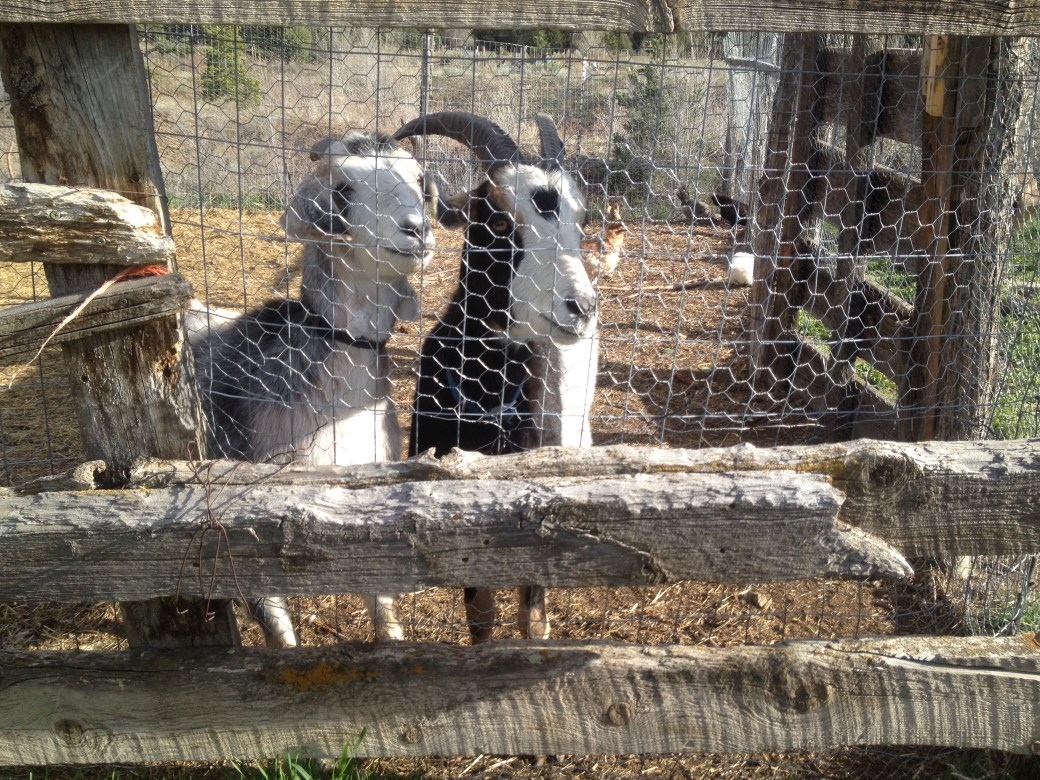
Yoda shows off his new horns.
California, too, had changed. Far from the drought-brown wasteland we’d left behind, the hills lining Highway 101 resembled a lush tropical paradise. We wound our way up along an emerald coast, circumvented the Bay Area, and settled down among the walnut groves, family-run vineyards and oak-lined streets of Lakeport.
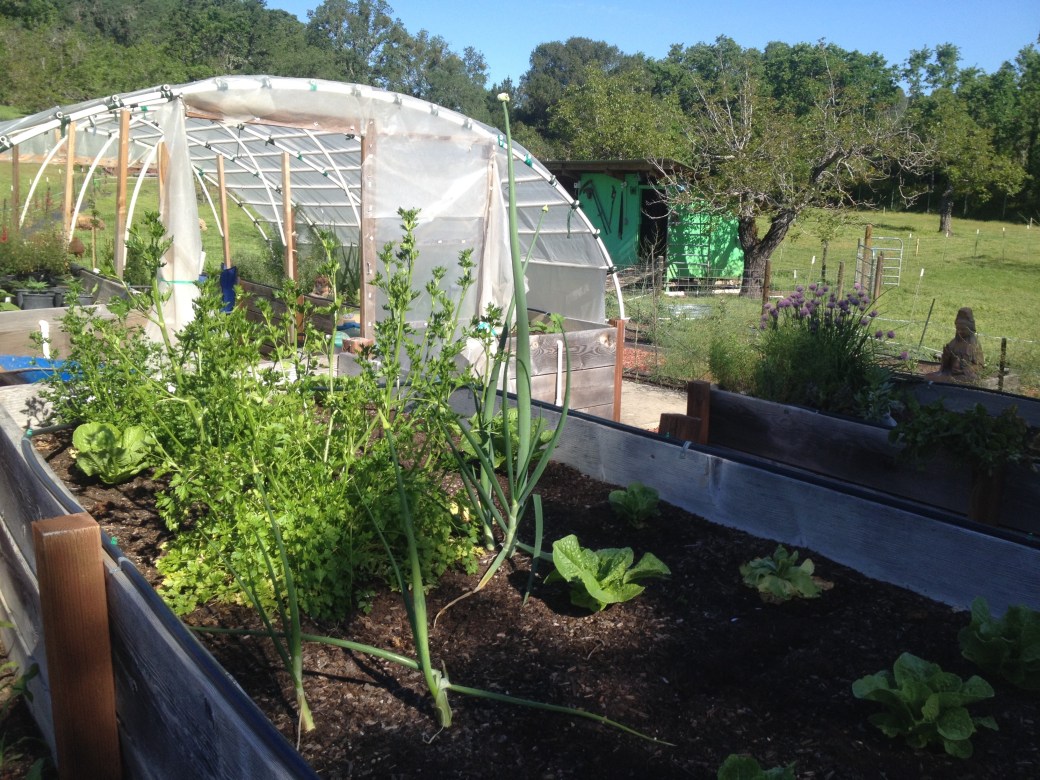
Vegetable beds and a greenhouse at Mostafa’s Garden.
There, Mostafa welcomed us to his garden – some three acres of fruit trees, vegetable beds and sheep pasture, lined with lavender bushes and decorated with a deliberate care. Mostafa – a passionate, lifelong gardener – had been inspired by Michael Pollan’s writings to move from Seattle to a place where he could raise, cook and eat his own food. He and his wife had settled on Lakeport, partly because of the surrounding landscape and superior air quality, and he’d transformed their property into a personal paradise. (The word “paradise,” I later learned, comes from an old Persian word for gardens.)
I was the eager beneficiary of Mostafa’s culinary efforts – lamb dishes, crunchy tahdig and fresh salads filled with steamed beets, mangoes, and his special avocado, feta and roasted garlic dressing. Making the evening salad was one of my duties, and, as I was informed prior to my arrival, “the fancier, the better.” Each day at mid-morning, we paused for “juice time” – a delicious ritual involving freshly juiced carrots, beets and ginger. And in the evening, Mostafa never failed to offer me ice cream, Persian sweets, or the pistachios and dried dates that he’d magically coaxed from his own trees – despite the fact that many of them were designed for different climes.

A swing made from Mostafa’s own walnut gazes out over his array of fruit trees.
Mostafa’s diverse and carefully tended garden was a natural expression of his own fascinating and highly varied life. Born to a traditional Muslim family in Iran, he spent just over a year in the U.S., where he met a Persian woman and fell in love. Both returned to Iran to participate in the Iranian Revolution, and were married. Mostafa and his socialist friends were some of the Revolution’s first political targets – once, a Mullah burst into the room where they were meeting, along with several guardsmen, and demanded somebody’s name. When the person refused to provide it without a lawyer present, Mostafa told me, one of the guardsmen shouted: “Wow, it’s just like the movies!” His companions laughed.
Mostafa and his friends were arrested soon after, and quickly discovered that prison in Iran had little in common with the American movies. The following morning, a man was shot right in front of them. Two female prisoners were sentenced to life in prison (women at the time had not been executed). Mostafa and the others struggled to prepare their own defenses against a laundry list of accusations, hoping desperately to receive the same sentence – they’d seen the execution chamber, and the ambulance waiting outside. The court tried to push them through, but the proceedings went late into the night – then spilled over into the next day, the next week. Eventually, the twelve of them were sent back to prison, where they continued to lobby for their release. But in the midst of the advocating and pleading and half-hearted hunger strikes, Mostafa, somehow, found a way to thrive. He toasted bread on a tiny rooftop stove, and spread it with butter, honey and feta cheese – a delicacy he still enjoys today. “My friends would joke that I was doing so well, if they set me free I’d choose to stay,” Mostafa said. After nine months of this, for reasons that seemed as opaque as their arrests, they were released.
Almost immediately, Mostafa was drafted to fight in the Iran-Iraq war – his second stint in the army – where he took a bullet in one side. And after further difficulties, including a tumultuous four months during which his pregnant wife was also imprisoned, the couple struggled to return to the U.S. While they suffered several misadventures, they eventually succeeded. They settled in Seattle, where his wife worked as a software engineer at IBM, and Mostafa, at first without a green card, traveled the country to earn money as a skilled face painter at Renaissance fairs. Ultimately, Mostafa learned to build computers, and was employed for much of his adult life as a software test engineer at Microsoft and a systems and software engineer at Compaq / Hewlett Packard.
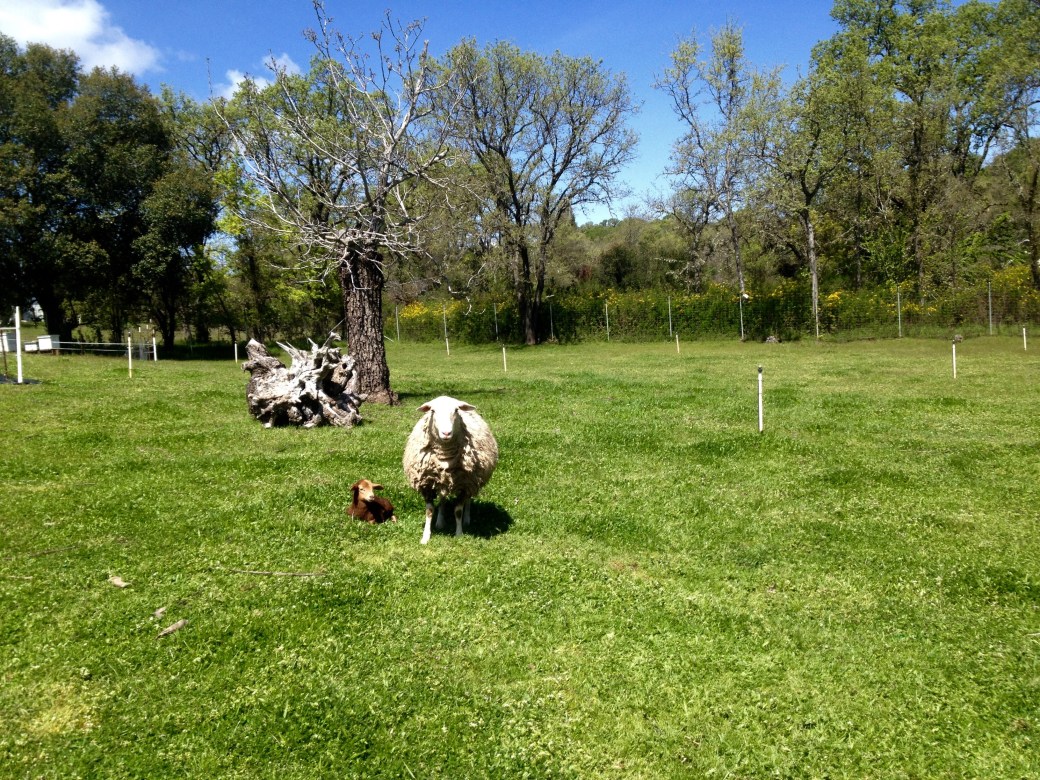
A mother watches over her young in the sheep pasture.
When his wife passed away two years ago, leaving Mostafa alone with his garden, he focused on raising game birds and lambs, and hosting farm help – like myself – for company. While he missed his wife terribly, Mostafa possessed a profound zest for life, and yearned to share it with others – ideally, gardening, hiking, biking, or otherwise enjoying the outdoors. I mostly assisted with weeding, salad making, and bottle-feeding a little lamb I named Sylvester. (Mostafa, who sometimes had trouble recalling the name, would occasionally refer to him as “Stallone.”) Each morning before dawn, when the sky was grey and the dew thick on the grass, I would trudge out to the sheep pasture and call Sylvester, and he would run over on eager, wobbly legs to greet me. And at lunch and dinner, he would stand by the gate, informing me that I was taking far too long to feed him.
But Mostafa’s garden, I soon realized, extended far beyond the confines of his property to encompass the hills, valleys, and assorted flora of Mendocino county. Several mornings, we trekked the eight miles to his favorite destination, Goat Rock – a large boulder nestled in the hollows of Cow Mountain – and I struggled to keep pace as he and his trusted dog, Balla, led the way. Luckily there were plenty of opportunities to catch my breath, as Mostafa regularly paused to exclaim in childlike wonder over oak leaves, creek beds, and newly blossoming flowers. He meticulously photographed the most recent blooms to identify later, and when his phone died, he insisted that I do the same. “You should really photograph that bunch,” he would tell me. “They are just so beautiful.”
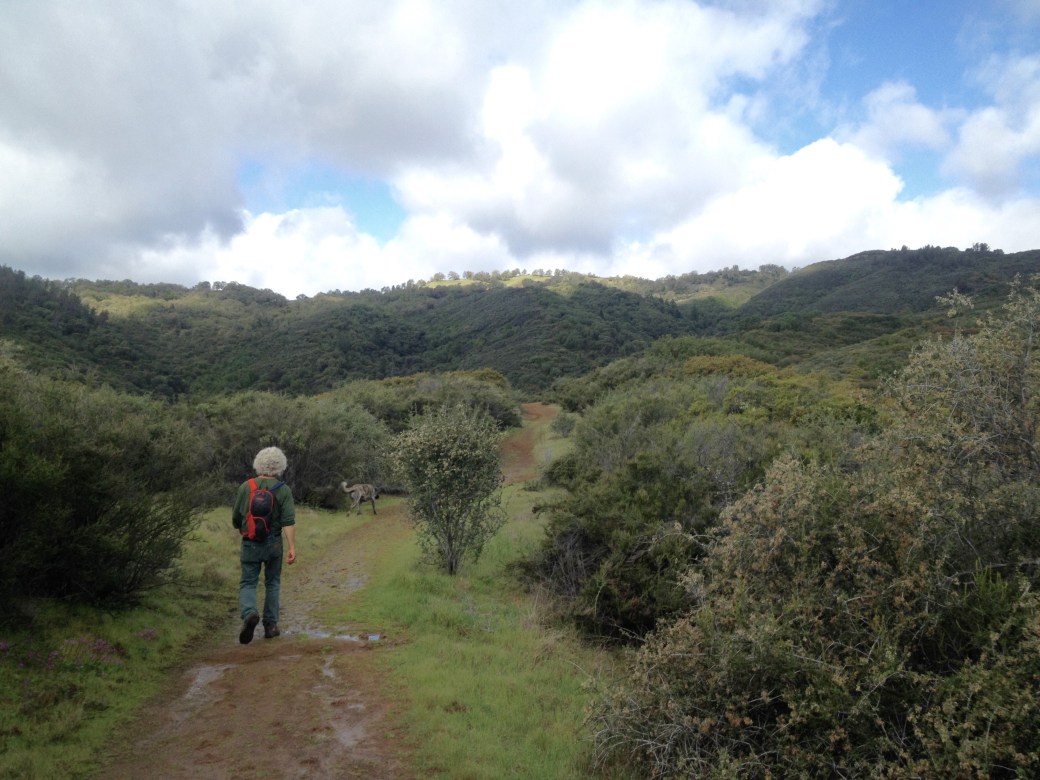
Mostafa and Balla trek through the Mendocino hills.
Mostafa’s enthusiasm was contagious. And it didn’t just apply to the natural world, but also to his wide-ranging interests – skiing, movies, music, podcasts; even, to my surprise, American democracy. He stressed that the current U.S. president, no matter how unfortunate, had been democratically elected, and, while saddened by the hate crimes that were reported with increasing frequency around the country, seemed relatively unfazed. Having struggled against the Shah, languished for months in an Iranian prison and narrowly escaped execution, Mostafa had a refreshingly positive appreciation for our choice-based system, electoral college notwithstanding. And he was equally enthusiastic about exercising his democratic right to protest, working hard to drum up support in his small, conservative town to find somebody – anybody – to accompany him to marches in Santa Rosa and beyond.
Mostafa spoke often and fondly of Iran – of the mountains, where, he told me, you could go for long, extended hikes to the most remote places, and still find a café that would serve you fresh juice. He even had good things to say about Iran’s political development –despite the fact that two of his distant family members had been recently imprisoned on unwarranted charges of espionage, and could face execution themselves. He saw it as a slow progression forward. “Iran is like a baby democracy,” he told me.
Having lived life, Mostafa had seen that one dramatic action does not necessarily solve everything – certainly not immediately. Instead, he saw democracy as something to nurture, to develop, to grow. Like one of the blooms in Mendocino county, on the way to Goat Rock, that takes its time to flower; that is to be appreciated at every stage along the way.


Flowers blossoming on Cow Mountain.
Because no matter how bad things are looking, if we can count on anything, it’s that they’ll change – and not always for the worse. A pending execution can be pardoned. Stunted goats like Yoda at Taos Goji can grow into healthy, flourishing adults. A drought-stricken coastline can, after an extensive season of rainfall, become a verdant green. And a federal decision to remove a nation from a worldwide climate agreement can always prompt better decision-making from local, state and business leaders. Mostafa treated our political situation the way he did his plants, his animals, his surroundings: with the unwavering hope and optimistic belief that, given the right conditions – the sun; the rain; a handheld bottle of lamb’s milk replacer – it, too, could find its way.
 travels with maría lionza
Beautiful, as always❤ Love following your journey. Maybe we’ll catch up one day🙏 Safe journeys.
LikeLiked by 1 person
Thank you for sharing your journey. I’m still here, changed for the better because you came this way.
LikeLiked by 1 person
❤️
LikeLiked by 1 person
Your stablishment with such a life events is amazing, l would love to visit you and your organic garden.
Your old friend
LikeLiked by 1 person