As I drove up into Idaho, winding my way north through green forests on empty roads, I pondered my next temporary home. María Lionza and I had spent a month visiting friends in Portland, Oakland and Boise, and were now heading to Lifewater Ranch, near the small town of Kooskia. I’d been told that the people in central and northern Idaho were “out there” in more ways than one. That they were libertarians, anti-government advocates, conspiracy theorists and doomsday preppers. They saw the world differently, I’d been told; as something much more dangerous and terrifying. Or at least, as something that was dangerous and terrifying for very different reasons.
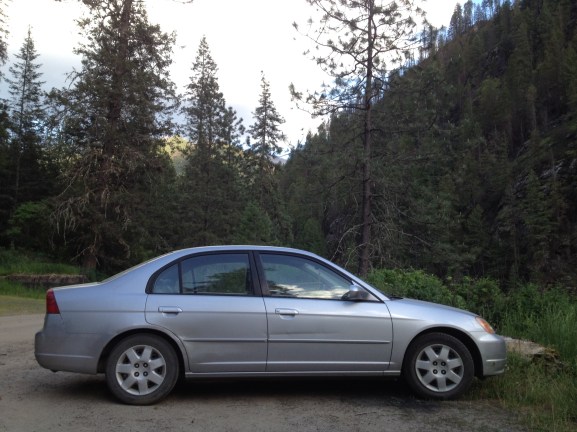
At the edge of the Selway-Bitterroot wilderness.
Fear was a phenomenon I’d lately found intriguing. Perhaps it was all the free time I’d had in April, but I’d been watching my own mind’s tendency to grab onto something – anything – that could possibly make it afraid. In the absence of any real threat – I’d had perfect weather, no car problems, and nothing but positive experiences while traveling – it would reach for anything that seemed plausible, no matter how remote. Some of these were relatively rational (What if I was spending too much money, and didn’t make enough next month? What if something happened to my car? What if I spun off on treacherous mountain roads?) Others started off somewhat rationally, and then veered off into the absurd. Probably the most obvious of these was a new and rather ridiculous obsession with my bear spray.
I’d been planning to get bear spray for months – not only would it protect me from grizzlies in Yellowstone, which I imagined I’d visit at some point, but it would also, I reasoned, prove useful on the off chance that I encountered a human predator. So when Bill, a wildlife biologist whose place I’d been housesitting in Wyoming, offered me a free can to take with me, I jumped on the opportunity. “Don’t threaten somebody with it,” he advised. “Just use it if you have to. This will bring a man to his knees.” I reassured him that I’d pepper-sprayed someone before and would be more than willing to bear spray someone if necessary. But then, he added the following warning: “And, make sure you don’t leave it in a hot car. I knew a girl who did that once and it exploded. The vehicle was useless after that.”
Well, this was concerning. How hot was hot? What if it went off while I was driving? I looked for more information on the Internet (always a dangerous venture in and of itself) and found myself ogling over photos of bear spray canisters that had lodged themselves in car roofs; videos of them wreaking havoc in moving cars; lengthy descriptions that likened them to “projectile missiles.” Soon, I found myself obsessing over the temperature outside, and what my bear spray might be doing in my trunk – actively plotting, I was sure, to demolish my only means of transportation. As I confided to friends: “I think I’m more afraid of my bear spray than I am of an actual bear.”

There it is – the infamous bear spray.
I was aware that this obsessive consideration was at best, unproductive, and at worst, totally crazy. As one friend advised, “that’s just one of those things you have to leave up to fate.” So why was I trying so hard control it? Perhaps it was that I’d given up control in so many other ways. Everything else was uncertain – I had no idea where I was going, or what I’d be doing more than a few months into the future. I never knew how much my next paycheck would be, or where it would come from. I didn’t know what my next home would be like – who I’d be living with, or where I’d be sleeping. And mostly, that was fine – it was exciting, even; invigorating. But maybe the fact that the bear spray – the one thing that was supposed to provide a certain sense of reassurance, a backup plan, a safety net – had morphed into another potentially dangerous uncertainty, was simply…well, simply too much to bear.
When I reached Lifewater Ranch, at the beginning of May, my host, Sandy, welcomed me to his own, personally designed safe space. He gave me a tour of his home – a beautifully constructed, four-bedroom house that he’d purchased prior to Y2K – and his property – 160 acres of forest filled with ponds, streams and wildflowers. As a former Microsoft engineer and graduate of UC Berkeley, he’d been convinced that Y2K would lead to a serious collapse. “I worked for Microsoft, and I knew how many glitches they had in their system,” he told me. “So I bought this place.” Lifewater Ranch was supposed to be a safe haven; a remote retreat; a self-sustaining stronghold. Sandy stocked up on dried goods and weapons, and built a hydraulic system that would convert running water into electricity. Then, three short days before Y2K, the inverter broke. “There was nothing I could do,” Sandy said. “All of this preparation, and the inverter breaks. I think it was God telling me that I had to trust in him, instead of trying to prepare for every possible outcome.”

Sandy’s beautiful home at Lifewater Ranch.

The lookout over Fish Pond – one of ten ponds on the property.
When January 1, 2000 came and went with no serious repercussions, Sandy went back to work in Seattle. And then, eventually, he retired out here, on his property in idyllic central Idaho. While he’s no longer preparing for a large catastrophic event (“I’m almost sixty, I don’t even know at this point if I’d want to survive,” he says) the area has drawn many who consider themselves survivalists. Many, like Sandy, feel disconnected from mainstream American culture, and some believe that our current economic and political climate could be paving the way for an apocalyptic disaster. Some were drawn to the area as a result of a novel, first officially published in 1998, called “Patriots: Surviving the Coming Collapse.”
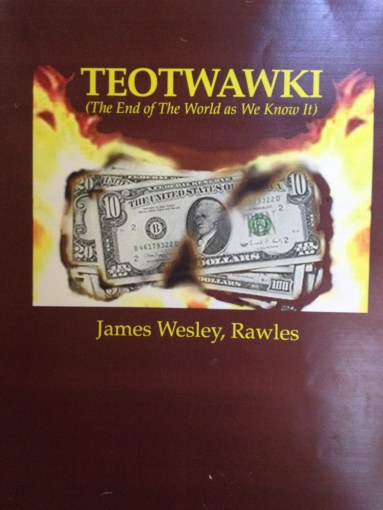
So much for U.S. currency!
Sandy gave me an early, pre-publication copy of the book, titled “Teotwawki – The End of the World As We Know It.” Written by James Wesley Rawles (Sandy attended high school with the author in Livermore, California), the tale charts the journey of a 9+ member survivalist group that holes up in central Idaho with a cache of food and weapons following a massive economic meltdown. The group manages to survive by employing their diverse skills – skills such as medical care, food storage, vehicle mechanics and weaponry. And they choose central Idaho specifically, for its high precipitation levels and relative remoteness. The book is something of a logistical how-to, and its reasoning has appealed to many similarly minded people. Enough of them have since moved out here that Rawles has himself abandoned the area for an undisclosed location west of the Rockies. “Even now I’ll meet someone new,” Sandy told me. “And I’ll ask them what brought them here. And they’ll say ‘Well, there’s this great novel…’”
But even here, in the Promised Land – even here, there are threats beyond one’s control. Last summer, wildfires swept the area, and a number of people lost their homes, including some of Sandy’s friends; a couple named Jay and Pearl.

Remnants of last year’s fires in a Bitterroot wilderness canyon.

Controlled burning at Lifewater Ranch, to reduce debris in case of wildfires.
The close-knit community banded together to help them, and one afternoon, Sandy and I joined several others in an effort to sheetrock the couple’s new home. We were working on the upstairs (myself harder than necessary, as I prove to be rather inefficient at driving screws), when Pearl called up to say that one of their Nigerian Dwarf goats was giving birth. Jay had stepped out for some supplies, and she needed help – its second baby was stuck inside.
I quickly volunteered – when would I ever have another chance to birth a Nigerian Dwarf goat, after all? – but when I hurried down the ladder, to find Pearl with her hands deep inside the goat and the distressed baby with its head out, bleating, I quickly grasped the situation’s gravity. Its forelegs were positioned backward rather than forward, and it was stuck, unable to fit through the opening. After six months at the Becker Family Stock Farm in Wyoming, I had no illusions about the fragility of newborn lives – despite our best efforts, some of them simply didn’t make it. And this situation was a threat not only to the baby, but to its mother as well. Still, there wasn’t time to think about it – all we could do was try.
I held the mother’s head and steadied it while Pearl continued to slip around inside, attempting to bring the baby out. The mother was pushing as hard as she could, but it wasn’t working. “I can’t feel the legs,” Pearl said finally. “Do you want to try?” I nodded and we switched positions. My hands slipped up inside, and both goats bleated loudly. “Sorry,” I muttered. Everything was wet and gooey; there was nothing to hold on to. Finally, though, I seemed to feel something bony – a shoulder. I grasped at it with wet fingers, and pulled, and suddenly, the baby goat slid out and onto the straw. It lay there, panting, encased in the wetness, and I looked up at Pearl in gratitude. Our eyes were filled with wonder. This time, things had gone the way we’d hoped – but we were both aware that they could have ended very differently. And no amount of preparation would have helped us.

I got to name the male we assisted – Mortimer – who’s standing. They kindly named his twin sister after me.
In recent years, Sandy has stopped trying so hard to plan for every eventuality. Instead, he’s been working through his dried foods, and has bartered away most of his guns and ammo. After all, even if we can anticipate every possible outcome and every potential danger, we still can’t control our surroundings, or ensure any intended outcome of our own. We can’t make ourselves secure or guarantee our survival, as Sandy has learned from his inverter, and I’ve learned from my bear spray. Often, we can’t even control the way our minds interpret such dangers. When Sandy suggested that I take his gun to go hiking around the property – to protect myself from wolves, and other predators – I declined. Not only have I never shot a gun, but, in a manner very similar to the bear spray, I’m much more afraid of handling one than I am of any animal.
So until that day comes – until the world collapses, the bear attacks, the fire sweeps through, or our prized goat dies – until then, we may as well enjoy the life we’re living, right now. Because while there may be some sensible means of action, some preventative options worth considering (such as burning debris to prevent wildfires), in the grand scheme of things, most of our fears are never realized; and those that are, well, they’ll be realized anyway. So instead of excessive prepping and planning and worrying – or worse, requiring that others suffer in an effort to ensure our own personal welfare – we may as well dance, sing and frolic with baby dwarf goats in green pastures. And offer solace, and comfort, and love. And yes, when necessary, grieve.
Because there’s very little we can do – and even if we could, if the past is any indication, we’ll likely get it all wrong anyway. We’ll end up wrecked on the side of the freeway, inhaling bear spray, or isolated in central Idaho with a broken inverter. We’ll impose our fears on anybody who seems strange or different or refuses to agree with us, or elect a president willing to go to any lengths, override any sense of humanity, for one last slippery grasp at control. Better just to trust that life will take us where it will – because it’s going there regardless, and we can either go along with it, frolicking merrily down the stream, or it will drag us behind it, kicking and screaming and fighting all the way.
 travels with maría lionza