Papa Karl has been a farmer all his life. He grew up on a livestock farm in Wisconsin, where his chores included milking cows, mending fences and raising baby chicks. After high school, he spent four years in the Coast Guard, including a year in Vietnam, before leaving to marry and father three children. He worked for more than a decade at a dairy farm in Georgia, and eventually took over operations of his parents’ 190+ acres in Mineral Point, WI. When they decided to sell the place six years ago, Papa Karl held an auction, and sold many of his Jersey cows to Sonja’s then husband Jon, who passed away shortly after. Papa Karl ended up coming out to the Becker Family Stock Farm in Wyoming to help Sonja keep the place running, and he now shares her grandparents’ old house with other, more temporary help such as myself.
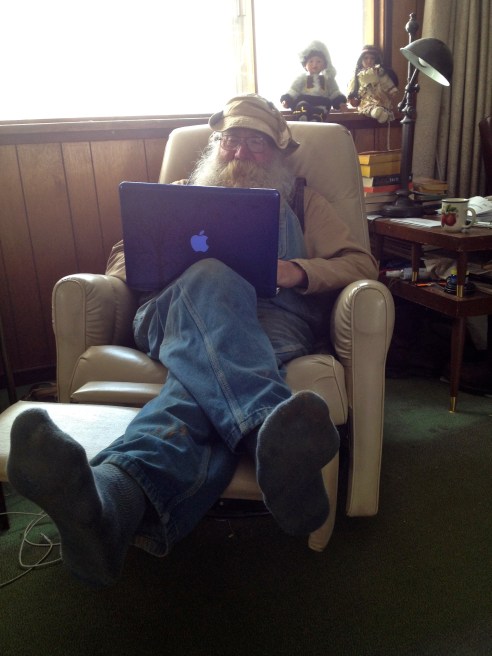
Papa Karl works on a puzzle in his usual chair.
As my roommate and coworker over the past six months, Papa Karl has taught me much. It was from him that I learned to drive the tractor and the Bobcat, and picked up some basic farm lingo: Eggs are “cackleberries,” milking cows is “juicing some moos” and “CBM Farmers” are the sort that grow Corn and Beans in the summer, and head off to Miami for the winter. Papa Karl taught me that bib overalls are the only practical option when tramping through mud and manure, and that there’s a song for every situation in life – whether it’s a dead skunk in the middle of the road, a possibility of escaping the draft or a lamentable lack of ripe bananas.
At 71, Papa Karl is a friendly but solitary soul, who’s lived life the way he wants to – he chose not to attend college, reside in a large city, or spend his time traveling and seeing the world. Instead, he prefers a simpler existence – caring for farm animals, the land and the few people close to him. To Papa Karl, the way that many humans choose to operate in the world remains a mystery.
Here are some of his insights.
On Bestsellers:
“I don’t read any of those bestsellers, the ones that get those reviews. Do you? I don’t see the point. There are lots of good books – old books, ones that are really good and that nobody even knows about.”
On Preserving Furniture:
“Some people like to keep coverings on their couch, to protect it. Why? Protect it from what? What’s the point of having a couch if you can’t sit on it?”
On Tourism:
“You know how people travel places and see things. Why do they do that? I’d rather be doing something useful.”
“People go off to Paris, to Rome. See the Roman ruins, go to art galleries. But they’re so….overwhelming! Don’t you think they’re overwhelming? I’m not sure I know what the point is. I’d rather go somewhere quiet and stay with ordinary people.”
On Politicians:
“They’re like children. ‘This is my toy, you can’t have it! Stay on your side of the line!’ It’s too much.”
On Immigration:
“How can they just draw a line and say, you can’t be here? It doesn’t make any sense.”
“You know, with the Berlin wall, Reagan went over and told Gorbachev, ‘You have to take this wall down!’ They were trying to keep people in. And now they want to build a wall to keep people out. What’s the difference?”
On School:
“I’ve had to sit at a desk before. I sat at a desk for 12 years.”
“My high school keeps contacting me, trying to get me to come back for reunions. Why would I want to do that? Do cellmates in prison have reunions?”
On Careers:
“A lot of employers say they want a ‘work ethic.’ And then you can’t take a vacation, can’t take a sick day. They want you to hand over your life.”
On Homes:
“A house and a home are two different things. Anything can be homey. Some people can make a little shack feel like a real comfortable home.”
“Somebody once invited me to see their house. They kept saying, ‘Come see my house.’ Well, if they’re calling it a ‘house,’ I’m not sure I want to see it.”
While Papa Karl often finds human activity mystifying, animal behavior makes much more sense. He has no problem explaining why cows are missing tufts of fur (they’re shedding their winter coats), kicking (their teats may be sore) or raising their tails (they’re going to poop). Often, he’d observe María Lionza as she wandered around the house, doing the things that cats do, and comment matter-of-factly on her behavior (As she scratched at the floor mat: “Well, she has to do a certain amount of that.” As she rolled around on her back: “She’s rolling back and forth, scratching her back.” As she groomed herself: “She’s licking her fur. You know how she does that. She’s taking a bath.”).
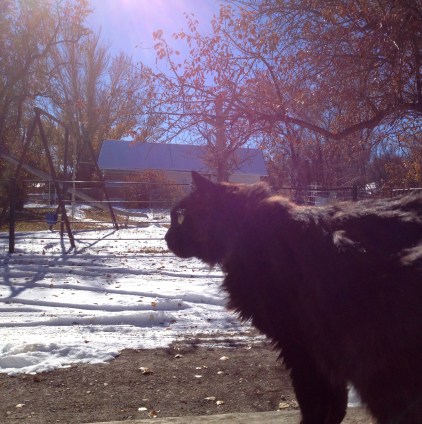
María Lionza regards her first snow with some skepticism.
The more time I spent with Papa Karl, the more I found myself easing into the simple, healthy rhythms of farm life – rising at 6 a.m. every morning, and in bed by 9 p.m. every night. At breakfast (usually with Oreo, the lamb, on my lap) we’d discuss the weather – for once, a relevant topic – and which tasks we planned to accomplish that day. At dinner, we’d share the animals’ most recent antics; updates on old friends (Was Bella taking to the new calf, the one we’d recently gotten to replace hers, who’d died? Did Lewis, the dog, manage to catch another chicken, and if so, how much longer would he be staying? Did we both see Queenie, the dog, and Tricksy, the cat, cuddling that morning?). And in the evenings, over hot chocolate made from fresh cows’ milk, we’d share bits and pieces of our lives, or simply sit quietly together – both of us reading, or Papa Karl piecing puzzles together on his computer.
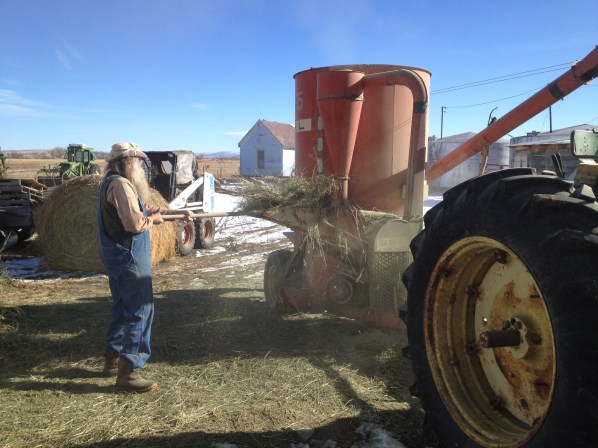
Papa Karl grinding hay for pig feed.
In his own way, just by being himself, Papa Karl taught me that the world around me has its own pace, its own rhythm; that the simplest way is often the best; and that life is too short not to be who you are.
 travels with maría lionza