Sometimes, when a mystery presents itself, there’s a need to investigate further. This recently happened to me, when I became fascinated with the giant bones of Wyoming.
The Thermopolis library is a small but friendly place, where they agreed to issue me a library card despite my lack of residency (“Oh, I know Sonja,” the librarian told me). It’s the only library I’ve seen that separates its fiction from its literature, and as it boasted only a few shelves of “literature,” I soon found myself gravitating toward first-hand accounts of life in the region by early timers such as “Buffalo” Bill Cody and various Native American peoples. In my reading, I came across two strikingly similar accounts of a “race of giants” that had occupied the area prior to the first Native Americans. The first of these, in “Buffalo Bill’s Life Story: An Autobiography” (copyright 1920), told this tale from the early 1870s:
“While we were in the sandhills, scouting the Niobrara country, the Pawnee Indians brought into camp some very large bones, one of which the surgeon of the expedition pronounced to be the thigh bone of a human being. The Indians said the bones were those of a race of people who long ago had lived in that country. They said these people were three times the size of a man of the present day, that they were so swift and strong that they could run by the side of a buffalo, and, taking the animal in one arm, could tear off a leg and eat it as they ran.”

Portrait of Buffalo Bill at the Whitney Western Art Museum in Cody, Wyoming.
The second appeared in “Pretty Shield: Medicine Woman of the Crows” (copyright 1932):
“‘Did you ever hear that a tribe of very large people once lived on this world, Sign-talker?’
‘No,’ I answered.
‘Well, once when I was a girl, and our village was at The-place-where-we-eat-bear-meat [near the present Headgate] several of us girls walked up to The-dry-cliff. This was, to me, a strange place. A great herd of buffalo had some time been driven over the cliff, and killed by the fall to the rocks below. There were many, many bones there that told a bad story. And on top, stretching out onto the plains, there were long lines of stones in this shape [she made a V with her hands] with the narrow part at the cliff’s edge. These had helped to lead the running buffalo over the cliff. I have heard old women tell of such things being done before the horse came to the plains; and yet this herd of buffalo that went over The-dry-cliff may have been driven to death by another people.
The cliff was high, sloping in a little from the top. At its bottom were the bones, many, many bones. I noticed a dark streak on the face of the cliff. It was narrow and straight, reaching from the bottom of the cliff to the rim above. It looked to me as though the smoke of a fire that had burned there for many snows had made this dark streak on the smooth stone, and yet I had never heard anybody mention this. I could not keep my eyes from looking at this dark streak as we girls were walking toward it.
We had brought some pemmican, and I had my ball with me, because we intended to stay all day. The sun was past the middle when we began to dig with a root-digger at the bottom of the cliff. We were not looking for any particular thing. We were only playing. But our playing stopped suddenly when, in digging, we brought up a man’s skull that was twice as large as that of any living man; and with it there were neck-bones that were larger around than a man’s wrist.
We ran away from that place, and I was first to run. The size of the skull frightened me. Upon reaching our village I told my father what we had found. He said that he wanted to see the skull. We took him to the place, sitting off quite a distance while my father smoked with the skull. He said that it was a medicine-skull, and powerful. While we girls watched him my father wrapped the great skull in a buffalo robe and buried it.
It was Shows-the-lizard who dug up that skull; and we found the blackened sticks of an old fire there, too. Yes,’ she said thoughtfully, ‘I believe that another kind of people once lived on this world before we came here. This big skull was not at all like our skulls. Even though I did not stay there very long I noticed that its seam ran from front to back, straight, with no divisions.’”
This was curious – the accounts came from similar time periods, covered similar geographical areas (Wyoming, Nebraska, Montana, the Dakotas), and reported similar findings. Why had I never heard of a race of giant people in the Northwestern plains? I began to ask around. One person suggested they could have been dinosaur bones – Wyoming is known for its massive deposits of dinosaur bones, and Thermopolis is home to the Dinosaur Center, where, during the summer, people can participate in excavations at a nearby dig site. (“Hmmm, ‘Shows-the-lizard,’” I thought.) But as I visited the center, gazing up at a cast of the second and most complete Supersaurus ever found – at 32 meters long, basically an Apatosaurus on steroids – I found it a stretch that someone would mistake a dinosaur bone for a human femur, and even less likely, a dinosaur skull for its human counterpart. Something else was going on.

Cast of “Jimbo” – the longest scientifically accurate mount of a Supersaurus in the world.
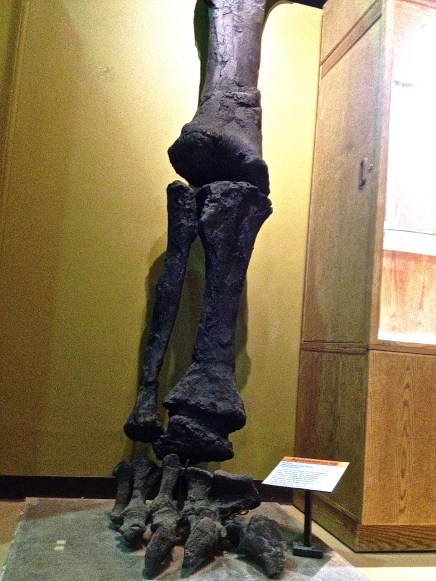
Apatosaurus replica. Apatosaurus means “deceptive lizard” because it was originally mistaken for a mosasaur. Could it also be mistaken for a giant human?
This was clearly a mystery that I couldn’t solve on my own. So I wrote to George Gill, professor emeritus at the University of Wyoming – an anthropologist and expert in skeletal biology. What could these accounts be referring to? He kindly responded, and agreed that both were likely reports of human bones. “I think that an early day surgeon would know a human femur when he saw one,” Gill wrote. “A lot of amputations were done in the old days! So, perhaps the bones brought in for examination were a mix of a human bone or bones and some other larger bones or fossils of large mammals or even dinosaurs. The surgeon probably had no comment on those specimens that he did not recognize.”
“Regarding the other story,” Gill said, “everything this woman describes seems to fit the archaeological and osteological record of our region. She obviously had encountered a Buffalo jump site from a previous era, and she knew what she had found! And I think that the skull she found was likewise from an earlier era. Some groups in Wyoming around 2,000 years ago and earlier did have much larger and longer skulls than the Late Prehistoric and later people of our region. I have documented this from the skeletal record in our area, and published on it in a few places.”
One such place is a dense tome called “Skeletal Biology and Bioarchaeology of the Northwestern Plains.” I ordered it through an inter-library loan (“Oh, you’re getting a fun book,” the librarian said) and checked out the chapter that Gill suggested. Sure enough, he had documented the skeletal remains from various sites, and had found that earlier specimens did have larger, longer cranial forms, and exhibited greater similarities with ancient Paleoamericans (such as Spirit Cave Man and Kennewick Man) than with the later Northwest Plains Indians. “Some of these also show a 10 percent frequency of the metopic suture (almost never seen on later Native American skulls) that joins the sagittal suture and makes a complete separation of the skull from ‘front to ‘back,’” Gill explained in his email.
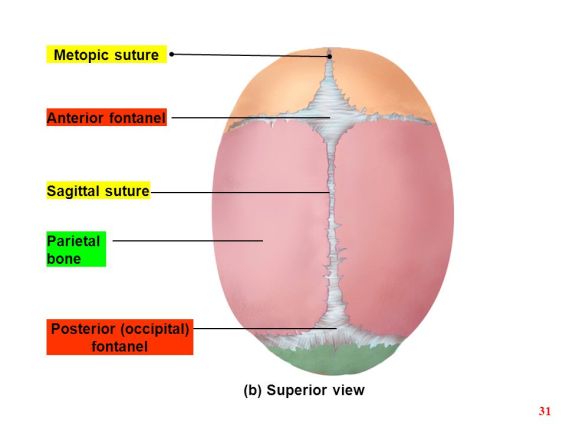
A skull showing metopic and sagittal sutures. A metopic suture occurs when the frontal suture fails to close in childhood.
So what did any of this mean? In his book, Gill suggested that the longer, larger skulls most likely represented “an isolated remnant of some earlier North American population that simply missed incoming migrations or other sources of later gene flow.” In short, they were likely an earlier people, and nobody is quite sure what happened to them.
But the Pawnee have their own explanation, according to Buffalo Bill.
“These giants, said the Indians, denied the existence of a Great Spirit. When they heard the thunder or saw the lightening, they laughed and declared that they were greater than either. This so displeased the Great Spirit that he caused a deluge. The water rose higher and higher till it drove these proud giants from the low grounds to the hills and thence to the mountains. At last even the mountaintops were submerged and the mammoth men were drowned.
After the flood subsided, the Great Spirit came to the conclusion that he had made men too large and powerful. He therefore corrected his mistake by creating a race of the size and strength of the men of the present day. This is the reason, the Indians told us, that the man of modern times is small and not like the giants of old.”
I was reminded of this story recently when visiting Legend Rock. The petroglyph site sits off of highway 120 down a long, dusty road. The looming red and yellow rocks overlook a relatively lush valley, with a gurgling creek and sprinklings of sagebrush – an understandable location for ancient peoples to make camp. I stood studying the drawings – anthropomorphic and zoomorphic forms depicting elk, thunderbirds and people with headdresses. Many of the drawings are in the Dinwoody style (named after the Dinwoody canyon in the Wind River Mountains) and are estimated to be more than 2,000 years old – the same time frame as the earlier peoples whose remains were found in eastern Wyoming.
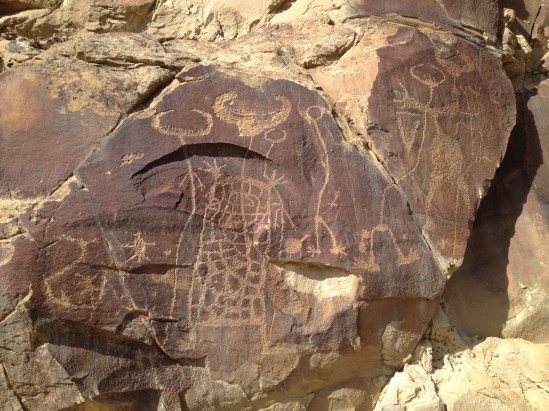
Human figures with horns and headdresses, in the Dinwoody style, at Legend Rock.
The Dinwoody style is characterized by large humans and small animals – as opposed to later drawings (beginning around 900 years ago), which show small humans and large animals. Does this change indicate an actual difference in human size? Or is it simply a change in humans’ way of thinking, a revised way of looking at the world; an appreciation of something bigger, a demonstration of respect?
I didn’t have any answers. But it seemed apparent, from observing the world around me, that this sense of appreciation and respect had diminished in recent years – and in some cases, had all but disappeared. As I gazed across the valley to the hill opposite, where pumpjacks hammered down into the Hamilton Dome oilfields, I considered how powerful we humans had become, regardless of our size.
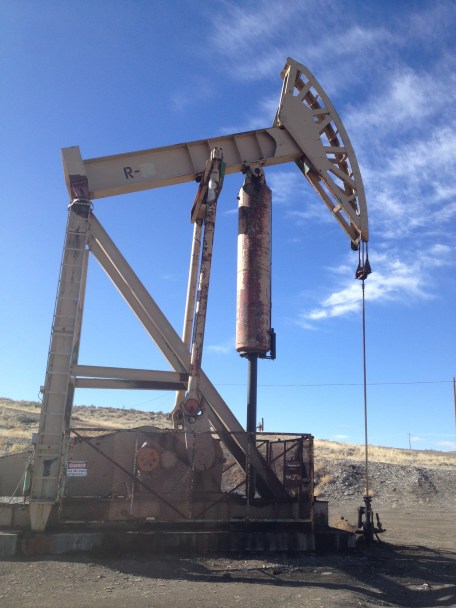
A pumpjack working at Hamilton Dome, across from the Legend Rock petroglyph site.
Those that came before us left small drawings on rock walls, pits full of buffalo bones and a scattering of skeletal remains. What would we leave in our wake? How would the earth respond to our own intrusions? What would it take to bring us back down to size – a flood, a drought, some other climate change-induced disaster? Whatever it was, I had no doubt that the earth was more than capable of delivering – and I suspected that, quite likely, the process had already begun.
 travels with maría lionza
i live In Goshen county Wyoming and have many stone artifacts but there made from curondum and mossinite not Flint or jasper and are about three times the size they should be. Makes perfect sense.
LikeLike
How interesting! Thanks for sharing.
LikeLike