“Curious how a place unvisited can take such hold on the mind so that the very name sets up a ringing.” – John Steinbeck, Travels with Charley.
María Lionza and I arrived in Wyoming in mid-October. We’d driven up through Colorado, as golden aspen leaves wafted from silver branches to the ground. I’d frolicked in the sand at Great Sand Dunes National Park, participated in a sweat lodge at the at the Aztlan Native American Earth Farm, and learned how to trim freshly harvested buds of cannabis. María Lionza had chased tiny chipmunks through forests, sunned herself in the Colorado Rockies and huddled with me, against the frost, in my tent. All in all, we’d had quite the adventure.

Sand in the mountains? Why not? Great Sand Dunes National Park in Colorado.

María Lionza guards our tent among the apsens.
So as we entered Wyoming, I wondered what it was about this empty land, in particular, that drew me. Low-lying, dusty hills stretched before me in endless succession, each one as cracked and barren as the last. The roadsides were desolate and empty, and there wasn’t a convenience store or gas station to be found. We stopped at a dreary motel in Rawlins, where we nevertheless reveled – after weeks of camping and sleeping off-grid – in the luxury of beds and hot showers. In the morning, I shared coffee and pastries with the other passers-through; rugged-looking men in hefty jackets and jeans. “So, where are you going?” asked one Colorado native, who’d been up hunting moose and deer with a friend. I explained that I was on my way north, to a livestock farm near Thermopolis, and he raised his eyebrows. “Oh?” he said. “So you like this land.”
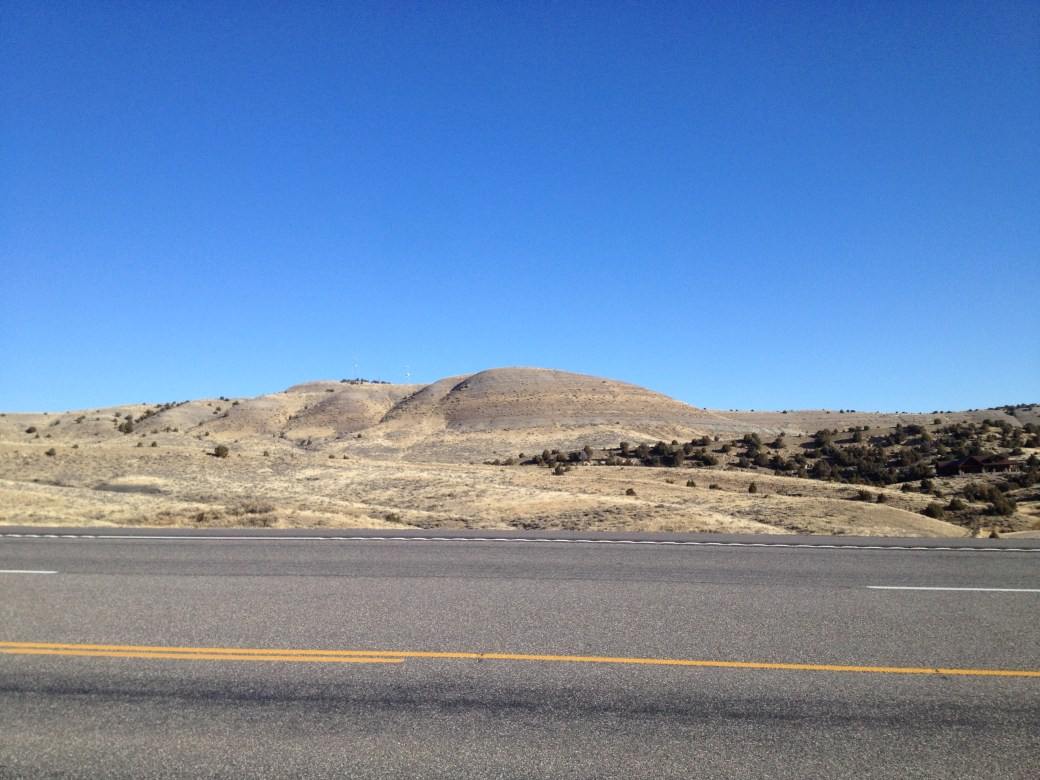
The rolling dirt hills of the Badlands.
And it appeared that I did, though I wasn’t sure why. Wyoming seemed like a strange and mysterious place (“Does Wyoming actually exist? Do you actually know anybody from Wyoming?” Mark – Ninja’s new human – asked when I told him where I was going). And it was true that I had gone from the most populous state in the U.S. – California – to the least. Perhaps it was the emptiness of it – the way the space around me stretched and yawned and exhaled to an endless horizon. Or the strong winds that unfurled across the plains, their forces untamed by mountains or bushes or trees. The power of the land was palpable; the presence of humans, by comparison, felt like an afterthought. Towns resembled trading posts more than urban centers, and it was easy to travel long stretches of freeway without seeing another vehicle.
As I reached the Wind River Canyon, the landscape changed to accommodate a wide lake and jagged outcroppings of red rock. I forged through several tunnels and soon found myself approaching Thermopolis: Population 3009 (Did I need to report my presence somewhere? I wondered). I caught a brief glimpse of the main street, lined with small shops, then it was gone, and I was heading northwest – past strange-looking tabletop hills, the color of sunsets – to the Becker Family Stock Farm. Sonja Becker welcomed me, explaining that she had some 720 acres of land – her grandparents had bought it for a mere $12,000 back in the day – and she used 150 of that to raise cows, sheep, pigs, chickens and turkeys. Some of it she leased to a neighbor to graze his cattle, and the rest remained in its natural state, untouched by human hand or plow.
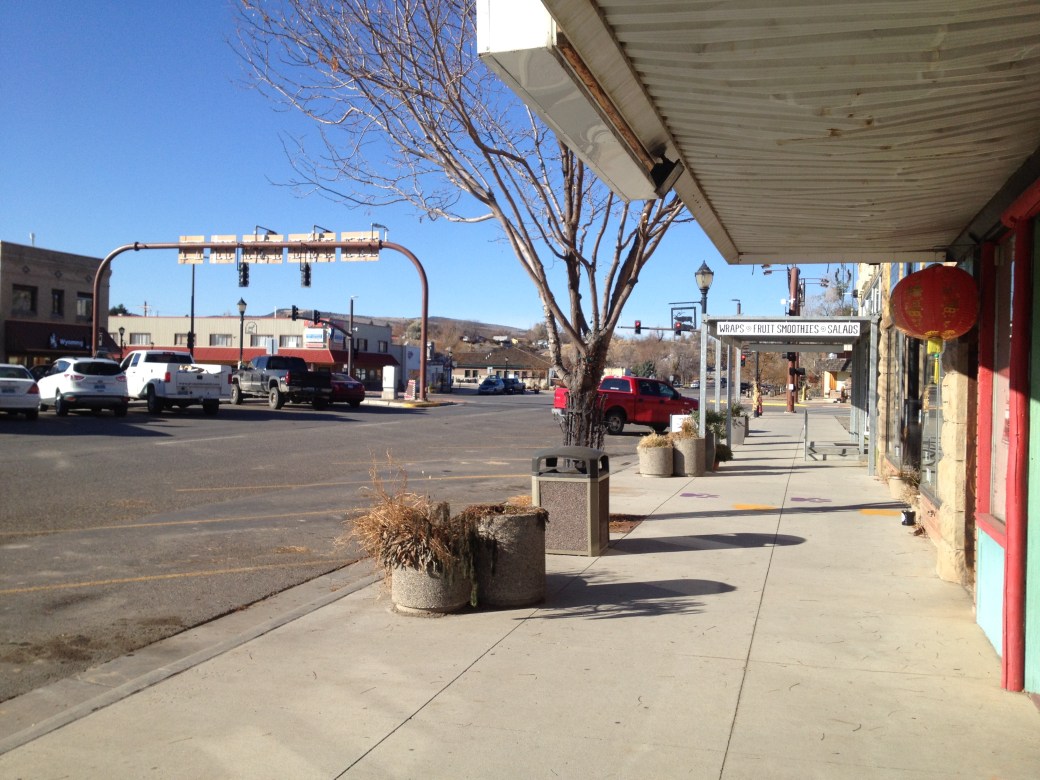
The booming metropolis of Thermopolis.

Red dirt hills, many of them flat-topped, rise from the land around Thermopolis.
When I had time to explore my surroundings, I found myself awed by the area’s beauty, humbled by its vastness, and outnumbered by the many creatures that called it home. Running in the evenings down a quiet back road, herds of deer would often stop to watch me, their ears alert and curious, before springing away, perky-tailed, into the bushes. Sometimes I’d pause to pet a horse – one of many – that peered over a fence, and it would nuzzle me, its nostrils flaring. Rabbits with cartoon-like tails raced next to me; inevitably, they would win. Once, a herd of cattle stampeded up to the fence – their eyes wide and challenging, dust billowing from their hooves – and stared at me intensely before turning, as a group, and galloping away in a mass of swirling grasses.


So when I heard about the Giant Crack that had formed in the earth just north of me, near the Big Horn Mountains – creating a crevice that some had dubbed a miniature Grand Canyon – I was hardly surprised. It seemed like just the kind of thing that would happen in Wyoming. News outlets had jumped on the story with headlines that labeled it a “Giant Crack;” a “Mysterious Gash;” and a “Yawning Hole.” There were rumors of super volcanoes and earthquakes. It was said to be the size of six football fields, and to have been caused when groundwater instigated a slow-motion landslide. When I ventured north on my next day off, planning to hike the Big Horns before the roads closed for the winter, it seemed only logical that I’d stop in the tiny town of Ten Sleep (Population: 260) to ask around. I found one open café on the main drag – The Crazy Woman Café – and bought an apple fritter and a hot chocolate before taking a seat next to the only two men in the shop. They were already regarding me with curiosity, so I leaned over. “Can you tell me anything about this giant crack in the ground?” I asked.
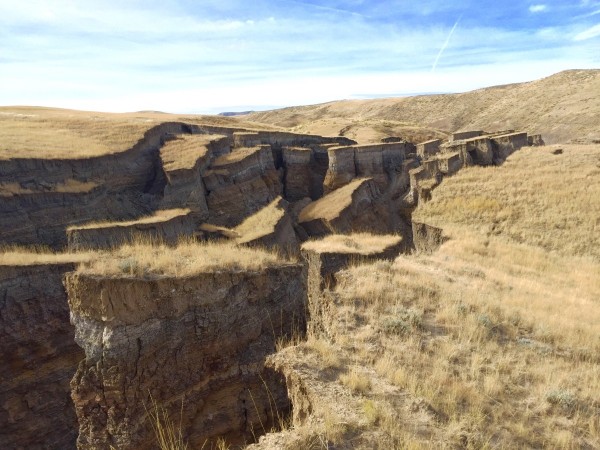
The Crack. Photo by Randy Becker, who came across it while hunting.
The men were pleased to oblige. The crack, they told me, was some 30 miles out, half of that on a gravel road, and situated somewhere in the middle of a private ranch. “You can call Rob up and see if he’ll let you on to see it,” one said. “But otherwise there’s not much point in driving out there.” I asked for Rob’s phone number, and made the call.
“I’m not sure how much I’ll be able to help you,” Rob said, when I got him on the phone. “You could come and see it if you want, but it’s really not worth your time. It’s just some dirt that sloughed off. Someone came and looked at it who didn’t know what they were talking about. It’s really not that big a deal.”
“Oh,” I said, disappointed. What about the Giant Crack? The Yawning Hole? The Mysterious Gash? Actually, when I thought about it, I realized I’d seen some strange-looking cracks on my own drive up from Colorado – nothing the size of six football fields, but still impressive fissures, to be sure. A blond woman had joined the men at their table, and when I got off the phone, they informed her that I was thinking about driving out to see the crack. The woman, who lived in that same area, looked skeptical. “Do you have 4-wheel drive?” she asked. I told her that I didn’t. “Well you can’t go out there without 4-wheel drive,” she said. “Besides, we’re supposed to get some weather.” I looked outside at the blackened sky; the first snowflakes of the year were just beginning to fall. I told her that Rob hadn’t been too encouraging anyway, crumbling my dream of a miniature Grand Canyon into a heap of sloughed-off dirt.
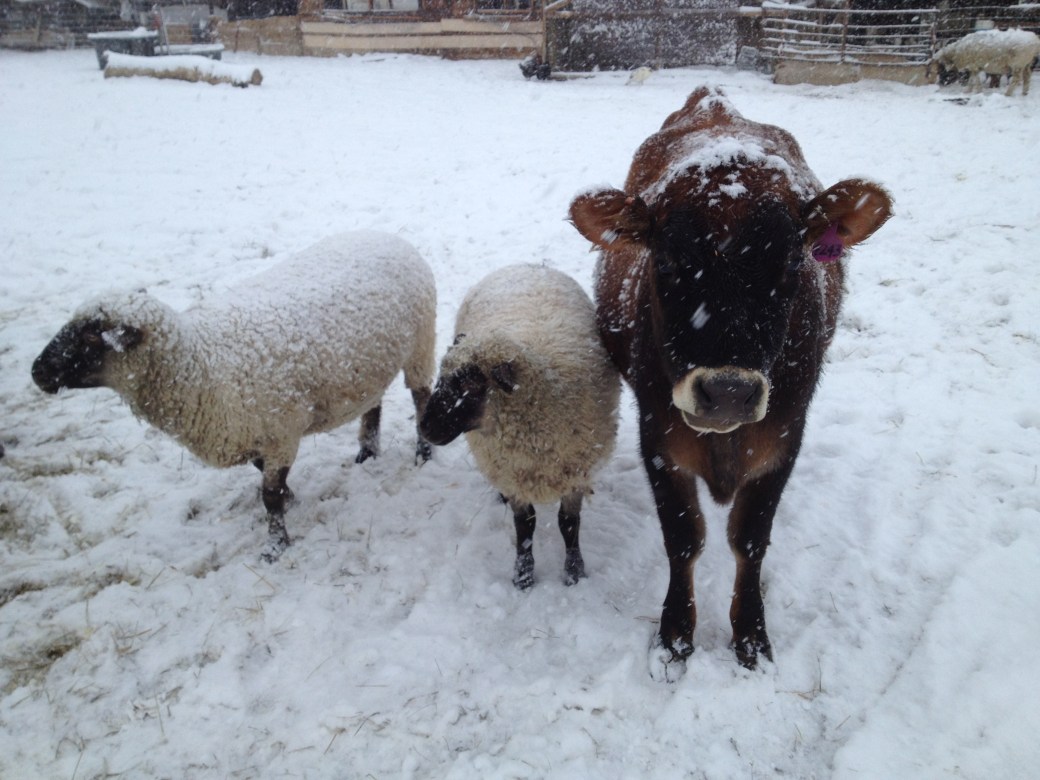
First snow at the Becker Family Stock Farm.
“Strange how big it got, though,” I mused, thinking of the media frenzy. Even Gawker had covered it, asserting: “These are the End Times.”
The woman – thinking I was referring to the size of the crack – nodded eagerly. “We had something strange happen on our own land,” she said. “Groundwater came seeping in under this cliff and caused what was like a big blister in the soil. And then in the spring, when it thawed, a huge chunk of land came off and was carried away.” Her story only served to confirm what I’d already suspected – that Wyoming’s land was wild and untamable, and the crack was just one incident among many, albeit a rather large and impressive one. Perhaps, in a place like Wyoming – where the land is vast and the people are few – these things are just more obvious. Perhaps it’s clearer, and therefore somewhat easier to accept, that we can’t control our surroundings. If the land wants to tear itself apart, or wash away, or form a yawning hole to nowhere, that’s just what’s going to happen.
I finished up my hot chocolate, thanked the kind people of Ten Sleep, and headed off to the Big Horns. Snowflakes splatted against my windshield and fog shrouded the road, obscuring rugged canyon walls that reached to a white sky. I turned off down a side road to a closed campground that someone had recommended – a spot with a well-marked ATV trail – and parked amid snowdrifts. Pulling on my hat, hiking boots and gloves, I hefted on a backpack with water, sandwiches and some other supplies, and headed off across the expanse of white meadow toward pine tree-laden hills. The snow was ankle-deep and falling softly all around me. There were no tracks aside from the cloven marks of deer hooves, and as I crossed a half-frozen creek on snow-covered rocks, I decided that I’d made the right call. Wyoming’s cracks and crevices may be sudden and dramatic, but they had nothing on the white-shrouded treetops of unexplored forests; the living silence of a mountain’s first snowfall.
 travels with maría lionza