“I am an avid reader of all signs, and I find that in the historical markers the prose of statehood reaches its glorious best, and most lyric. I have further established, at least to my own satisfaction, that those states with the shortest histories and the least world-shaking events have the most historical markers. Some Western states even find glory in half-forgotten murders and bank robberies. The towns not to be left behind proudly announce their celebrated sons, so the traveler is informed by signs and banners – Birthplace of Elvis Presley, of Cole Porter, of Alan P. Huggins. This is no new thing, of course. I seem to remember that small cities in ancient Greece quarreled bitterly over which was the birthplace of Homer.” – John Steinbeck, Travels with Charley.
Many of the greats in the arts and literature have called New Mexico home. And while some signs remain to indicate their presence, New Mexico – unlike the western states of Steinbeck’s experience – has no need, or perhaps no real desire, to advertise its ties to fame and notoriety. Prints of work by R.C. Gorman, one of the best-known Navajo painters, stare out from Taos gallery windows with minimal introduction. Georgia O’Keeffe – who famously spent 40 years replicating the stunning landscape surrounding the Ghost Ranch in Abiuqiu – has left behind little more than the home she once occupied, and a modest museum in Santa Fe. In fact, the longer one spends in New Mexico, the more one realizes that even the most mundane of objects could well retain ties to the greats. After a few days at the Taos Gogi Eco Lodge in San Cristobal, I learned that the outhouses next to my bunkhouse weren’t just some dilapidated old structure – they’d been built, it was said, by none other than Aldous Huxley.

Outhouses – One of Huxley’s lesser-known achievements.
Some of the most prominent advertising, at least in San Cristobal, is linked to D.H. Lawrence’s old ranch – but even that’s minimal. A small sign off the freeway indicates the turnoff, and a slightly larger version at the fork relates the odd hours that it’s open to visitors.
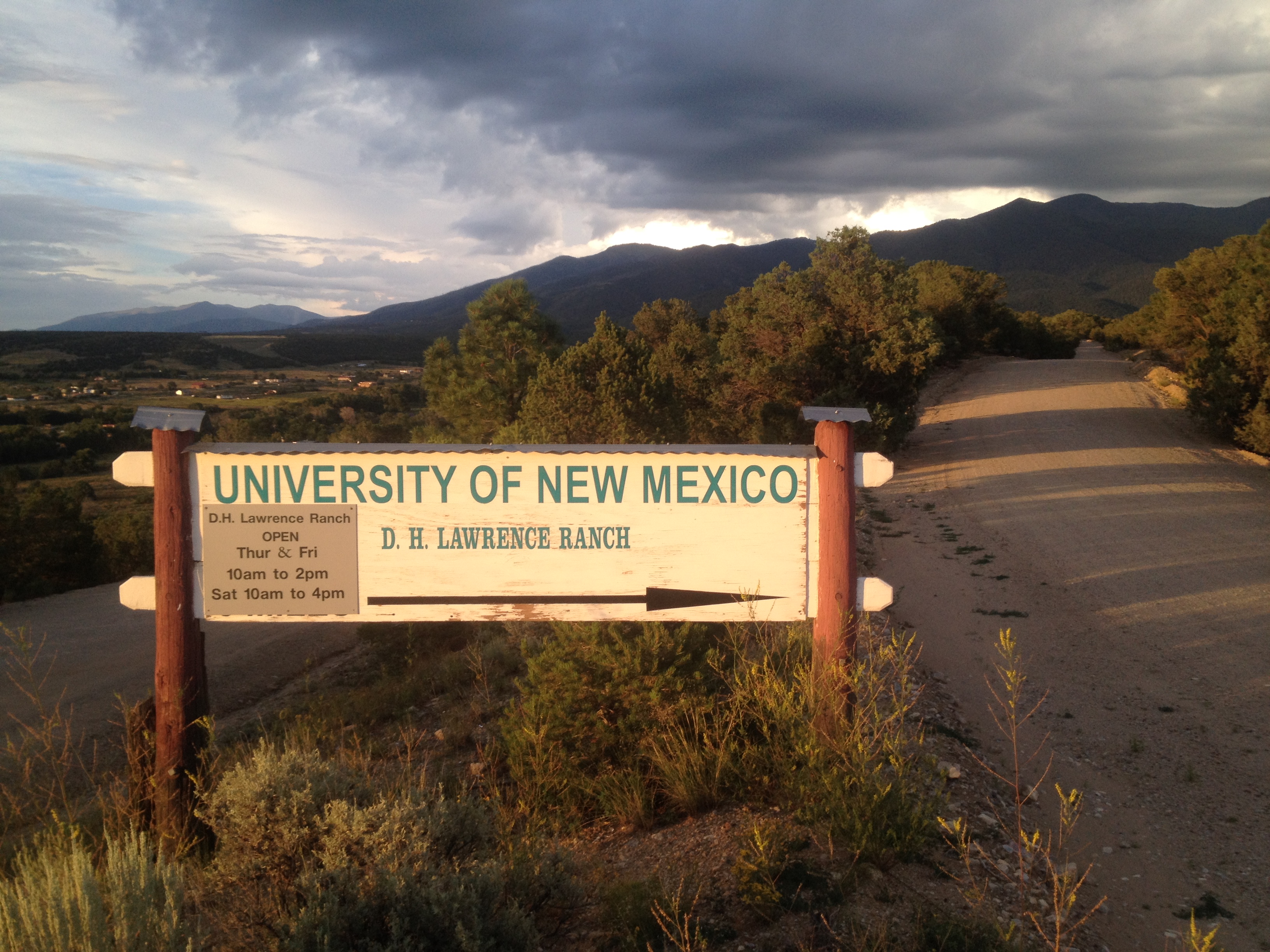
The turn-off to D.H. Lawrence’s old ranch.
The noted English author spent several months at the ranch from 1922-25, where he produced a variety of work – pieces such as the grippingly symbolic, if disturbingly stereotypical, short story, “The Woman Who Rode Away”; several poems whose sounds and images resonate deep within one’s chest; and a rather bizarre essay titled “Reflections on the Death of a Porcupine,” among others. Reading these pieces on New Mexican soil, one is transported into Lawrence’s own conflicted world – a place where indigenous peoples are stereotyped, spiritualized, and recognized as being both stereotyped and spiritualized; a place where nature is both trance-inducing and deadly; a place where humans exhibit the darkest of desires – none more prominent than the desire to gain power, dominance and control over one another, whether overtly or covertly. As Lawrence notes in “Reflections on the Death of a Porcupine” – “it is always conquest, conquered and conqueror, for ever.”
This violent and competitive worldview pervades many of Lawrence’s writings, and seems to have informed his personal relationships as well – his marriage suffered from its share of physical brutality. Lawrence ostensibly moved to New Mexico with the idea of starting a utopian community called Rananim – but only his wife Frieda, his friend Dorothy Brett and his American patron Mabel Luhan (who owned the ranch, and eventually gave it to the Lawrences in exchange for the manuscript of “Sons and Lovers”) actually showed up. According to signs at the ranch, the three women “often competed for his attention,” and after his death from tuberculosis in 1930, they continued to battle over his ashes. When Brett and Luhan expressed a desire to spread them across the ranch, the story goes, Frieda dumped them into a wheelbarrow of fresh cement, saying, “Now let’s see them steal this!” Today, the ashes are allegedly cemented into a rather gaudy altar at the Lawrence Memorial, topped by a statue of Lawrence’s “personal symbol”: the phoenix. This phoenix – unlike the fiery figure of death and rebirth immortalized in Lawrence’s poetry – is rather sad-looking, faceless, and resembles something more along the lines of a plucked chicken.
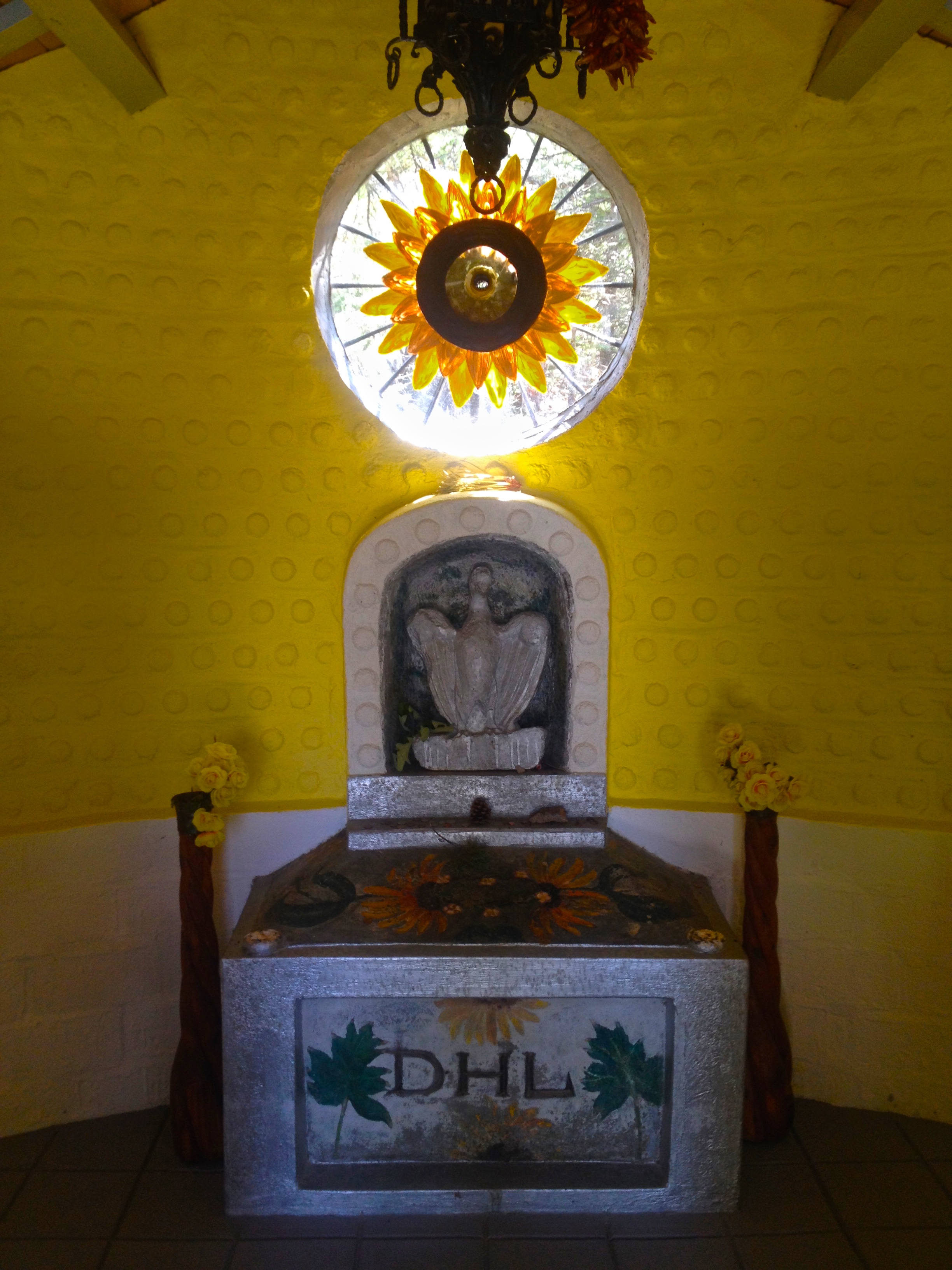
The D.H. Lawrence Memorial shrine.
Lawrence’s novels were contentious as well – The Rainbow (1915) and Lady Chatterley’s Lover (1928) were both considered “obscene” and suppressed in England – and his series of oil paintings that were shown at a London gallery in 1929 were promptly confiscated by police and banned from English soil for similar offenses. Nine of these now reside at the La Fonda Hotel in the Taos plaza, protected by a curtain. One afternoon I wandered down there with the intent of seeing the “D.H. Lawrence Forbidden Art Collection,” as it was called; a postcard of the paintings showed several naked people frolicking with fawns in a garden. I’d visited his ranch; I’d read most of his writings on New Mexico – all that remained, it seemed, was to view his hidden paintings.
But as I wandered around the plaza, waiting for the tour to start, I noticed a man seated on the steps, painting on small paper cards. He had long black hair and weathered skin, and introduced himself as Frank Trujillo, an artist from Taos Pueblo – one of the oldest continuous settlements in the U.S. and home to the Tiwa people, about whom Lawrence had written several essays. (Lawrence’s writings on Native peoples range from sympathetic to racist to insightful to absurd; he calls them “savages” in one breath, and in the next, argues that they should keep their lands.) Frank invited me to sit down, and showed me his work – beautiful watercolors of animals and landscapes. He was currently painting a raven, and one side of the bird was dark as the night sky and filled with stars; the other was pure white.
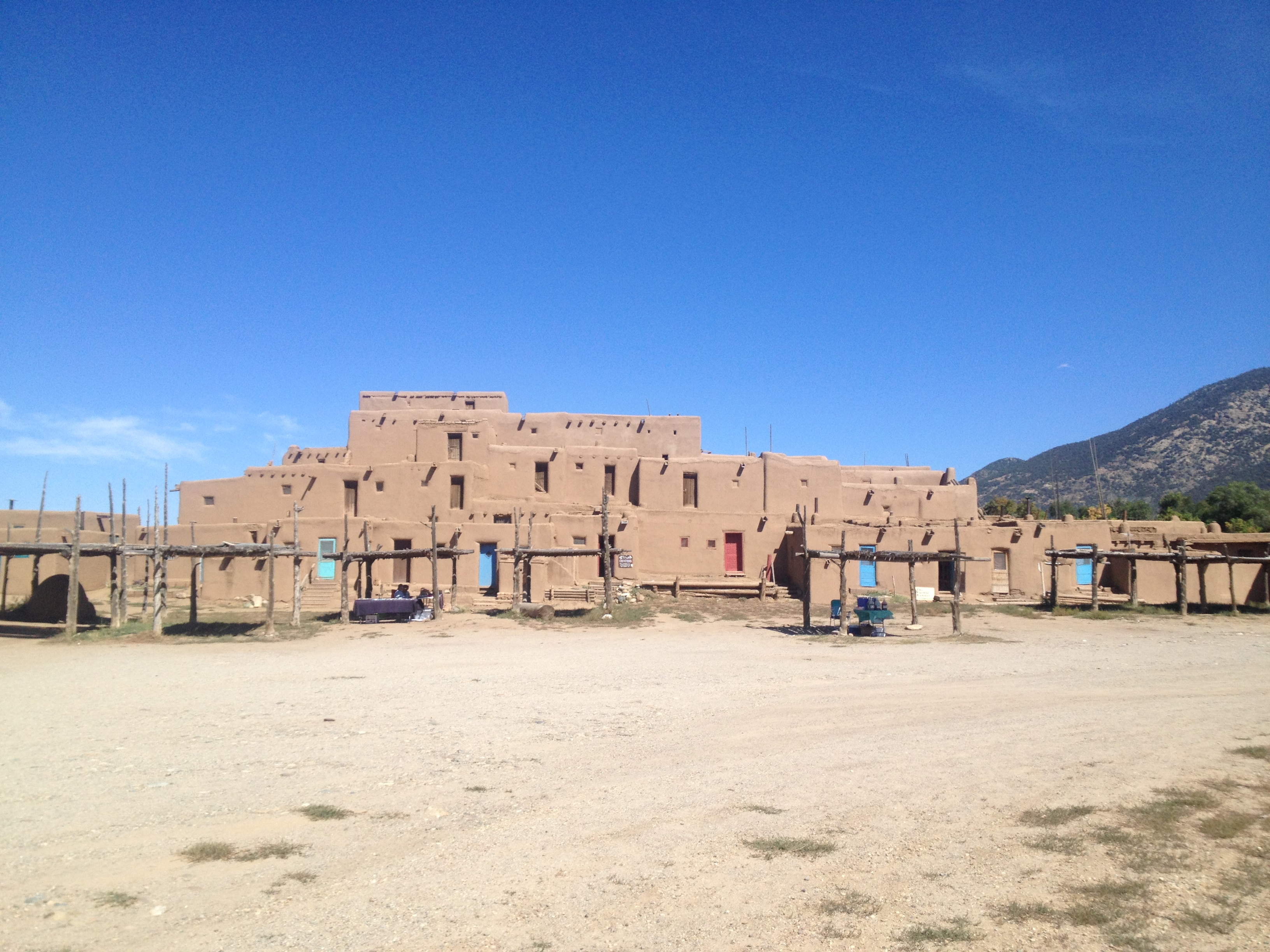
The Taos Pueblo.
“Each of my cards has a meaning,” Frank explained. “This is the raven. One side is black because it represents curiosity and intuition. But the other is white, because it represents the other side of the raven – the trickster.” Then, Frank pulled out a plastic-covered photo album and began showing me the chalkboards that he’d done for various businesses – including a number of cafés in Denver, where he used to live. He began reminiscing about one particularly successful chalk piece he’d done in Taos – Dennis Hopper’s character from “Easy Rider.”
“I did this life-sized portrait, for Dennis Hopper Day,” he said, tossing out another big New Mexico name. “People loved it – they were all stopping to take photos with it.”
“Wait a minute,” I said. “There’s a Dennis Hopper Day?”
“Oh yeah,” Frank said. We continued to chat, and soon moved away from celebrities and on to more personal subjects. Frank told me about his childhood, and about his biggest regrets in life. He encouraged me to accomplish whatever it was that I wanted to accomplish. I explained that I was less interested in accomplishments lately, and felt more that I was following a path that was somewhat out of my control. Frank paused thoughtfully. Then, he said: “You know, I didn’t grow up in the kiva, so I trained to do sweat lodges in the Lakota tradition. I was in charge of keeping the fire. At first, I was scared of the fire. I would wear big coats, and keep my distance from it. But my teacher told me that I had to make friends with the fire. So I learned how to do that, and in the end, I would tend the fire wearing just a loincloth.” We talked some more, and then I gave Frank a book of poetry that I was carrying. He gave me one of his cards – a shaman holding an eagle feather. By the time we were finished, some hours had passed, and I’d missed my chance to see Lawrence’s infamous paintings. Instead it was just one woman meeting a man, in a place where nothing ever happened, under the big New Mexican sky.
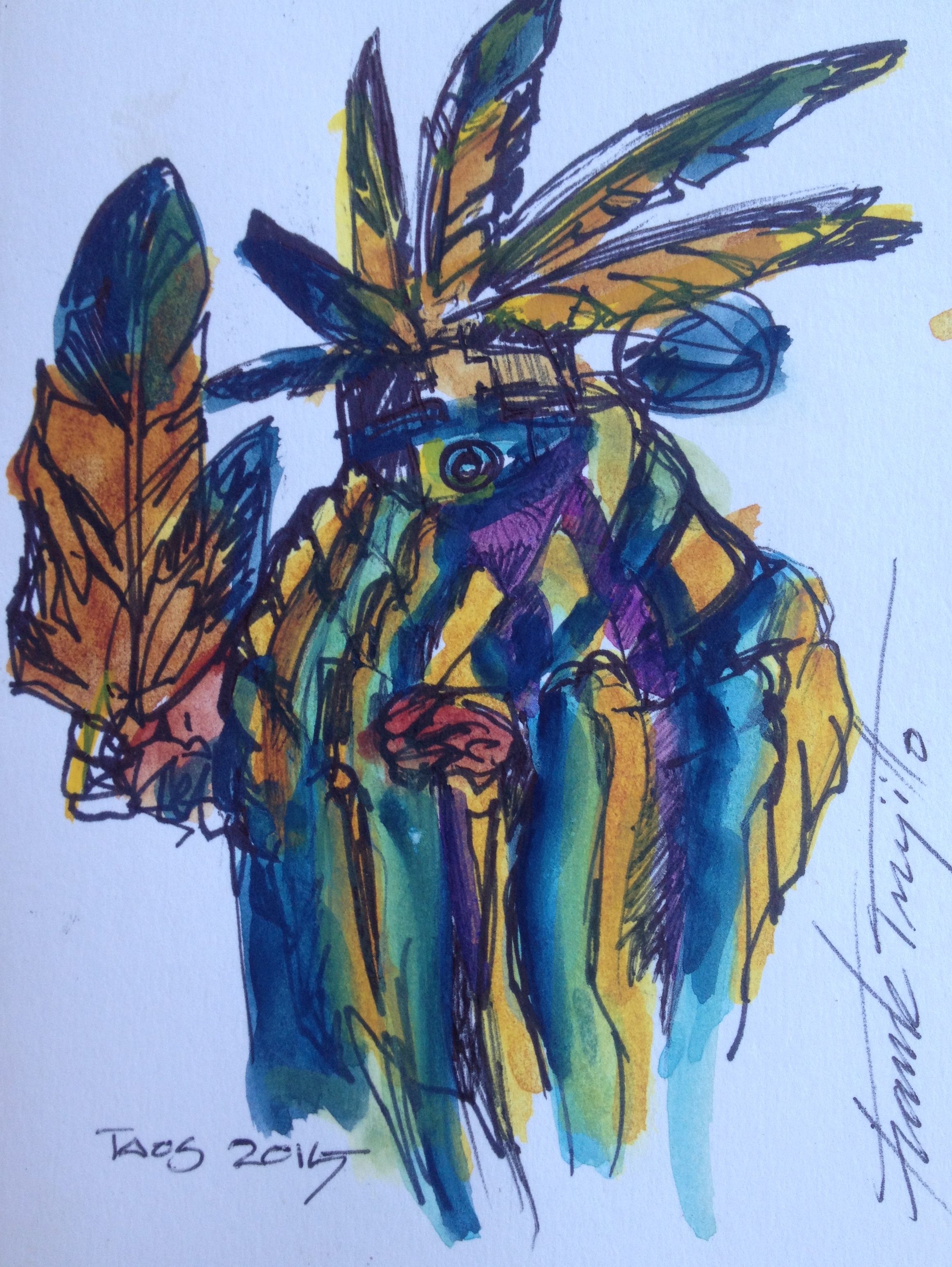
Frank Trujillo’s card, picturing a shaman holding an eagle feather.
Later, I finished the book of D.H. Lawrence’s writings on New Mexico, and discovered that the ashes in the shrine were quite possibly not Lawrence’s at all (according to Keith Sagar’s account, Frieda’s next husband, not wanting to deal with the bother of transporting them from France, had replaced them with ordinary cinders). I wondered what Lawrence would have made of the switch. I wondered what he would have made of my detour earlier that day; of my appreciation of Frank’s artwork in lieu of his own. What would have been the conquest? Who would have been the conqueror, and who the conquered?
In the end, though, it didn’t really matter – his worldview was not my own. Sometimes it’s simply more important to appreciate what’s vital and alive and right in front of you than what someone else has said, or done, or hidden behind the curtain of some fancy hotel. Sometimes you set out in search of one thing, and find another. Sometimes, ashes aren’t what they seem – and sometimes, when life demands it of you, you have to make friends with the fire.
 travels with maría lionza
I, too, spent an afternoon talking to this wise and wonderful man. I noted how messy he was. Paint in his hair, crusted on his hands, spilled in puddles at his feet. He told me good art, like good sex has to get messy!
LikeLike
That’s great! I’m so glad to know that he’s still there, and still touching people’s lives. Haha, love that wisdom! 🙂
LikeLike