“A trip, a safari, an exploration, is an entity, different from all other journeys. It has personality, temperament, individuality, uniqueness. A journey is a person in itself; no two are alike. And all plans, safeguards, policing and coercion are fruitless. We find after years of struggle that we do not take a trip; a trip takes us.” – John Steinbeck, Travels with Charley.
The small, still voice started sometime around January. “Go to the mountains,” it said.
At first, I ignored it. I went about my business as usual, juggling a mixture of part-time jobs – teaching, waitressing, walking dogs. I struggled with the same novel that I’d been writing and rewriting for years. I spent time with friends, went on dates, saw movies. I’d already stepped away from the mainstream of career and ambition and drive, and had fashioned a fairly comfortable, meaningful life for myself (albeit one that wasn’t entirely sustainable in the price-driven Bay Area). At nearly 37, I felt that any voice I heard should be concerned with financial stability or settling down or job security – not pushing me still further in the other direction. But, there it was. “Go to the mountains,” it said.
Finally, in an effort to appease it, I planned a solo trip to Big Sur. The last time I’d heard such a voice, I’d spent three months backpacking through the Sierras, living on less than 1,000 calories a day and going for weeks without human interaction. This time, I was hoping to get off a little easier. So I booked two nights at a campground, and two at the New Camaldoli Hermitage – a serene Carmelite monastery overlooking the ocean. On my final afternoon there, I sat on a bench with one of the monks, gazing down the lush hillside to the startling blue water below. We watched as it pounded up against the rocks, creating a whirlpool of frothy white foam.
“I just feel this urge to move to the mountains,” I told him. The Big Sur trip, I was starting to realize, hadn’t quite done it. Hell, it wasn’t even really the mountains. “Maybe it’s just about leading a simpler, more contemplative lifestyle.”
The monk nodded. “Mountains are very archetypal, you know. We’re very into Jung here.”
“What does the archetype represent?”
“Moving closer to God,” he said. “Moses went to the mountains to get the Ten Commandments. The mountains represent reaching up into the heavens while staying connected to the earth.”
“Huh,” I said. I wasn’t sure about God, but there was certainly something that was telling me to go. I asked him about the contemplative lifestyle. “I thought when I became a monk that I’d just be up here relaxing and meditating,” he laughed. “But then they sent me to Rome to get a degree. And then I was teaching in Italy for a while. Now that I’m in my 50s, I finally get to come up here and spend some time in silence. But you can’t just go to the mountains. You have to figure out how to make a living.”
Exactly, I told the voice – a living. What about a living? As the voice was clearly not satisfied with Big Sur, I found myself engaged in an ongoing argument, one that sometimes left me muttering to myself like a crazy person. What was I going to do for work? What about my two cats, Ninja and María Lionza – both of whom I’d adopted as kittens when working as a journalist in Venezuela and had since housed for eight years? María Lionza was easygoing – she could probably handle the change – but Ninja would never agree to such a move. What about my friends in the Bay Area? What about my life? But the voice didn’t have any answers. It just kept on repeating itself, like an old, tired cliché: “Go to the mountains,” it said.
I was convinced that I’d win – after all, I was the only one with any reason. Strangely, though, things began taking shape on their own – with or without my consent. A woman texted me to say that she’d met Ninja at the Kaiser Hospital garden, where he spent his days rubbing up against patients’ legs and suckering nurses into giving him treats from the coffee shop, and added that she’d love to offer him a home if ever necessary. My Internet searches turned rather unconsciously from “Kanye West Beyonce Grammys” or “Baby Zedonk” (Look it up!) to “How to repair a hole in your tent” and “Rural mountain jobs.” When I found myself bidding, against my better judgment, on an old, converted trailer on eBay – this despite the fact that I didn’t even own a car – I gave in. Fine. OK. Clearly it was happening, so I might as well get on board. I give up, I told the voice. I’ll go to the mountains.
Then, finally, the voice subsided. And, rather magically, things continued to come together on their own, with very little effort on my part. I found a Gogi berry farm north of Taos, New Mexico that offered me a work exchange for the month of August. A silver car whose low price sticker kept catching my eye– a friendly-looking, 2001 Honda Civic – turned out to be a surprisingly worthy purchase. I took María Lionza camping, and while she was rather angry at me for disrupting her routine, she handled it with enough grace to give me confidence that she’d adapt. I met someone who introduced me to someone who offered me remote work writing PR articles. And while Ninja’s new home fell through – the woman’s own missing cat had returned – another opportunity quickly presented itself with a man named Mark, an artist and military veteran who lived across the street and was a neighborhood fixture in his own right.
“I’ve decided that Ninja is from another level of consciousness,” Mark told me as we sat in his apartment in a high-ceilinged old building, cluttered with half-finished canvases, antique vessels and thick, woven tapestries. Ninja scratched at an authentic Persian rug, one that Mark had rescued from somewhere and restored. “That’s why he spends all his time with those cancer patients over at Kaiser. Because a lot of them aren’t going to make it, you know. He’s here to guide them into the next world. He’s here to ask them, ‘What do you want to do in your next life? What do you want to do with the time you’ve got left here?’”
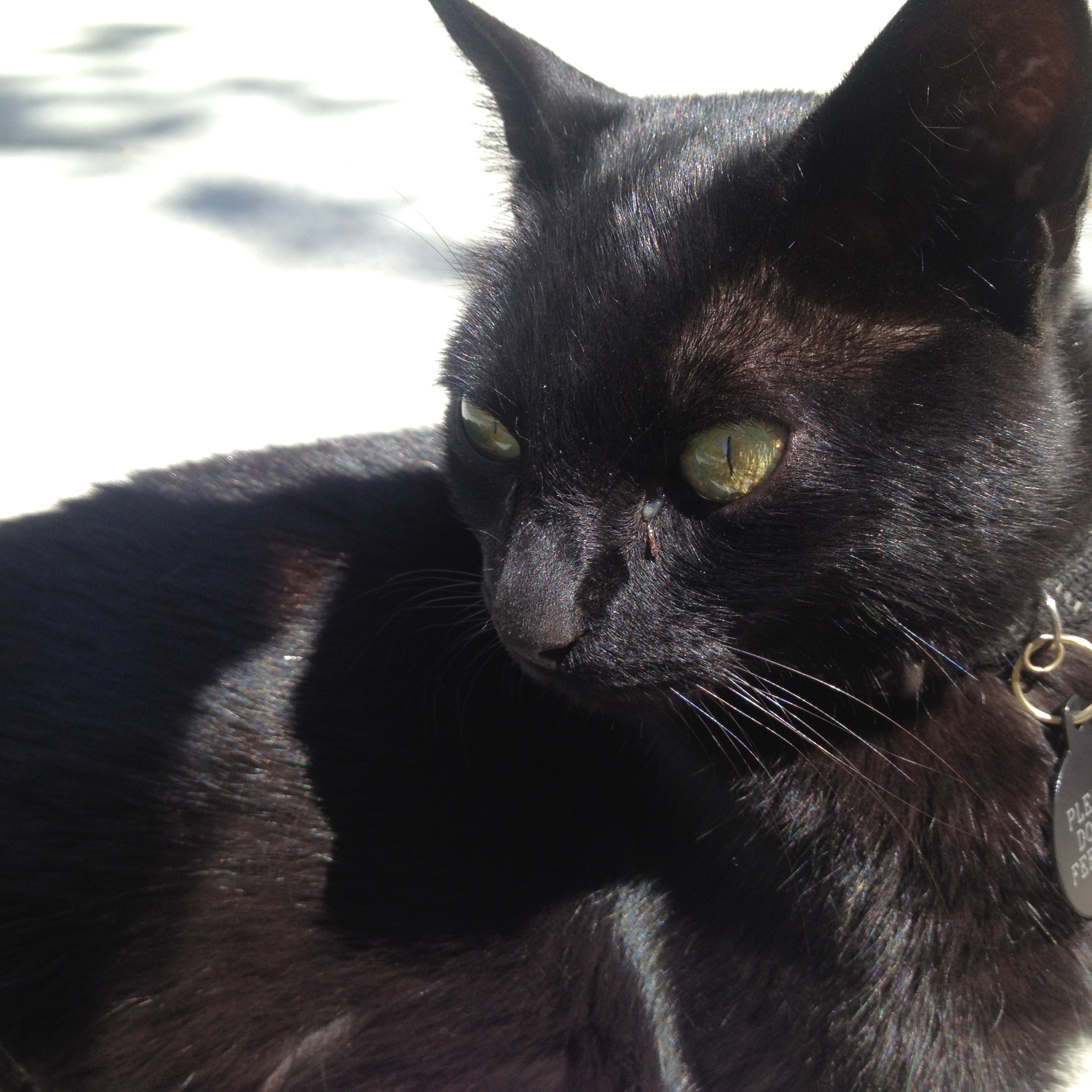
Ninja – the saddest of many sad goodbyes.
Ninja certainly had some good questions – some familiar questions. I regarded him suspiciously as he crouched beneath an ancient wooden chair. Perhaps he’d been the one nagging at me from the beginning. His dark green eyes seemed to glow in the dim light. “Eeoowww,” he said. I tried to focus, to understand what he was saying. “Eeoowww,” he repeated. For all I knew, that could very well be cat-speak for “Go to the mountains.” For all I knew, his could have been the voice all along.
 travels with maría lionza